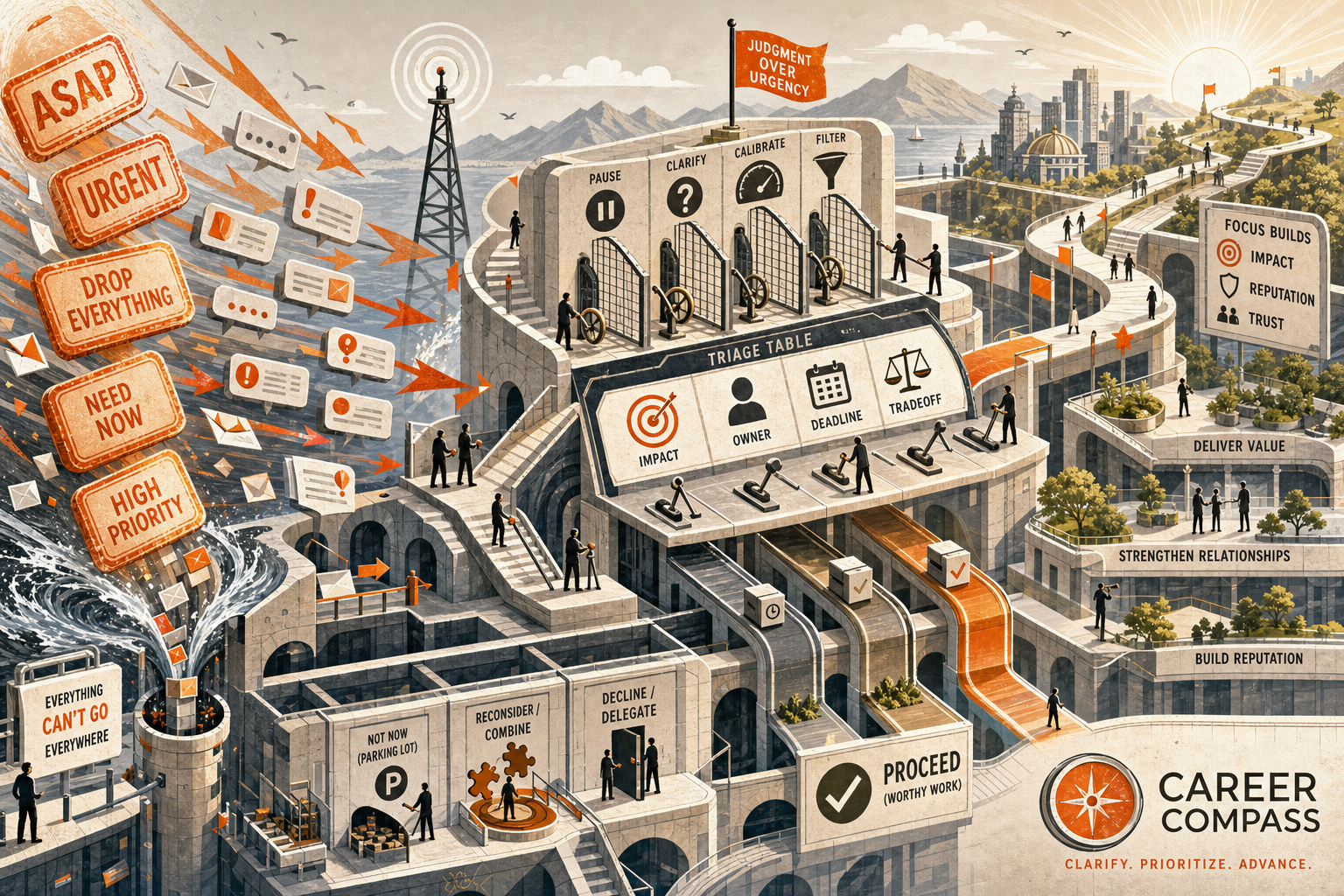
How to Push Back on Unrealistic Deadlines

Push Back on Unrealistic Deadlines at Work
Most early-career professionals treat deadlines like moral judgments.
If the date is brutal, they do not think, “This plan has bad assumptions.” They think, “I need to be tougher.” So they swallow the panic, start bargaining with their sleep, shave quality in places nobody is supposed to notice, and hope the whole thing somehow limps over the finish line before anyone asks hard questions.
That response looks loyal. In practice, it is often a very polished form of self-sabotage.
One of the uglier lessons of working life is that “being helpful” without being honest will damage your reputation faster than respectful pushback ever will. In more than one role, I confused being dependable with being endlessly absorbent. I thought my job was to take pressure in and never let it show. What I should have done much earlier was force reality into the room: name the constraints, show the tradeoffs, and make adults choose between scope, quality, and speed instead of pretending I could conjure all three out of caffeine and guilt.
Here’s the blunt version: pushing back on an unrealistic deadline is not a sign that you are difficult, lazy, dramatic, or secretly bad at your job. Done well, it is one of the clearest signs that you understand how work actually happens, as opposed to how people like to talk about it in meetings.
TL;DR
- An unrealistic deadline is not “a date that makes you anxious.” It is a date that cannot be met at the expected quality, with the current scope, given your actual time, dependencies, and competing priorities.
- The biggest mistake is saying yes before you understand the real ask. A startling number of “urgent” deadlines shrink the second you ask what actually needs to exist by that date.
- Strong performers do not merely execute. They surface risk early, document constraints, and force tradeoff decisions before the work becomes a mess.
- Use the CAP framework: Clarify the ask, Assess effort and constraints, Propose options. Do not bring a stress cloud; bring a decision menu.
- The most professional pushback is option-based: keep the date and reduce scope, keep scope and move the date, or keep both and explicitly deprioritize something else.
- If you already said yes and now realize the deadline is fantasy, reset expectations immediately. Waiting until the night before is how competent people accidentally look flaky.
- You should not push back on every uncomfortable deadline. Push back on plans that are not credible, not on effort, ambiguity, or normal stretch work.
- If impossible deadlines keep happening, you are no longer dealing with one chaotic week. You are dealing with a management problem, a planning problem, or a role designed by raccoons.
An unrealistic deadline is not a personal failure
Let’s start with the most important distinction, because it saves people years of unnecessary shame: an unrealistic deadline is not automatic proof that you are slow, disorganized, or not cut out for the job. Sometimes the problem is you. More often, the problem is a flimsy plan wearing your name tag.
Early in your career, you usually get rewarded for being eager, responsive, cheerful, and low-friction. Those are useful qualities. They are also dangerous when taken too far. Many ambitious people let those traits mutate into self-erasure. You become the person who says yes before you understand the work, who avoids “annoying” follow-up questions, who volunteers to “just make it happen,” and who quietly assumes that any mismatch between the ask and reality must be your fault.
That script can feel noble. It also sets you up to become the office shock absorber. Every vague request, every lazy timeline, every “quick thing” with 17 hidden steps gets absorbed into your week. At first you get praised for being flexible. Later you get blamed when the cracks show: the deck is late, the analysis is thin, the other project slipped, the stakeholder is irritated, your Sunday night is ruined, and you are lying in bed doing time arithmetic instead of sleeping.
That dread has a very specific texture if you know it well. It is not just stress. It is the queasy feeling that you are about to disappoint someone and maybe be seen as less capable than they thought. That fear makes people accept deadlines they should question. They are not agreeing because the plan is sound. They are agreeing because they do not want to look like the person who “can’t handle it.”
Workplaces make this worse. Many teams run on Slack pings pretending to be planning, offhand dates thrown out in meetings, leaders under pressure themselves, and a culture where urgency is easier to communicate than precision. “Can you get this by Thursday?” might mean a hard business deadline. It might mean a preference. It might mean a guess. It might mean “I would feel calmer if I heard a date out loud.” If you treat all four as equally binding, your calendar starts to resemble the aftermath of a bar fight.
A credible deadline has four ingredients:
- Defined scope
- An agreed quality bar
- Realistic time
- Visible dependencies
If one of those is missing, the date may be aspirational, but it is not operational. That distinction matters more than most people realize. “We need this soon” is not a plan. “We need a one-page draft by Wednesday for the VP review, and we can do final polish Friday after legal comments” is a plan. One is anxiety with a timestamp. The other is work.
Here is the definition worth memorizing:
An unrealistic deadline is a deadline that cannot be met at the expected quality, with the current scope, given available time, dependencies, and competing priorities.
Notice what is not in that definition: your feelings. Your feelings matter, but they are not the test. The knot in your chest when the request lands is real. Sometimes that knot is accurate and the ask is absurd. Sometimes it simply means you do not yet understand the work. Sometimes it means a more senior person asked, and your nervous system is screaming, “Do not blow this.” Your job is to separate emotional alarm from operational fact.
This is where a lot of career advice is genuinely unhelpful. It tells people to “manage their time better” when the actual problem is unmanaged expectations. If your manager has stuffed ten hours of work into a three-hour window, no planner app is going to rescue you. You do not have a productivity problem. You have a tradeoff problem, and pretending otherwise only keeps the organization dumb.
When I moved into more corporate environments, one of the hardest adjustments was learning that doing the work was only half the job. The other half was sequencing, expectation-setting, and helping other people see the cost of their requests. I had learned how to work hard long before I learned how to say, “I can give you a strong draft by Friday if we cut the appendix, or the full version on Tuesday.” If I had learned that sentence five years earlier, I would have saved myself a remarkable amount of dumb suffering.
Your job is not to silently absorb bad planning so other people can feel comfortable for forty-eight hours. Your job is to make reality visible early enough that the team can make an adult decision. That is what competent operators do. If you tend to auto-accept dates, the move this week is simple: buy yourself ten minutes. Say, “Let me confirm scope, dependencies, and current priorities, and I’ll come back with the best plan.” Then actually do that.
What actually makes a deadline unrealistic?
A deadline becomes unrealistic in two broad ways: either the work itself is misunderstood, or the surrounding context is ignored. Those sound similar, but they create slightly different disasters.
The first is scope confusion. People say “deck,” “analysis,” “launch plan,” “draft,” or “review” as if everyone shares the same definition. They do not. A “draft” to one manager means bullet points in a doc. To another, it means polished copy, cleaned-up visuals, sourced data, comments incorporated, and three rounds of approval magically completed by noon. If the deliverable is fuzzy, the deadline is fake. Usually not maliciously fake. Just detached from the real labor involved.
The second is dependency blindness. A date may look fine if you pretend you control every input. But maybe you need numbers from Finance, copy from Brand, legal review, a manager’s sign-off, access from IT, and comments from someone who is in the air most of Thursday. The hours on your calendar are not the whole timeline. Waiting is part of the work. Review cycles are part of the work. Chasing people who say “I’ll look in an hour” and then disappear for six is very much part of the work.
That is why I like sorting deadlines into three buckets:
| Deadline type | What it looks like | What it means |
|---|---|---|
| Realistic | Scope is clear, dependencies are known, timeline fits current workload | Commit and execute |
| Stretched | Tight but possible with focused effort and small compromises | Accept consciously and monitor risk |
| Unrealistic | Date requires hidden overtime, quality cuts, or ignoring dependencies and current priorities | Push back with options |
This distinction matters because not every hard deadline deserves resistance. Some work should be hard. Some weeks are compressed because the business genuinely needs speed. A stretched deadline can be a great opportunity, especially early in your career, if the scope is clear and the push is temporary. The point is not to become allergic to pressure. The point is to stop confusing pressure with planning.
So what does a non-credible deadline actually look like in the wild?
It often has one or more of these traits:
- The deliverable is not clearly defined.
- The quality bar is high, but the timeline only supports a rough pass.
- The date was set before anyone asked how long the work actually takes.
- You need approvals from people who have not even seen the request yet.
- You are waiting on inputs you do not control.
- The new ask collides with work that is already committed.
- The phrase “should be quick” is doing an outrageous amount of unpaid labor.
There is also a social pattern you can learn to spot. Unrealistic deadlines often arrive wrapped in emotion instead of clarity. Someone sounds urgent but vague. A cross-functional partner says, “This is really important,” but cannot explain what materially happens if it arrives on Friday instead of Wednesday. A leader wants reassurance more than accuracy. Their stress leaks into the request, and if you are inexperienced, you start managing their mood instead of the actual business need.
That is where a lot of good people get trapped. They hear urgency and assume deadline. They hear confidence and assume plan. They hear “we really need this” and assume there must be a solid reason somewhere upstream. Often there is. Sometimes there absolutely is not. Sometimes a date exists because someone senior blurted it out in a meeting and nobody wanted to be the first person to say, “That is not how calendars work.”
Let me make this concrete.
Example 1: Analyst, vague executive ask
Jordan, a first-year business analyst, gets a Thursday morning message: “Need the competitive landscape by tomorrow for leadership.” Jordan initially thinks this means a polished 15-slide deck. He feels the familiar wash of panic, cancels lunch in his head, and starts planning a miserable evening. But he asks two questions before committing: “What exactly do you need in the meeting?” and “Is this for discussion or final readout?” The answer: a one-page summary with three competitors, major risks, and one recommendation. Suddenly the “impossible” deadline becomes a very manageable three-hour task. The issue was never time. It was scope fantasy.
Example 2: Recruiter, hidden dependencies
Mina, an internal recruiter, is told to “have the offer packet out by end of day.” On paper that sounds fine. In reality, compensation approval is still pending, legal has not cleared relocation language, and the hiring manager is in back-to-back interviews. Mina can draft the packet, but she cannot finalize it alone. If she says yes without naming that, she will own a delay caused by three separate bottlenecks. The honest answer is not “I’m too busy.” It is “I can have the draft ready today, but final send depends on comp and legal approvals that are still outstanding.”
Example 3: Marketing coordinator, competing priorities
Leah is already finishing webinar assets due Wednesday when Sales drops a “quick” customer one-pager due the same afternoon. The one-pager sounds small until she realizes it needs updated messaging, product confirmation, and design cleanup. On its own, maybe it is possible. In context, it means the webinar launch slips. That is what makes the deadline unrealistic: not the task in isolation, but the collision with work already promised.
Those examples matter because they show the core truth: a deadline is never just a date. It is a date plus scope plus dependencies plus current workload. Ignore any one of those and you get fiction.
Before you accept your next rush request, ask yourself five plain questions:
- What exactly am I delivering?
- At what quality level?
- What or who do I need before I can finish?
- What current work gets displaced?
- What breaks if we keep this date?
If you cannot answer those, you are not looking at a real deadline yet. You are looking at an assumption with a calendar attached. Your next move is not to panic or perform heroics. It is to clarify the shape of the work.
The pushback mistake most early-career professionals make
Most bad pushback fails for one predictable reason: it sounds like emotion without evidence.
That does not mean your emotions are irrelevant. They are not. Anyone who tells you workplace pressure should feel neutral is either lying or has achieved a level of psychic detachment I do not personally trust. The same-day request that lands at 3:47 p.m. can absolutely send a hot spike of panic through your chest. The thought of telling your boss, “I cannot do all of this by then,” can make your stomach drop straight through the floor. The embarrassment is real. The fear of being seen as weak is real. The urge to just say yes and sort it out later is extremely real.
But if those feelings run the conversation, the other person hears resistance instead of risk.
The first mistake is saying yes too quickly. This is the classic early-career reflex. You want to be helpful. You want to seem fast. You do not want to be the person who immediately creates friction. So you agree first and evaluate second. Unfortunately, every fast yes creates hidden debt. Hours later, when you finally realize the timeline is nonsense, your reset sounds like backpedaling. It feels to the other person like you changed your mind, when in reality you never had enough information to commit in the first place.
The second mistake is pushing back with vague language. “I’m slammed” may be sincere, but professionally it is mush. Everyone says they are slammed. It communicates stress, not insight. Compare it to: “I can complete the analysis by Thursday if we shift the slide build to Friday, or I can deliver a shorter readout Thursday and the full deck Monday.” That is a different caliber of conversation. One sounds like strain. The other sounds like management.
The third mistake is turning the conversation into a fairness trial. “This is unreasonable” might be true. It is also rarely the most effective thing to say in the moment. Fairness language tends to pull people into defensiveness. Tradeoff language pulls them toward decisions. “To hit Thursday, we would need to skip stakeholder review and reduce QA” is much stronger than “This timeline is unfair.” The first sentence points at consequences. The second invites an argument about your attitude.
The fourth mistake is waiting until the deadline is visibly on fire. This is the one that causes real reputation damage. People delay raising risk because they hope they can still save it. Sometimes they can. But when you wait until the day before, everyone else loses room to adjust. Meetings cannot move. Scope cannot shrink intelligently. Other support cannot be allocated. Your private stress becomes a public emergency. In most organizations, surprise is treated as a bigger sin than difficulty.
I learned that one the expensive way. I spent stretches of my career trying so hard to prove I could carry a heroic load that I stopped communicating clearly about what the load actually was. From the inside, it felt dedicated. From the outside, it occasionally looked erratic. That is a painful lesson: you can be hard-working, competent, and deeply committed, and still get judged as unreliable if people keep getting surprised. Stakeholders are not inside your head. They only see what lands and when.
So here is the reframe that matters: your goal is not to “push back.” Your goal is to help the other person make a better decision. That sounds like wordplay, but it changes everything. “Pushback” sounds oppositional. “Decision support” sounds like leadership. The facts are identical. The posture is not.
That posture has three qualities:
- calm
- specific
- option-oriented
Calm does not mean meek. It means you are not handing the other person your adrenaline and asking them to sort through it. Specific means you have translated the work into scope, time, and dependencies. Option-oriented means you do not stop at “I can’t.” You continue to “Here are the paths.”
Here is a quick before-and-after:
Weak:
“I’m overwhelmed and I don’t think this is realistic.”
Strong:
“With the current scope, I can deliver a reviewable draft by Thursday or the full version Monday. If Thursday is fixed, we’ll need to cut the appendix and skip stakeholder review.”
See the difference? The second version is not tougher because it is less emotional. It is tougher because it is more useful.
Ask yourself this before your next deadline conversation: am I about to describe my feelings, or am I about to describe the plan’s failure points? Feelings can alert you. They should not be your only exhibit.
Pick one phrase to retire this week. “I’m slammed” is a good candidate. Replace it with one sentence naming what is true: “If I take this on for Thursday, the sales analysis due Friday moves.” That is how you stop sounding frazzled and start sounding trusted.
Use the CAP framework: Clarify, Assess, Propose
When a deadline looks impossible, do not freestyle your way into a nervous, apologetic exchange. Use a sequence. Mine is CAP:
Clarify the ask. Assess the constraints. Propose options.
It is not glamorous. It is useful. Most deadline conversations go badly because people skip one of the three. They react before clarifying. They assess based on dread instead of facts. Or they raise the problem without offering a path forward, which leaves the other person irritated and you looking blocked.
CAP is not about sounding corporate. It is about giving your brain a structure when your nervous system would prefer to sprint into the woods.
Clarify: make sure you are responding to the real ask
Start here because a remarkable number of “deadline problems” are actually scope problems in a trench coat.
When a request comes in, ask: - What exactly needs to exist by that date? - Is that date for a draft, a reviewable version, or a final version? - Who is the audience? - What quality bar matters most here? - What is non-negotiable, and what can be cut? - Who needs to review or approve it? - What happens if it lands later?
That last question is especially powerful because it reveals the true source of urgency. If the answer is “the board packet locks at noon,” that is useful. If the answer is “I’d just feel better having it,” that is also useful, though perhaps in a different spirit.
Here is a strong opener:
“I want to make sure I’m solving the right problem before I commit to the date. What exactly needs to be delivered by Thursday, what quality bar matters most, and who needs to review it before it’s considered done?”
That line buys time without sounding evasive. It signals ownership. It also quietly tests whether the other person has thought any of this through.
Assess: translate the ask into actual work
Once the ask is clear, do a fast operational audit. Not a theatrical spiral. Ten to twenty minutes is enough for most requests.
Break the work into chunks. Estimate the time. Name the dependencies. Compare it against what is already committed.
A lightweight assessment might look like this:
| Current item | Time needed | Deadline | Flexibility | Risk if unchanged |
|---|---|---|---|---|
| Q2 performance report | 4 hours | Wednesday | Low | Miss leadership review |
| Customer analysis | 6 hours | Thursday | Medium | Delays enablement meeting |
| New urgent request | 5 hours | Thursday | Unknown | Quality drop or missed date |
This is not bureaucracy for its own sake. It is how you stop treating workload like a vague emotional fog and start treating it like a set of visible constraints.
Separate internal from external constraints. “I need two uninterrupted hours to write this” is a planning challenge. “I cannot finish until Legal signs off” is an external dependency. You need to manage the first and surface the second.
Propose: bring choices, not a brick wall
This is the part that saves your reputation.
Do not stop at “I can’t do that.” Move immediately to “Here are the best options.”
In most situations, your menu will be some version of these:
- Keep the date, reduce scope
- Keep scope, move the date
- Keep both, move another priority
- Deliver in phases: draft now, polished later
For example:
“I can get a reviewable draft by Thursday if we narrow this to the top three slides and skip stakeholder feedback. If you want the full analysis and polished deck, I can deliver Monday. If Thursday and full scope are both fixed, I’ll need to pause the customer analysis due Friday.”
That sounds calm because it is grounded. It sounds senior because it is forcing the conversation onto the real battlefield: tradeoffs.
CAP in action: two vivid examples
Example 1: Product manager, launch plan request
Priya, a product manager at a fintech company, gets a Tuesday message from her director: “Need the launch plan by Friday.” Her pulse jumps immediately because her week is already packed with sprint planning, customer research synthesis, and a vendor review. She resists the reflex to say “working on it.”
She clarifies first:
“What exactly do you need by Friday — a final cross-functional launch plan or a decision memo for the Monday exec review? And who needs to review it before then?”
Answer: not the full plan. The director needs a one-page memo outlining launch options, key risks, and one recommendation.
Priya assesses the work:
- Pull notes from existing launch draft: 30 minutes
- Confirm two dependencies with Design and Ops: 45 minutes
- Draft memo: 90 minutes
- Review with director: 30 minutes
Now the ask is no longer “the launch plan.” It is a three-hour memo.
She proposes:
“I can send the one-page memo by Thursday afternoon for your review and use Friday morning for edits. The full cross-functional plan would come next week.”
Result: she delivers what was actually needed, looks sharp, and does not donate her weekend to a deliverable nobody required.
Example 2: Customer success manager, same-day executive request
Ethan, a customer success manager, gets pulled into a Slack thread at 11:20 a.m.: leadership wants “an account health summary” for a major client by 4 p.m. Today. He is already preparing for a 2 p.m. renewal call and has two customer escalations open.
He clarifies:
“Do you need a rough internal summary for discussion at 4, or a polished client-ready version? And what decisions will this be used for?”
Leadership only needs a rough internal view for a pre-meeting, not something client-facing.
He assesses:
- Pull account notes and support tickets: 45 minutes
- Check product usage data: 30 minutes
- Draft summary: 45 minutes
- Renewal prep still required: 60 minutes
- Escalations still active
He proposes:
“I can send a one-page internal summary with account risks and recommended talking points by 3:30. A more complete version with trend data and renewal scenarios would be tomorrow morning. If today’s version needs to be client-ready, I’ll need to move the renewal prep.”
That is CAP. No drama. No martyrdom. Just adult work management.
If you want to build this as a habit, do something very simple the next three times a compressed request lands: wait five minutes before replying, spend fifteen minutes on assessment, then respond with two options in writing. You will feel less panicked, and you will sound markedly more senior.
Clarify before you push back
I am belaboring clarification because so much workplace conflict is caused by two people using the same words for different realities.
“End of day.”
“Quick review.”
“Final draft.”
“Launch ready.”
“Just a summary.”
These phrases sound specific enough to keep work moving. Half the time they are verbal confetti. Everyone nods. Everyone leaves with a different movie playing in their head.
Take the classic example: “Can you get me a deck by Friday?” That could mean five rough slides for internal discussion. It could also mean an executive narrative with sourced data, polished visuals, reviewed messaging, and approvals from three people who all have the mystical ability to say, “Looks good, just a few tiny tweaks,” right before they blow up half the content. If you hear version one and your manager means version two, you are not disagreeing about pace. You are living on separate planets.
This is why pushing back too early can make you look rigid. If your first response is “That’s impossible,” and five minutes later it turns out they only need a rough one-pager, you have created friction unnecessarily. Clarification protects your time, yes. It also protects your credibility. It shows that you are trying to understand the work, not dodge it.
Use a short question set before you react:
-
What exactly needs to exist by that date?
A draft, a reviewable version, or final output? -
What quality bar matters most?
Precision? Speed? Polish? Enough to make a decision? -
What can be left out?
This question alone rescues a shocking amount of bad planning. -
Who needs to review or approve this?
Review cycles are where fantasy timelines go to be buried. -
What is actually driving the date?
A client meeting, board packet, compliance deadline, launch event, or somebody’s preference?
Here is a script worth stealing:
“I want to make sure I’m solving the right problem before I commit. What exactly needs to be delivered by Thursday, what quality bar matters most, and who needs to review it before it’s considered done?”
That sentence does three useful things at once. It slows the interaction down. It frames you as responsible rather than resistant. And it exposes whether the deadline was ever attached to a real plan.
Now for a more detailed example.
Priya, product manager at a mid-size fintech gets a Tuesday morning Slack from her director: “Need the launch plan by Friday.” Her body responds before her brain does. Little adrenaline spark. Tight shoulders. Quick mental scan of everything already stacked in the week: sprint planning, customer research synthesis, vendor review. The old version of Priya would have replied, “Got it,” and started mentally sacrificing her weekend.
Instead, she asks:
“What exactly do you need by Friday — a review draft or a final cross-functional plan? And is the audience leadership or the working team?”
The answer changes the entire problem. The director does not need a fully socialized launch plan. He needs a one-page decision memo for a Monday exec check-in: launch date options, top risks, recommendation.
Priya sends the memo Thursday afternoon. Her director is happy. Her weekend survives. She also quietly teaches her director that vague asks will be met with clarifying questions rather than blind labor.
That is not a tiny administrative win. That is professional leverage.
Here is another one.
Diego, HR generalist at a healthcare company, gets asked for “a hiring process update for tomorrow.” That sounds awful until he asks who the audience is. Turns out the VP only wants three bullets for a staff meeting: time-to-fill trend, top bottleneck, proposed fix. Diego had initially imagined a polished dashboard and written summary. Instead, he sends a concise update in an hour and keeps the rest of his day intact.
The lesson is simple: many deadlines are inflated by the story you tell yourself before you ask one clarifying question.
There is another advantage to clarification if you work in a place with moving goalposts: it creates a record. When you follow up in Slack or email with, “My understanding is that Friday’s deliverable is a draft for internal review, not final approval,” you protect yourself against future revisionist history. And revisionist history is one of the most annoying genres in office life.
So before you push back on the date, make sure you are not really pushing back on ambiguity. Ask the questions. Make the ask concrete. Then respond to the actual work, not the scary shadow version of it.
Your move: the next time someone says “quick,” ask them what “quick” contains. Not sarcastically. Calmly. Then watch how often the request changes shape.
Assess the real constraint, not just your stress
After clarification comes the part people either skip entirely or turn into melodrama: assessment.
This is where you stop treating your stress response like a project plan.
When a request lands and you feel that sharp plunge in your stomach, do not automatically translate it as “this is impossible.” Translate it as “I need a quick reality check.” Then do one. Open a note. Spend ten or fifteen minutes mapping what the work actually is.
I like a three-part assessment.
1. Map the effort
Break the task into concrete chunks.
Not: “work on deck.”
Instead:
- Gather inputs: 45 minutes
- Clean data: 90 minutes
- Draft narrative: 60 minutes
- Build slides: 2 hours
- Review and revise: 1 hour
Concrete work is estimable. Vague work expands like gas and fills your whole nervous system.
If the total comes to seven hours and you have two workable hours before the deadline, you now have evidence. You are no longer dealing in vibes.
2. Surface dependencies
Write down what has to happen that you do not control.
- Need approval from manager
- Waiting on numbers from Finance
- Need legal language review
- Need design support
- Need system access
- Need stakeholder comments
Early-career professionals often internalize dependency failures as personal failures. That is a bad habit. Own what is yours. Name what is external. If Legal is the blocker, the story is not “I’m behind.” The story is “final delivery depends on legal review that has not happened yet.”
3. Compare against current commitments
This is where honesty gets uncomfortable.
What is already on your plate that is committed, real, and not imaginary? If you already have twelve hours of deadline-driven work in the next day and a half, a new five-hour ask is not a motivation issue. You are out of runway. Something has to move.
Use this sentence with yourself first:
“If I accept this as stated, what specifically slips, degrades, or disappears?”
That answer is often the core of your eventual pushback.
Let’s put this into real-life scenes.
Example 1: Financial analyst before month-end
Tara, a financial analyst, gets asked Wednesday at 1 p.m. for “a quick variance summary” before Thursday’s leadership meeting. She already has month-end close tasks due that afternoon. Her first reaction is dread and anger — because “quick variance summary” is never actually quick. She maps the work:
- Pull latest numbers: 30 minutes
- Validate anomalies: 45 minutes
- Draft explanation: 60 minutes
- Build summary slides: 45 minutes
- Review with manager: 20 minutes
Total: about three hours.
Then she compares it against reality:
- Month-end close issue reconciliation: 2 hours
- Forecast file update: 90 minutes
- Existing manager check-in prep: 30 minutes
Tara now has a concrete picture. The issue is not that the variance summary is impossible in a vacuum. The issue is that accepting it without moving something else creates a collision. She can now say, “I can do the variance summary for tomorrow, but I’ll need to move the forecast update currently due this afternoon.”
Example 2: Content marketer with invisible review steps
Noah is asked for a blog draft by Friday. At first blush, fine. But he maps the real work:
- Research and source stats: 1.5 hours
- Draft: 2 hours
- Internal SEO review: 30 minutes
- Legal review because claims are product-related: 24-hour turnaround
- Revisions and publish formatting: 1 hour
The external dependency — legal — is the real constraint. Without surfacing it, Noah would own a “late” deliverable caused by process, not laziness.
Assessment also requires a little self-honesty, and this matters. Sometimes the deadline is reasonable and your planning was not. Maybe you had the task for a week and delayed starting because it felt annoying or unclear. Maybe you let meetings colonize every useful work block. Maybe you said yes to too many lower-value things before protecting time for the important one. Not every stressful deadline is unfair. Credibility comes from knowing the difference.
There is an emotional skill here too. When you are scared of looking incompetent, it is tempting to hide capacity constraints. Resist that urge. Competent adults know capacity exists. Incompetent adults pretend it does not, then deliver surprises.
One practical move that pays off fast: keep a tiny workload snapshot you can update in under five minutes. Nothing fancy. A note, a doc, a task list. Current priorities, remaining hours, due dates. That gives you something solid to refer to when new work drops from the ceiling.
For example:
“Current commitments this week are the forecast deck due Wednesday, the sales analysis due Thursday, and onboarding updates due Friday. This new request is about five hours of work. If it needs to happen by Thursday, I’ll need help deciding which of those moves.”
That sentence is not melodramatic. It is resource allocation in plain English.
Question to sit with: when you say “I’m overwhelmed,” what are the actual tasks, hours, and dependencies underneath that feeling? Write them down once this week. You will instantly sound more credible in your next deadline conversation.
Propose options, not resistance
Here is the sentence I wish more people would carve into the inside of their professional skull:
Good pushback comes with options.
This is the hinge. It is the difference between sounding blocked and sounding trusted. If you only say, “I can’t do that by Friday,” the other person now has a problem and no path. If you say, “I can give you X by Friday, Y by Monday, or keep both if we move Z,” you sound like someone who knows how work runs.
Most deadline conflicts can be resolved with four basic options.
Option A: Keep the date, reduce scope
This is often the cleanest move when the date is fixed for a real reason. Ask what is essential. Cut everything else. Define the smaller deliverable plainly.
Script:
“We can keep the Thursday date if we narrow the scope to the customer summary and recommendations only. The appendix and competitor analysis would follow next week.”
Why it works: many people care less about completeness than they claim. What they actually need is the decision-relevant core.
Option B: Keep scope, move the date
Use this when the full deliverable genuinely matters and compressing it would create bad work.
Script:
“If the goal is a complete, polished version with stakeholder review, the realistic delivery date is Monday. That gives enough time for analysis, revisions, and approvals.”
Why it works: you are connecting the timeline to quality and process, not personal preference.
Option C: Keep both, move another priority
This one matters most for managing up. A lot of managers do not realize they are making hidden priority decisions every time they drop in a new “urgent” request. Your job is to make those decisions visible.
Script:
“I can prioritize this for Thursday, but that would mean moving the onboarding updates currently due Friday. I’m fine with that tradeoff if that’s the priority.”
Why it works: it puts prioritization responsibility where it belongs.
Option D: Deliver in phases
This is the reputation-saving move when speed matters but polish will take longer.
Script:
“I can send a draft version by end of day with the key findings and open questions, then send the polished version tomorrow after I incorporate feedback.”
Why it works: it gets something useful into the room fast without pretending the final product will materialize instantly.
Here is a simple tradeoff table to keep in your back pocket:
| If we want... | Then we should... | Tradeoff |
|---|---|---|
| Same date | Reduce scope | Less completeness |
| Full scope | Move date | Slower delivery |
| Same date + full scope | Deprioritize other work | Another commitment slips |
| Fast visibility | Ship draft now, polish later | Partial quality upfront |
Now let’s make this vivid.
Example 1: Marketing analyst, executive readout
Marcus, a marketing analyst at a B2B SaaS company, gets asked Wednesday afternoon for a full campaign performance readout by Thursday morning for leadership. His first instinct is to panic quietly and disappear into spreadsheets until midnight. Instead, he assesses the ask and replies:
“I can have the topline metrics and three key insights ready by 9 a.m. tomorrow. A full readout with channel breakdowns and recommendations would be Friday afternoon. If tomorrow morning is fixed, I recommend we use the topline version for the meeting.”
That is Option D. Leadership takes the topline version, the meeting goes fine, and Marcus’s manager later tells him she appreciated that he “managed the tradeoffs instead of just stressing out in silence.” That is exactly the reputation you want.
Example 2: Operations associate, same-week policy update
Sofia, an operations associate, is asked to update a policy document and employee FAQ by Friday because “we should get this out soon.” She clarifies and learns that what truly matters is employees seeing the policy changes before Monday. The polished FAQ can wait.
She proposes:
- Thursday: short summary of changes for internal circulation
- Monday: full updated policy and FAQ
That is Option A mixed with D: smaller scope now, fuller deliverable later. The team gets what it needs, and she avoids doing unnecessary perfectionist work at speed.
Example 3: Software engineer, two leads, one body
Eli is told by one engineering manager to finish bug triage by Thursday and by another to prepare a demo for the same day. He cannot do both well. Instead of privately deciding and hoping nobody notices, he writes:
“I can complete bug triage by Thursday or prepare the demo by Thursday, but not both at the expected quality. I need help aligning on which one takes priority.”
That is Option C in its purest form. He is not refusing. He is refusing to make an invisible priority call that belongs to leadership.
There is an emotional shift you need to make here. Stop seeing yourself as the obstacle. You are not the obstacle. You are the person naming the physics. Time, scope, quality, and attention are finite. Pretending otherwise does not make you collaborative. It makes you the future owner of a preventable mess.
And yes, direct tradeoff language can feel awkward at first, especially if your professional conditioning has been “be positive,” “be flexible,” and “never make anyone uncomfortable.” But flexibility without boundaries is just silent failure wearing good manners.
Pick one live deadline risk this week and respond with two concrete options instead of one nervous apology. That small change can alter how people see you.
Scripts for real situations
People do not search for “stakeholder management posture under resource constraints.” They search for “what do I say to my boss when the deadline is impossible.” Fair enough. Let’s get practical.
Below are scripts you can actually use, but do not just memorize the words. Notice the structure: clear assessment, visible tradeoff, calm tone, no groveling.
Script for your manager
“I reviewed the scope and my current priorities. I can get this done by Friday if we reduce it to the top-line recommendations and skip the deeper analysis. If you want the full version with review, I can deliver Monday. If Friday is fixed and the full scope is fixed, I’ll need your help deciding what moves.”
Why it works: it shows you did the thinking, gives options, and puts the priority call where it belongs.
Script for a cross-functional partner
“I want to support this, and I need to be transparent about timing. With the current scope and existing commitments, I can deliver a draft on Tuesday or a final version on Thursday. If there’s a smaller version that would still unblock your team sooner, I can do that first.”
Why it works: collaborative, clear, not floppy.
Script for a same-day request
“I can take this on today. To do that credibly, I need to know whether you need a rough answer by 4 p.m. or a polished version tomorrow morning. I can do one well, but not both.”
Why it works: it forces a quality choice instead of letting the other person imagine they are getting everything immediately.
Script when two leaders want conflicting things
“I’m currently supporting two priority requests with overlapping timing. I can complete Project A by Thursday or Project B by Thursday, but not both at the expected quality. I need help aligning on which one takes priority.”
Why it works: no triangulation, no victim energy, no secret resentment.
Script when you already said yes and need to reset
“I committed before I had full visibility into the dependencies and effort, and I want to reset the plan now rather than surprise you later. The original date isn’t credible for the full scope. I can send a draft by Thursday and the completed version Monday, or we can reduce scope to keep Thursday.”
Why it works: accountable without becoming a confessional essay.
Script for documenting risk in a status update
“Status: on track for a draft by Thursday, but final delivery is at risk due to pending input from Finance and legal review timing. If those inputs land by noon Wednesday, Thursday remains achievable. If not, final delivery moves to Friday.”
Why it works: calm, specific, time-bound.
Now let’s put some human texture on this, because the emotional side matters.
Case: Marcus, marketing analyst
Marcus is asked Wednesday afternoon for a campaign performance readout by the next morning. He feels the exact mix many people know well: heat in the face, instant irritation, then shame for being irritated. He wants to look capable. He also knows a “full readout” overnight means a garbage product or a garbage night.
So he writes:
“I can have topline performance, three key insights, and one recommendation ready by 9 a.m. tomorrow. A full readout with channel-level detail and next-step recommendations would be Friday afternoon. If tomorrow morning is fixed, I recommend we use the topline version.”
His manager agrees. The leadership meeting gets what it needs. Marcus does not spend the night rage-formatting charts at 11:43 p.m.
Case: Aisha, nonprofit program coordinator
Aisha is asked to produce a funder update “by end of day” on a day already filled with a site visit and a board prep meeting. The old Aisha would have nodded, smiled, and quietly detonated her evening plans. The current Aisha responds:
“I can send a short funder update with the core numbers and milestones by end of day. If you want the fuller narrative version with program quotes and polished formatting, I can send that tomorrow afternoon.”
Her director says the short version is perfect. This is what happens when you stop assuming every ask requires the gold-plated edition.
The more you do this, the less emotionally loaded it becomes. At first, sending these messages can feel like stepping onto a stage in your underwear. Very exposed. Very unnatural. Then you see that reasonable people are often relieved by clarity. They do not want your silent suffering. They want to know what is possible.
Try This: Save one of these scripts in a note on your phone or laptop. The goal is not to sound robotic. The goal is to avoid inventing language while your pulse is doing drum solos.
What to write in Slack or email
A huge percentage of deadline management lives or dies in writing.
If everything stays verbal, expectations turn mushy fast. People remember the version of the conversation that flatters them most. “I thought you said final.” “I thought you were handling the approvals.” “I thought Friday meant morning.” Of course they did.
You do not need long, defensive messages. In fact, long, defensive messages often make things worse because they smell like panic. What you need are short, precise notes that document scope, timing, risk, and tradeoffs without sounding theatrical.
Here are templates you can use directly.
Short Slack version
“I reviewed the ask and current priorities. I can deliver a draft by Thursday, or the full polished version by Monday. If Thursday is fixed for the full scope, I’ll need to move the sales analysis currently due Friday. Which option do you want me to prioritize?”
Short. Clear. Decision requested.
More formal email version
Subject: Timeline and options for [Project Name]
Hi [Name],
I reviewed the requested deliverable, the work required, and my current commitments for this week. With the current scope, a credible timeline for a polished version is Monday. If the Thursday date is important, I can deliver a narrower draft version by then focused on [specific elements]. A third option is to keep both the current scope and Thursday deadline, but that would require moving [other priority] currently scheduled for [date].
Please let me know which option you’d like me to prioritize, and I’ll proceed accordingly.
Best,
[Your Name]
Status update that documents risk
“Quick status update: I’m progressing on the draft and remain on track for the initial version by end of day Thursday. Final delivery is at risk because review from Legal and updated numbers from Finance are still pending. If both arrive by noon tomorrow, I can keep the current timing. If not, final delivery moves to Friday.”
That is what professional risk communication sounds like. Not dramatic. Not evasive. Not weirdly cheerful either. Just clear.
A few writing rules matter here.
1. Replace emotional adjectives with operational facts
Do not write: - “I’m super slammed” - “This is impossible” - “This is really unfair” - “I’m drowning”
Write: - “I’m currently committed to X, Y, and Z this week” - “The current timeline does not allow for review and QA” - “Final delivery depends on Finance and Legal inputs” - “If this moves up, [other task] will move out”
This is not about suppressing your feelings. It is about not making your feelings do a job better done by specifics.
2. Use conditional logic
Conditional language is your friend because it shows how the plan changes based on real factors.
- “If Thursday is fixed, we need to reduce scope.”
- “If Legal reviews by noon, Friday remains possible.”
- “If the audience only needs a draft, I can send that today.”
This makes you sound measured and credible. It also helps the other person see the mechanics instead of just your resistance.
3. Write what you understand the deliverable to be
This one is gold, especially in sloppy environments.
“My understanding is that Friday’s deliverable is a draft for internal review, not a final approved version.”
That sentence has saved many people from the special workplace horror of being blamed for not reading minds.
4. End with the decision you need
Do not write beautifully and then leave the next move ambiguous. Ask for the call.
- “Which option would you like me to prioritize?”
- “Can you confirm whether you want the draft tomorrow or the full version Monday?”
- “Please let me know which current priority should move if this becomes the top item.”
The point of the message is not merely to explain yourself. The point is to force clarity.
Let’s make this more vivid with a small contrast.
Weak Slack:
“Hey, I have a lot going on and I’m not sure I can get this done by Friday.”
That invites confusion and negotiation around your stress.
Better Slack:
“I reviewed the work required. I can send a reviewable draft by Friday, or a polished final on Monday. If Friday is fixed for the final version, I’ll need to move the onboarding deck due Friday afternoon. Which do you want me to prioritize?”
That invites a decision.
Writing also matters because it creates memory. Teams forget verbal nuance constantly. Written notes survive. If someone later insists the deadline was always for the polished final, your message becomes the record that says otherwise. This is not cynical office politics. It is reality preservation.
If you adopt one written habit, make it this structure:
- What I understand the deliverable to be
- What I can deliver by when
- What tradeoff applies
- What decision is needed
Use that structure once this week in Slack or email. You will feel the difference immediately.
When not to push back
Not every painful deadline is a bad deadline.
That is worth saying plainly, because some people discover the language of boundaries and then start swinging it around like a novelty sword. Not every hard ask is exploitation. Not every burst of pressure means the system is broken. Sometimes the business truly needs speed. Sometimes the ask is reasonable and your discomfort is simply the feeling of stretching.
Real emergencies exist. Customer incidents. Board deadlines. Regulatory filings. Public launches. System outages. If payroll is broken or the company is about to send the wrong pricing to a major client, this is not the moment for a dramatic speech about your preferred pace of work. It is the moment for disciplined execution under pressure. You can still clarify scope and communicate tradeoffs, but the energy is different. You are solving, not posturing.
Sometimes the ask is reasonable and your planning was weak. If you had a project for ten days and only opened the file yesterday because you were avoiding it, that is not an unrealistic deadline problem. That is a procrastination problem with better branding. Own it. Nothing tanks credibility faster than using the language of “pushback” to camouflage avoidable delay.
Sometimes you do not understand the ask yet. If your first reaction is negative because the request feels large or vague, resist the temptation to declare it impossible immediately. Clarify first. A lot of career damage is self-inflicted by people pushing back on a phantom version of the work.
And sometimes the deadline is stretched but valuable. This matters especially when you are early in your career. There are seasons when doing something hard, fast, and a little uncomfortable genuinely expands your judgment and skill. The question is not “Do I like this?” The question is “Is this credible with focused effort, and is the stretch temporary and meaningful?” If yes, leaning in may be the right move.
The rule I like is this:
Push back on non-credible plans, not on effort.
That distinction keeps you honest.
“This requires legal review we cannot get by then” is a credible reason.
“I need help choosing between these two committed priorities” is a credible reason.
“The quality bar and the time available do not match” is a credible reason.
“I just don’t feel like working late” may be personally understandable, but it is usually not the right first frame in a professional conversation. The workplace is not group therapy. You need to translate your experience into operational terms.
There is also some emotional self-management required here. When you feel imposed on, a flare of indignation often rises. It says things like, “Are you kidding me?” or “Do these people think I’m a machine?” Sometimes that anger is useful because it points to a real pattern of disrespect. Sometimes it is just your nervous system objecting to pressure. Before you respond, cool the temperature a little. Ask: is this a one-off crunch, a planning mismatch, or a chronic culture issue? Those require different responses.
Here is a quick gut-check:
- One-off crunch: lean in, communicate clearly, recover afterward.
- Planning mismatch: clarify, assess, propose options.
- Chronic culture issue: document patterns, raise process concerns, consider whether this place is teaching you or draining you.
Let’s ground this.
Example 1: Real emergency
A customer data issue breaks on a Tuesday afternoon. Support is flooded, leadership is involved, and the team needs a clean incident summary by 5 p.m. That is not the time to say, “This feels unrealistic.” It is the time to clarify what level of detail matters most, divide work, and move.
Example 2: Personal delay, not bad planning
A designer had mockups due Friday, but she spent Monday and Tuesday tinkering with lower-priority work because the mockups felt ambiguous. On Thursday she realizes she is behind. In that case, the clean move is not blame. It is ownership: “I started too late and need to reset expectations on polish. I can deliver the core designs Friday and the refinements Monday.”
Example 3: Healthy stretch
An associate consultant is asked to turn comments around overnight before a client meeting. It is a short-term push, the ask is well defined, and the team is aligned. That may be tough, but it is not absurd. Not every intense evening deserves a principled stand.
So before you push back, ask yourself one question: is this deadline actually non-credible, or is it simply unpleasant? Those are not the same thing. Your credibility rises when people can see that you use pushback selectively, with evidence, and in service of better outcomes rather than self-protection alone.
If your manager keeps setting impossible deadlines
One bad deadline can happen anywhere. Repetition is the tell.
If your manager repeatedly sets dates without asking about scope, ignores dependencies, stacks urgent work on top of already committed work, or treats every request like a house fire, you are no longer dealing with a random stressful week. You are dealing with a planning environment that can steadily damage your performance and reputation.
This matters because bad planning cultures create a weird kind of self-doubt. You start every week thinking, “Maybe I just need to be faster.” Then you try harder, absorb more, cut more corners, and end up even more depleted. Sunday evening starts to feel contaminated. Your laptop becomes an object that produces a low-grade stress reaction. You get that electric relief after a good 1:1 where priorities are finally clear — and then resentment when they become muddy again two hours later. None of this is just about one deadline. It is what happens when a system trains you to live in reactive mode.
Start by documenting the pattern quietly.
Not a dramatic dossier. Not a revenge spreadsheet. Just notes over four to six weeks: - What was requested - When it was requested - Original deadline - Scope changes - Missing dependencies - Tradeoffs you surfaced - What actually happened
You are not collecting courtroom evidence. You are trying to see the shape of the problem. Maybe late approvals are the real issue. Maybe priorities change three times a week. Maybe your manager says everything is top priority, which is a great way of saying nothing at all.
Once you can name the pattern, you can discuss it without sounding scattered or purely emotional.
Here is a strong 1:1 opener:
“I’ve noticed a recurring pattern I want to improve. Over the last month, several deadlines were set before scope and dependencies were clarified, which led to last-minute tradeoff conversations and compressed work. I think we could reduce that by aligning earlier on what is draft versus final, and by being explicit about what moves when urgent work comes in.”
That is a process conversation, not a character attack. A decent manager will hear it. A weak manager may get defensive. That reaction is information too.
If the issue is constant priority collision, ask for a priority rule:
“When new urgent work comes in, can we agree on how to decide what gets deprioritized? I can move faster if I know which commitments are actually movable.”
If the issue is vague asks, try this:
“Could we spend two minutes at the start of new requests defining whether the deliverable is a draft, a reviewable version, or a final? That would help me plan more accurately.”
If the issue is invisible dependencies, say:
“I can own the core work, but several delays have come from waiting on approvals or inputs. Can we decide who is responsible for chasing those upstream so the timeline is realistic?”
Let’s look at two examples.
Example 1: Consulting associate in a churn-heavy team
Nina’s manager regularly says things like “Need this tomorrow” without clarifying whether “this” means a rough analysis or client-ready slides. Nina starts tracking requests for a month. She notices a pattern: most last-minute rushes were actually caused by her manager delaying review until the eleventh hour. In their 1:1, she says:
“I’ve noticed several of the urgent turnarounds happened because review happened very late in the process. If we can lock review windows earlier, I can give you better work with fewer last-minute scrambles.”
That changes the conversation from “I’m overwhelmed” to “Here is where the process is breaking.”
Example 2: People operations specialist with everything-on-fire leadership
Dev’s boss labels nearly every request urgent. Dev tracks four weeks of incoming work and sees that three “urgent” requests were later postponed without consequence, while one genuinely time-sensitive compliance task got squeezed. In a 1:1, Dev says:
“I’m seeing that several requests are marked urgent, but not all have the same impact if delayed. Could we use a simple ranking when new work comes in — same day, this week, or flexible? That would help me protect the truly time-sensitive work.”
That is not rebellion. It is operational maturity.
Now, the hard truth: if you have raised the issue professionally, offered process fixes, documented patterns, and nothing changes, then yes, you may be dealing with a manager quality problem or a role design problem. There is a point where escalation or exit becomes rational. If your reputation is being damaged by structurally bad planning and every attempt to improve it gets ignored, resilience is no longer the lesson. Pattern recognition is.
Do not leap to “I need to quit” after one terrible month. But do not spend two years trying to outwork a system designed to manufacture chaos. Some environments confuse pressure with leadership. Some managers confuse urgency with competence. You are allowed to notice that.
The question to sit with is this: are you in a role that occasionally demands a sprint, or in a role that feeds on permanent confusion? Your answer should shape what you do next.
A quick checklist before you reply
Before you accept, reject, or renegotiate a deadline, run this quick check:
- Do I understand the real deliverable?
- Is the date for a draft, reviewable version, or final version?
- Do I know which quality bar matters most?
- What dependencies could block this?
- How many hours of actual work does it require?
- What current commitments would be displaced?
- Can I propose at least two credible options?
- Have I stated the tradeoff clearly?
- Have I documented the risk in writing?
If you can answer those questions, your response will already be better than most workplace deadline chatter.
Your Move: put these bullets in a pinned note or saved doc. The goal is not to remember them when you are calm. The goal is to have them when a 4:36 p.m. Slack message tries to ruin your evening.
FAQ
What is an unrealistic deadline?
An unrealistic deadline is a deadline that cannot be met at the expected quality, with the current scope, given available time, dependencies, and competing priorities.
How do you say a deadline is not realistic professionally?
Say:
“I reviewed the scope, dependencies, and current priorities, and the current timeline isn’t credible for the full deliverable. I can offer a draft by Thursday, the full version by Monday, or keep Thursday if we reduce scope. Which option would you like me to prioritize?”
Can pushing back on deadlines make you look bad?
Yes, if you do it emotionally, vaguely, or late.
No, if you do it early, specifically, and with options. Good pushback usually improves your reputation because it shows judgment, planning, and honesty.
What if your boss ignores your pushback?
Document the tradeoff in writing, ask for explicit prioritization, and track repeated patterns. If impossible deadlines are frequent and your manager consistently ignores constraints, you are likely dealing with a management problem rather than one difficult project.
Build your own deadline playbook while you are at it. Save your best Slack and email templates. Keep a lightweight workload tracker. Spend ten minutes each Friday asking where you absorbed unrealistic planning instead of surfacing it. That weekly review is not overkill. It is how patterns become visible before they become your personality.
The professionals who earn trust over time are not the ones who say yes to everything. They are the ones who make reality legible before the work turns feral.
If you are early in your career, this can feel deeply unnatural. You may still hear that earnest little voice saying, “Just take it on. Don’t be difficult.” I know that voice. It sounds responsible. It can also march you straight into burnout, sloppy work, and completely avoidable reputation damage.
So the next time a deadline lands and your first instinct is to silently absorb it, pause. Clarify the ask. Assess the actual constraints. Propose options. That is not resistance.
That is professionalism.