How to Stop Being Reachable After Hours

Stop Proving You’re Reachable
Most early-career professionals think answering Slack at night makes them look serious.
Sometimes it does.
More often, it teaches everyone around you that your attention is a vending machine: press button, receive response. Maybe not instantly every time, but often enough that people start counting on it.
That sounds harmless until it starts colonizing your evenings. One message at 9:17 p.m. becomes a “quick thought,” then a “while I have you,” then half an hour of low-grade work adrenaline while your dinner gets cold and your brain forgets how to stand down. The next morning you’re technically on time, but spiritually already annoyed.
And the worst part is that this habit flatters you on the way in.
You feel needed. Competent. A little noble, if we’re being embarrassing and honest. You also feel the darker thing under it: the fear. Fear of seeming lazy. Fear of missing context. Fear that the one night you don’t answer will be the night someone quietly updates their internal file on you from promising to not that committed.
So you answer.
Then you answer again.
A month later, your evenings have developed a leak, and somehow you’re the one holding the bucket.
I learned this in a less flattering way than I’d like. Early in a leadership role, I compensated for inexperience with effort, speed, and near-constant responsiveness. I told myself I was being dependable. What I was actually building was a very efficient system in which other people got convenience and I got a scorched nervous system.
Here’s the clean version of the argument: if you answer everything after hours, people stop admiring your work ethic and start budgeting against your access.
The short version
- Fast night replies build a reputation for availability more quickly than they build trust.
- Most after-hours messages are not urgent. They are simply sent after hours.
- The goal is not to become dramatic or icy. The goal is to create predictable norms.
- A strong boundary is not “no.” It is “here’s what counts as urgent, here’s how to reach me, here’s when I’ll respond.”
- Careers tend to reward judgment longer than they reward frantic speed.
If you do nothing else tonight, decide what actually deserves a same-night response. Don’t keep making that decision while your phone is glowing in your hand and your body is already halfway into stress mode.
Why this gets messy so fast
Nobody tells you the rule out loud.
No one says, “Just so you know, if you answer one 9:40 p.m. Slack with suspicious enthusiasm, we will all quietly absorb that as your operating model.” The expectation forms through vibes, timing, and repetition. Which makes it hard to challenge, because technically nobody asked you to do this.
If you’re early in your career, that ambiguity is brutal. You’re already reading the room too hard. You’re decoding punctuation in manager messages. You’re trying to figure out whether “when you get a chance” means tomorrow morning or right now, coward. In remote and hybrid teams, the uncertainty gets even uglier. The green dot starts to feel moral. You see people posting at night and think, Ah. So this is what the serious adults are doing.
Sometimes that’s true.
A lot of the time, it’s theater mixed with habit. Parents logging back on after bedtime. Night owls clearing their own inboxes. Managers dumping thoughts before they forget. None of that automatically means they expect you to snap to attention in real time. But if you’re anxious, you won’t experience it that way. You’ll experience it as a little electric jolt: Should I answer? Will this be noticed? Am I being tested?
That feeling is real. It’s also a terrible manager.
Quick replies change expectations much faster than they build respect. If you respond within five minutes every night for two weeks, your coworkers are not sitting back thinking, “What a high-trust operator.” They’re thinking, “Great, he’s around.”
That is a different reputation.
Ask yourself a slightly rude question: are people relying on your judgment, or on your willingness to act like the lobby desk?
Write down the last five times you replied after hours. Next to each one, note what actually happened because you answered that night. Not what you feared would happen. What happened.
Helpful is a role. On-call is a system.
A lot of smart, decent professionals blur those two because the line feels socially dangerous. You want to be generous. You don’t want to become the person who is weirdly precious about their own time while everyone else is scrambling. You definitely do not want to look like someone who discovered boundaries on Instagram and now needs everyone informed.
Fair. But let’s be adults about this.
“Helpful” means you step in when the stakes are real.
“On-call” means your evening belongs partly to work unless proven otherwise.
Those are not the same arrangement. One is professional generosity. The other is unpaid infrastructure.
If your role genuinely includes after-hours coverage, great. Then there should be actual scaffolding around that reality: compensation, rotation, backup plans, an escalation path, some honest language. If none of that exists and everyone still behaves as if you should be reachable all night, what you have is not excellence. It is a sloppy operating model wearing a blazer.
So stop asking the mushy question — Am I allowed to ignore this? — and ask a cleaner one: What category of issue is this, and what response does that category deserve?
Here’s a practical version:
| If the message is... | Then do this |
|---|---|
| A true deadline tonight, a client issue that worsens by morning, a major blocker for tomorrow, a safety or operational problem | Reply now |
| Important, but nothing gets better by solving it at 10 p.m. | Acknowledge if needed; handle tomorrow |
| Routine update, FYI, brainstorm, non-urgent request, someone emptying their own head into Slack | Respond during work hours |
That middle category is where most people get trapped. They think the only two options are “drop everything” or “be rude and disappear.” There is a third option, and it sounds wonderfully boring:
- “Saw this — I’ll handle it first thing tomorrow.”
- “Got it. I’ll come back with a proper answer in the morning.”
- “Offline now, but I have this for tomorrow.”
Save three versions somewhere obvious. The point is to stop making your overstimulated evening brain invent policy from scratch.
Late is not the same as urgent
This distinction would rescue a shocking number of careers.
A 9:12 p.m. message usually means exactly one thing: somebody sent a message at 9:12 p.m.
That is all.
The modern workplace loves to smuggle urgency through timing. Late message, urgent vibe. Weekend email, heavy tone. Calendar invite with no agenda, tiny coronary. But often the urgency is theatrical, accidental, or entirely in your own nervous system.
There are real exceptions. Incidents. Launches. Live deals. Travel disasters. Safety problems. If your job includes those, then yes, your rules are different. But that is precisely why you need rules. “Sometimes things are urgent” is not a system. It is just ambient dread with a laptop.
Here’s the test: if this waited until 8:30 a.m., what would happen?
Be embarrassingly specific. Would money be lost? Would a customer be harmed? Would a team be blocked against a hard deadline? Or would someone simply be mildly irritated that they had to wait?
Mild irritation is not an emergency.
The move this week is to audit the last ten after-hours messages you answered. Circle the ones that were genuinely time-sensitive. Most people discover they have been saluting a lot of false alarms.
Set the norm before resentment starts freelancing
The worst time to discuss boundaries is after you’ve spent six weeks smiling through clenched teeth.
By then, every tiny ping carries emotional backstory. You are no longer saying, “I usually reply in the morning.” You are saying, “I have been quietly losing my mind and this innocent message is now representing the whole problem.” That conversation rarely comes out graceful.
Do it earlier, while your tone is still normal.
In a 1:1 with your manager, the strongest version is plain and operational. No TED Talk on wellness. No legal brief. No trembling declaration that you, too, are a human being with dusk-related preferences. Just clarity.
Try this:
“I want to make sure I’m handling after-hours messages the right way. If something is urgent or blocks tomorrow’s work, I’m happy to jump in. Otherwise I’ll usually respond in the morning so I can stay focused and useful.”
That works because it frames the boundary around performance, not personal philosophy. You are not asking for a gold star for self-care. You are explaining how you do reliable work.
With cross-functional teams, specify the route:
“If something affects tomorrow’s launch, text me or mark it urgent. Otherwise I’ll pick it up in the morning.”
With peers, lower the temperature for everyone:
“Sending this now so I don’t forget — no need to reply tonight.”
That last sentence is tiny and almost stupidly effective. It gives other people the relief you probably wish someone would give you.
Pick one person you work with regularly and make the norm explicit this week. Not after your next bad evening. Before it.
Use the tools. Martyrdom is not a communication strategy.
People love to act like statuses, scheduled send, notification settings, and channel conventions are flimsy little productivity accessories.
They’re not accessories. They’re architecture.
A Slack status that says “Offline for the evening — text for urgent issues” does two useful things at once: it makes your default visible, and it leaves a clear door open for actual urgency. That is not rude. That is clean systems thinking in sweatpants.
Scheduled send matters too. If you work weird hours, fine. But punting your late-night thoughts into someone else’s evening and then pretending timing has no social meaning is nonsense. Send it at 8:05 a.m. like a civilized menace.
And if your reflex is to check “just in case,” stop pretending the answer is more discipline. Build friction. Mute noisy channels. Remove Slack from your lock screen. Star the people or channels that truly matter. Put your phone in another room if you have to. The goal is not to become spiritually superior. The goal is to stop handing your nervous system a cattle prod every time a notification twitches.
Your Move
Set up these four things today:
- An evening status with an urgent path
- Scheduled send for non-urgent night messages
- Muted notifications for channels that are noisy but rarely critical
- A short list of people or channels that actually matter after hours
If you need guardrails, good. Adults with functioning self-knowledge use guardrails all the time.
What good boundaries actually feel like
A lot of ambitious people hear “boundaries” and picture becoming stiff, fussy, and slightly insufferable.
What good boundaries actually feel like is quieter than that.
They feel like not checking your phone during dinner and realizing, with almost comic relief, that nothing caught fire. They feel like waking up without that stale, buzzy resentment that comes from doing fake emergencies in the dark. They feel like a good 1:1 where your manager says, “Yes, that makes sense,” and your whole body unclenches because the rule is no longer living only in your head.
They also make you easier to trust.
The most respected people on strong teams are usually not the ones firing off Slack messages from the grocery store freezer aisle. They are the ones who keep commitments, flag risks early, communicate clearly, and make it obvious how to reach them when something genuinely matters. They don’t force everyone else to guess. Their reliability has edges.
That’s the real target: become easy to work with, not endlessly reachable.
Notice the difference between these two people:
- The person who replies at 11:06 p.m. but forgets a critical handoff at 9:00 a.m.
- The person who says, clearly, “I’m offline now, back at 8:30, text me if it affects tomorrow’s launch,” and then follows through
One looks eager. The other builds confidence.
Here’s the question to sit with: what have you trained your team to expect from you that you no longer want to maintain?
If your workplace really expects night access, call it what it is
Sometimes the problem is not your habits. Sometimes the problem is that your team has smuggled in on-call expectations without naming them.
That deserves a different response.
If your manager regularly expects same-night answers, if critical work appears in the evening as a matter of routine, or if the team’s basic functioning depends on certain people being half-available after dinner, this is not a personal productivity quirk. It is an operating model problem. You cannot solve an operating model problem with a better mindfulness app.
Name it professionally:
- “We’re treating a lot of non-urgent work as after-hours work. Can we define what truly needs evening coverage?”
- “If this requires same-night response, can we set an escalation process so it’s predictable?”
- “We may need clearer ownership or a rotation here, because the current setup assumes constant availability.”
That is not complaining. That is management.
And if you worry this will make you sound difficult, bring evidence. Track one week of after-hours requests: what came in, what was actually urgent, who was affected, what improved by handling it that night. Evidence drains the melodrama out of the conversation.
Do that tracking before your next 1:1. You will either confirm that the issue is structural, or discover that your anxiety has been doing some very expensive fan fiction.
Fast can help. Dependable wins.
One of the dumber myths in modern work is that boundaries only count if they’re dramatic. They don’t.
You do not need a manifesto. You do not need a personality transplant. You do not need to become one of those people who treats every email like a constitutional violation.
You need a standard you can repeat without resentment.
That matters even more if you’re ambitious. Maybe especially if you’re ambitious. Because ambition has a sneaky way of making every boundary feel like self-sabotage. You start thinking, What if this one reply is the thing that proves I care? What if this one extra bit of access is the price of momentum? But most early-career professionals are not being evaluated on whether they answered Slack at 10:14 p.m. They’re being evaluated on whether they think clearly, do strong work, communicate well, and make life easier for the people around them.
Constant after-hours responsiveness can quietly damage all four. It scatters your focus. It turns your evenings into surveillance. It replaces judgment with reflex. And over time, it can train you into a career shape you never consciously chose: useful, responsive, exhausted, and strangely proud of being interrupted.
The better career move is less glamorous and much more durable. Build the reputation of someone who can be counted on, not someone who can always be pinged. Make urgency explicit. Make your availability legible. Let a handful of messages wait until morning and watch how quickly the world fails to collapse.
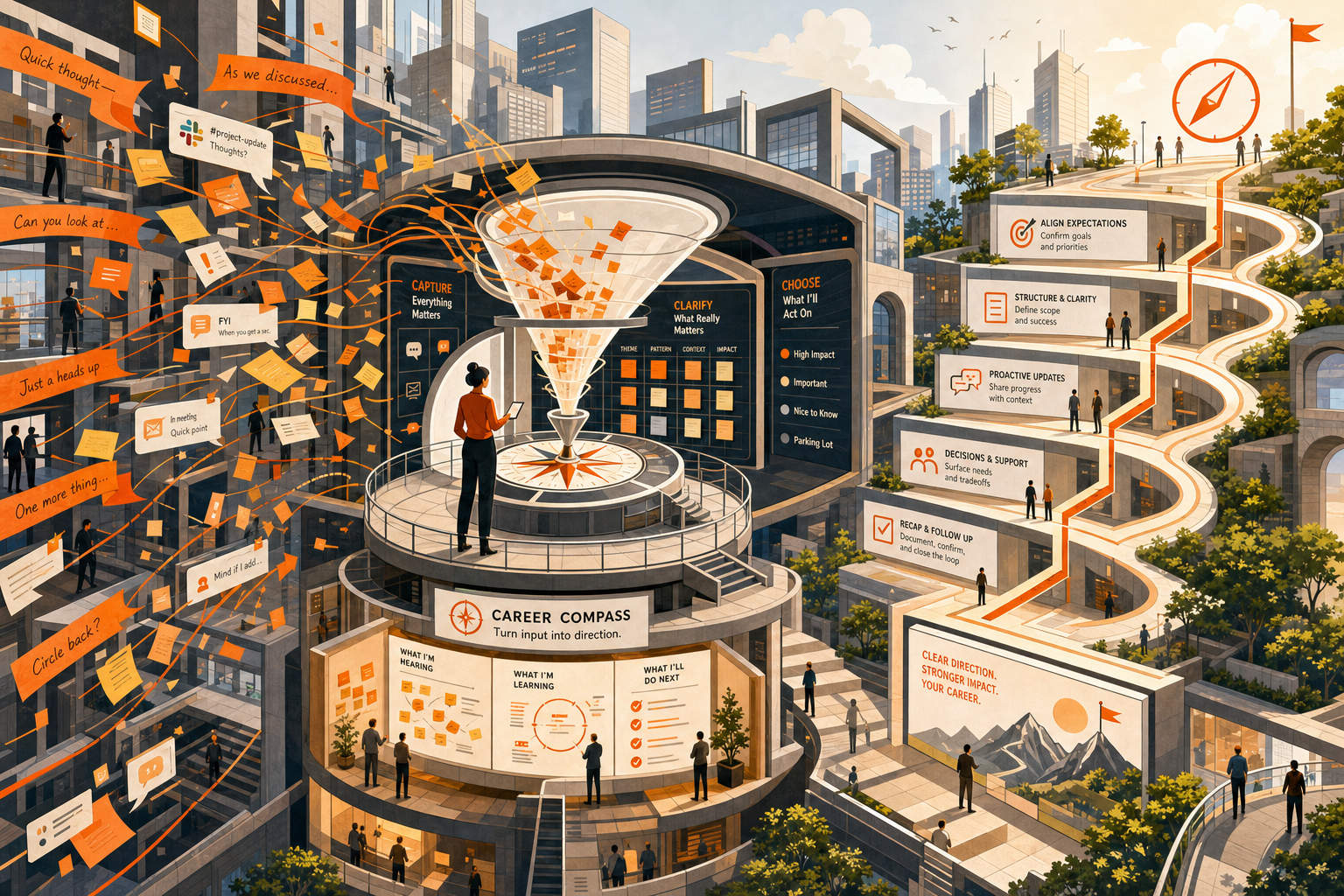
That’s also why Career Compass exists. Careers rarely go off track in one cinematic disaster. They drift through repeated small choices that start to feel normal: the Sunday-night stomach drop, the compulsive checking, the story that being needed is the same as being valued, the slow surrender of evenings you thought were still yours. Career Compass helps you catch those patterns while they’re still editable — to track signals like stress and work-life balance, build a growth plan that fits your actual values, and get nudges that ask a better question than “Can I keep tolerating this?” The better question is “What am I teaching people to expect from me, and is that building the life and career I want?”
So here’s the shift to carry with you: not every message deserves access to your nervous system. Some deserve a response tonight. Many deserve a calm answer tomorrow. Knowing the difference is not selfishness. It is professional judgment.
Work will ask a lot from you over time, and some seasons really will require extra effort. Fine. Give the hard push when the moment is real. But if you want to be respected for your judgment, don’t train people to believe your most reliable skill is replying in the dark.