Inherited Your Boss’s Work? Set Boundaries Early
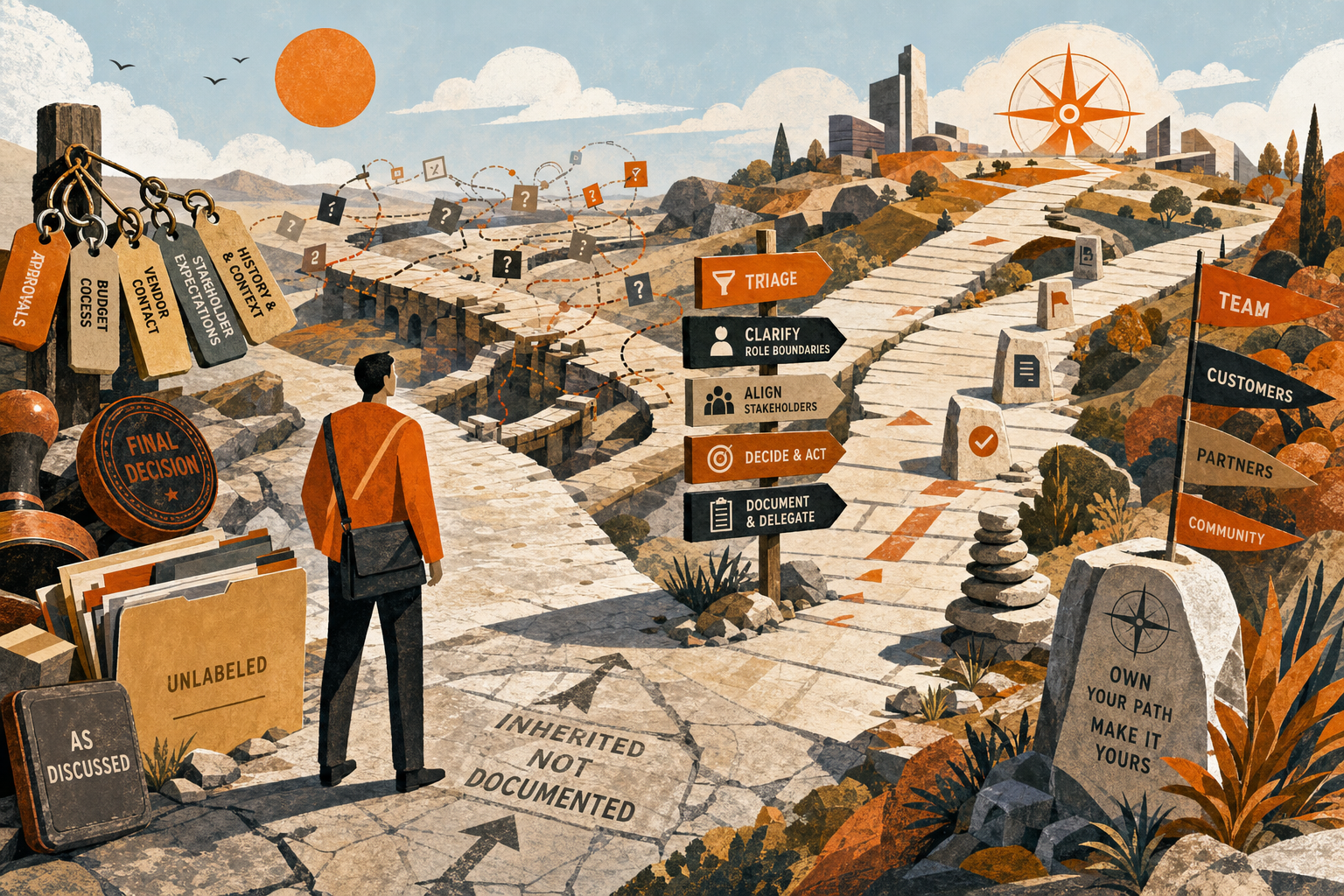
Inherited Your Boss’s Work? Stop Treating It Like a Compliment
There is a very specific workplace trap that catches capable people early in their careers.
Your manager disappears in a boring corporate way. They get promoted. They go on leave. They resign but linger for two weeks as a ghost in Slack. Or they remain technically employed while becoming spiritually unavailable. Then their meetings, approvals, stakeholder pings, budget questions, and random operational nonsense start sliding toward you like mail under a door.
Nobody says, “Congratulations, you are now doing a chunk of management without management power.”
It simply becomes the atmosphere.
And because you are competent, conscientious, and at least a little ambitious, you are tempted to treat that atmosphere like an opportunity.
Sometimes it is. Often it is a staffing failure wearing a flattering outfit.
That is the part people do not say loudly enough.
The danger is not just “too much work.” The danger is that your role changes without anyone admitting it changed. You start covering tasks, then making judgment calls, then absorbing accountability, and before long people speak to you as if you own problems you never agreed to own. By the time you feel the resentment, the Sunday-night dread, or that sour little pulse of panic when another “quick question” lands in your inbox, the pattern is already setting.
So let’s name the rule up front: if the work changed, the agreement about your job needs to change too.
Not eventually. Not after you prove yourself. Now.
The mistake smart people make first
The first instinct is usually: I’ll keep everything moving, show I can handle it, and then we can talk about scope later.
That feels mature. It feels generous. It feels like the behavior of someone who is promotion material.
It is also how people accidentally train an organization to believe they can do two jobs for the price of one.
Once you make the transition look frictionless, the company learns the wrong lesson. Not “we need to clarify ownership.” Not “we should rebalance priorities.” The lesson it learns is: great, this apparently fits.
This is why “I’ll absorb it for now” is so risky. Temporary coverage turns into assumed capacity with terrifying speed. Two weeks becomes six. Six becomes a quarter. Then review season arrives and nobody remembers the disruption; they only remember that you managed to keep things afloat, so perhaps this is simply your level now.
If this is happening to you, pause before you become impressive in the wrong way. Do not start by proving endurance. Start by naming the shift.
A simple version sounds like this:
“I’m happy to help keep things moving during the transition. I want to clarify which parts I’m covering temporarily, which decisions still need another owner, and what should pause until we have that owner.”
That sentence does real work. It marks you as helpful without volunteering for a silent promotion with no terms attached.
This is not mainly a workload problem. It is an ownership problem.
People often describe this situation badly.
They say, “I’m slammed.”
Or, “There’s just a lot going on right now.”
Or, “I’ve been picking up extra stuff.”
Those phrases are true, and almost useless.
The core issue is not busyness. It is ownership drift.
There is a huge difference between these two realities:
- You are covering a few tasks while the team sorts out a transition.
- You are becoming the default owner of your boss’s responsibilities without clear authority, backing, or reward.
Those are not neighboring situations. They create totally different risks.
Temporary coverage might mean running a status meeting, keeping a project timeline updated, or answering routine questions for a short stretch. A role shift is heavier. It changes who makes prioritization calls, who handles escalations, who absorbs stakeholder disappointment, who signs off, who gets blamed, and who is suddenly expected to “just know” the context behind decisions they were never in the room for.
That is why this feels so emotionally strange. On paper, you are “just helping.” In your body, it feels more serious. You feel jumpy. Defensive. Hypervigilant. You start checking Slack earlier in the morning because you suspect a fire is already burning. You rehearse explanations in the shower. You can’t tell whether this is exciting or unfair, which is often the first sign that it is both.
Here is the question worth sitting with today: What exactly am I being asked to own now that I did not own a month ago?
Write the answer as a list. Not vibes. Not a rant. A list.
Before you carry it, sort it
When more work falls on your plate, your reflex may be to act first and organize later. Reverse that.
Do not begin by heroically carrying the whole pile. Spread it out on the table and sort it like evidence.
The fastest useful framework is three buckets:
- Keep moving: work that must continue right now to avoid immediate damage
- Needs an owner: work that involves approvals, prioritization, budget, people calls, or stakeholder commitments
- Can pause: work nobody has officially decided matters enough to resource
This sounds basic. It is not basic in practice. Most teams avoid this level of clarity because it forces an awkward truth into the room: the team does not merely have “a lot on.” It has orphaned responsibilities.
And orphaned responsibilities are where careers get messy.
Manager work, especially, is not just a bigger volume of tasks. It includes tradeoffs. Judgment. Ambiguity. Saying no. Taking heat. Making choices that affect other people’s timelines and sometimes their trust. If those calls now flow through you informally, then your exposure is rising even if your title stays frozen.
So sort the work before you become the sorting system.
Pick one page, one note, one spreadsheet. List every inherited responsibility currently touching you. Then mark each item with one of those three labels: keep moving, needs an owner, can pause. Bring that list into your next 1:1 or send it before the meeting if you want to lower the emotional temperature.
That one move changes the conversation from “I’m overwhelmed” to “Here is the operating reality.”
Leaders can dodge feelings. Lists are harder.
The approval trap: tasks are easy to inherit, authority is not
Here is where people get burned.
The tasks transfer first. The authority usually does not.
So now you are expected to produce updates, soothe stakeholders, chase dependencies, and keep decisions moving, but you do not actually have the standing to make the call cleanly. You become the human extension cord for a role that is no longer fully staffed.
This is miserable.
It creates a special form of workplace anxiety because everyone behaves as if you are in charge right up until a real decision appears. Then suddenly someone senior needs to weigh in, nobody is available, and you are left standing in the middle trying to explain delays you were never empowered to prevent.
That gap between responsibility and authority is where resentment breeds.
I learned this young, and not elegantly. I was pushed upward before I had enough support around me, and I confused willingness with readiness. For a while it looked flattering from the outside. Inside, it felt like constant low-voltage panic. I was making calls, absorbing consequences, and trying to project calm while quietly running out of runway. Eventually I burned out hard enough to leave. The lesson stuck: unsupported responsibility may look like growth for a while, but it eventually feels like exposure.
So be blunt about decision rights.
Try language like:
“I can coordinate these workstreams and keep execution moving. I’m less clear on who owns approval for priority changes, budget tradeoffs, and stakeholder commitments. If those calls sit with me for now, I’d like us to state that explicitly.”
Or even more directly:
“I’m covering the work. I’m not assuming invisible authority. Can we name who makes the final call in these three areas?”
Use that sentence if you need it. It will save you hours of cleanup later.
“I’m overloaded” is weak. “Here’s what slips” is management language.
A lot of talented people sabotage themselves by describing a structural problem as a stress problem.
When you say, “I’m drowning,” many leaders hear emotion. Some sympathetic ones care. Many busy ones simply log it as general strain and move on.
When you say, “I’m currently covering stakeholder reporting, weekly intake triage, and budget approvals, which means the launch timeline is slowing and customer research is now a week behind,” you force a real decision.
That is the standard to aim for.
Make the tradeoff visible. Name the displaced work. Put the cost on the page.
Because management is not actually the art of nodding kindly while someone says they’re busy. Management is choosing what gets done, what waits, and what risk the team is willing to carry. If you do not present the issue in that language, you make it too easy for everyone above you to misread the situation.
A clean way to document this is a simple tracker with five columns:
| Inherited work | Original owner | Risk if delayed | Decision needed | What this displaces |
|---|---|---|---|---|
| Weekly stakeholder update | Former manager | Confusion across partner teams | Confirm temporary owner | Delays roadmap planning |
| Budget approval review | Former manager | Spending decisions stall | Assign approver | Pulls time from core analysis |
| Intake triage | Former manager | Priorities get muddy | Clarify criteria and owner | Shrinks project execution time |
You do not need a dramatic memo. You need a boring artifact.
Boring artifacts win workplace arguments all the time.
Your move this week is to create that tracker before you feel desperate. Early documentation makes you look composed. Late documentation makes you look cornered, even when you are right.
Do not wait until you are furious
One reason people delay this conversation is emotional.
They want to be easy to work with. They do not want to sound political. They worry that raising scope early makes them seem fragile, territorial, or less “all in.” So they push through. They smile in the meeting. They tell themselves they can do this for a little longer.
Then one tiny extra ask breaks the seal.
A stakeholder says, “Can you just approve this?”
Someone forwards another standing meeting.
A skip-level casually says, “You’ve got this area covered, right?”
And suddenly you are replying from a place of accumulated rage instead of calm clarity.
That is a much harder position to recover from.
The better moment to speak is earlier, when your tone can still be measured and your thinking can still be crisp. The relief of a good clarifying 1:1 is real and electric; you can feel your shoulders come down when somebody finally says, “Yes, this belongs with X,” or “No, stop doing that,” or “We need to adjust your goals while you cover this.”
Do not deny yourself that relief by waiting until your frustration turns theatrical.
Pick one stakeholder and send the email today. Ask for 20 minutes to clarify temporary coverage, decision rights, and priorities. Not next week. Today.
Coverage can be great for your career, but only on terms you can name
Let’s be fair: taking on some of your boss’s work can absolutely help you grow.
Sometimes it is the best possible test. You get to see how decisions actually get made. You learn where the bottlenecks are. You discover whether you want the next level or whether you merely liked the idea of the next level from a safe distance. That information is valuable.
But “stretch” is one of corporate life’s favorite euphemisms. Real stretch has structure. Fake stretch is just under-resourced chaos with a motivational caption.
Useful coverage usually has a few clear features:
- a defined timeframe
- a named sponsor who knows you are doing it
- an adjusted workload somewhere else
- a specific learning upside
- visible criteria for what success looks like
Bad coverage is murkier. Nobody updates your goals. Everyone keeps forwarding work to you. The timeline is fuzzy. The expectations expand. Three months pass. You are still doing budget prep, stakeholder smoothing, escalation handling, and half your old job, while people compliment your flexibility as if praise were payroll.
That is when you need categories, not optimism.
Ask the direct question: Is this temporary coverage, a stretch assignment, or a redesign of my role?
Those are different deals.
If it is temporary coverage, ask for an endpoint.
If it is a stretch assignment, ask what skill or experience you are meant to build and how that will be evaluated.
If it is a role redesign, ask about title, compensation, scope, and performance expectations.
Do not let anyone blur those lines because blurred lines are cheap for the company and expensive for you.
Good work is evidence. It is not negotiation.
This is the part ambitious people resist.
Many smart professionals tell themselves a hopeful story: I’ll do the bigger job well, and then they’ll have to recognize it.
Maybe. Sometimes that happens.
Plenty of times, though, what actually happens is simpler and less flattering: you prove you can absorb more, so more keeps arriving.
Work does speak for itself in one sense. It generates evidence. It does not automatically generate fairness. Organizations are fully capable of benefiting from your extra effort while failing to convert it into a cleaner title, better pay, or even a coherent acknowledgment of what changed.
That is why performance and negotiation are separate skills.
You need both.
So if you have already been covering upward for a while, stop waiting for the perfect moment when someone magically notices. Build the case. Name the scope. Ask for the conversation. You are not “making it weird.” The situation is already weird. You are just describing it accurately.
A useful script:
“Over the past two months I’ve taken on A, B, and C in addition to my core role. I’m glad to help, but I want to align on whether this is temporary coverage or an ongoing scope change, and what that means for priorities and expectations.”
That is not aggressive. That is adult.
If you want to handle this well, track your career while it is happening
This is where people often lose the plot.
When work gets chaotic, your attention narrows to survival. You stop noticing your own patterns. You cannot tell whether the situation is helping you grow or just grinding you down. You normalize the stress. You forget what your actual goals were before you became the team’s emergency absorber.
That is one reason I built Career Compass.
Not as a preachy “optimize yourself” machine. As a way to stay oriented when work gets noisy.
If you are inheriting pieces of your boss’s job, you need more than a pep talk. You need a way to see your career clearly while events are moving fast: what you are learning, what is draining you, which wins are real, whether your stress is spiking, whether your work-life balance is quietly collapsing, whether your key relationships at work are strengthening or fraying. You need a place to turn vague unease into patterns you can actually use.
That is what Career Compass helps with. It gives you a personalized growth plan, a way to track weekly wins and signals like Job Satisfaction, Stress, Work-Life Balance, and relationship health, plus coaching nudges that keep you from disappearing into other people’s priorities for three months straight.
That matters here because inherited work can look good on paper while feeling terrible in your actual life. You need both views.
The bottom line
When your boss’s work starts landing on your desk, do not ask only, “Can I do this?”
Of course you probably can. Competent people usually can, for a while.
The more important question is: What is changing, who knows it, and what are the terms?
That question will save you from low-grade resentment, muddy accountability, fake opportunities, and the slow demoralization of doing a bigger job in a smaller story.
Take the learning. Take the visibility. Take the chance to see above your level.
Do not take undefined liability and call it gratitude.
Name the scope change out loud. Put the tradeoffs in writing. Clarify decision rights before a messy outcome makes them painfully relevant. And if you need a way to keep your own career visible while you are busy holding the team together, use Career Compass to track the reality, not just the narrative.
The people who navigate this well are not the ones who say yes to everything. They are the ones who can help generously without vanishing into the gap.