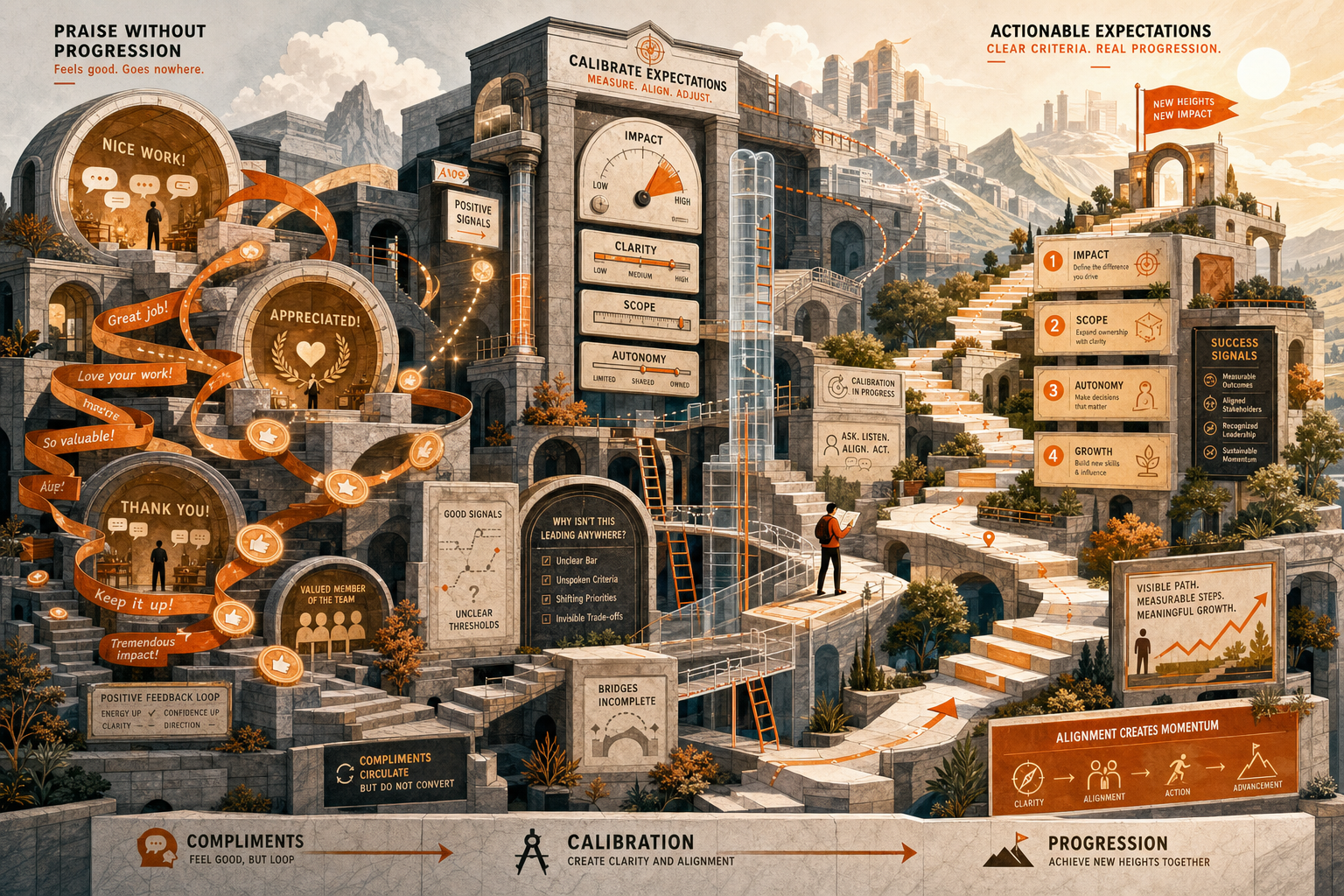
Performance Calibration: Make Your Work Legible

Performance Calibration: What Your Manager Actually Needs From You
Most early-career professionals are handed a childish little story about performance reviews.
Do good work. Be reasonably likable. Mention your wins without sounding obnoxious. Then the system, like some wise old judge, rewards merit.
Cute story.
Also not how this usually works.
A huge share of review outcomes gets decided in a less visible step called calibration: the meeting where managers compare employees side by side and argue over ratings, raises, and promotion cases while half the room is underprepared and the other half is campaigning hard for their people. Your manager may genuinely think you are excellent. They may praise you all year. They may even rely on you constantly. But if they cannot explain your impact quickly, specifically, and comparatively, that admiration can evaporate in ten minutes.
That is the part that makes people feel crazy. You hear “you’re doing great,” then you get a middle rating that lands in your inbox like a clerical error from another universe. First comes confusion. Then anger. Then the ugly little thought: Was I delusional all year?
Usually, no. Usually the simpler truth is worse and more useful: your work may have been strong, but your case was weak.
And yes, this offends people’s sense of fairness. It should. But it is still true: “My work should speak for itself” is terrible career advice. Work does not speak for itself. Managers speak for it, mostly from memory, under pressure, while someone across the table is making a much cleaner argument for another employee.
TL;DR
- Calibration is where managers compare people against peers, not against effort, stress, or good intentions.
- Review outcomes often depend on whether your impact is easy to summarize, prove, and compare.
- “Great attitude” and “super helpful” are compliments, not cases.
- A disappointing rating does not automatically mean weak performance; it often means weak evidence, vague standards, or weak advocacy.
- Your job is not to become a self-promotional cartoon. It is to make your impact legible before other people decide what your year meant.
Calibration is where fuzzy praise goes to die
Calibration is the meeting before ratings harden into consequences.
Managers sit around and compare people across teams and levels. Who had more impact? Who handled more scope? Who solved harder problems? Who showed growth? Who operated above level? Who did solid work, but not unusually so?
That last category is where a lot of careers quietly get parked.
Calibration is rarely about how tired you were, how much you cared, or how many nights you ate dinner next to your laptop like a hostage. It is comparative. When your manager says, “She’s been fantastic,” the next question is often, “Compared to whom?” Then comes the knife twist: “What changed because of her work?”
If your manager can answer that cleanly in 90 seconds, you have something durable.
If they start free-associating with words like “reliable,” “positive,” and “really stepped up,” you are in danger of becoming review-season wallpaper: pleasant, respectable, and forgettable.
Here is the difference:
| In calibration | Strong case | Weak case |
|---|---|---|
| Summary | Clear enough to repeat in two sentences | Long, vague, impossible to retell |
| Evidence | Specific examples tied to outcomes | General praise and effort |
| Scope | Shows ownership, complexity, influence | Sounds task-based or narrow |
| Comparison | Distinguishes you from peers | Blurs into “solid contributor” |
| Advocacy | Direct, confident, credible | Hesitant, thin, defensive |
That is why so many people leave review season feeling slightly gaslit. The praise was real. It just was not built to survive comparison.
Sit with this question for five honest minutes: if your manager had one minute to explain your year to a skeptical room, what would they say after “They’ve been great”?
What your manager needs is not more enthusiasm. It is an evidence stack.
Managers do not enter calibration with a mystical vibe detector. They need material.
The strongest cases usually include the same ingredients: outcomes, scope, difficulty, stakeholder effect, consistency, and growth. Outcomes answer what changed. Scope shows how important or broad the work was. Difficulty explains why this was not just routine execution. Stakeholder effect proves other humans felt the difference. Consistency shows it was not one heroic Thursday. Growth shows trajectory.
This is why “always positive,” “great teammate,” and “super helpful” are career junk food. Nice to hear. Better than being called a menace. But if another manager says, “He cut onboarding time by 30%, stabilized a cross-functional launch that was wobbling, and became the default problem-solver for sales ops and product,” your nice little pile of attitude compliments starts looking nutritionally empty.
A lot of managers are also farther from your work than you think. They miss details. They forget timelines. They inherit projects midway through the year. They manage too many people. They are in too many meetings. They are trying to remember who did what from a blur of Slack threads, 1:1s, dashboards, and hallway conversations. That is not always malicious. Often it is just cognitive wreckage.
So if you expect them to reconstruct your impact from scattered context and good feelings, you are basically asking someone to argue a court case with no exhibits.
A simple test helps: claim, evidence, impact, comparison.
- Claim: What are you saying about your performance?
- Evidence: What examples support that?
- Impact: What changed because of your work?
- Comparison: Why was that above expectations, broader than standard scope, or stronger than typical execution?
If one of those is missing, your case has a hole in it.
Take one recent project and write those four lines today. If the comparison line makes you wince, good. That discomfort is information.
Invisible work gets rewarded only after you translate it
Some of the most valuable work in an organization is maddeningly hard to defend.
Fixing a broken process before it becomes a crisis. Preventing an escalation. Calming a tense stakeholder who is one weird email away from going nuclear. Cleaning up ugly data nobody wanted. Onboarding the new person so they stop looking like they are drowning in a software aquarium. Catching the mistake that would have made the entire team look incompetent in public.
This work matters.
It also disappears fast unless someone names the before and after.
Invisible work gets buried under tragic phrases like “helped out,” “supported the team,” or “kept things moving.” Those phrases flatten actual skill into niceness. They turn ownership into background scenery.
You need translation.
Instead of: - “I helped with the launch.”
Try: - “I rebuilt the launch tracker, surfaced three dependency risks early, and kept marketing and product aligned so we shipped on time without the usual last-minute chaos.”
Instead of: - “I supported onboarding.”
Try: - “I created a repeatable onboarding flow that reduced ramp confusion and became the template the team now uses.”
Instead of: - “I handled stakeholder issues.”
Try: - “I stepped into a stalled ops relationship, reset expectations, and got decisions moving again after two dead weeks.”
Same work. Different level of legibility.
This matters even more if you do a lot of emotional labor at work. The person who keeps meetings from becoming blood sport, absorbs tension, smooths cross-functional friction, and quietly creates order is doing real labor. But organizations are spectacularly bad at rewarding labor that gets described like weather. If you leave it as atmosphere, it gets treated as atmosphere.
Pick one invisible contribution from the last month and write it as a before-and-after. What was messy? What did you do? What improved? No corporate sonnet. Just translation.
Vague feedback is not comfort. It is a warning light.
A lot of people hear “you’re doing great” and relax.
Bad idea.
If your feedback all year has been generic, you may not actually know where you stand. You may know your manager likes you. You may know you are not actively alarming anyone. But you may have no clue what they see as your standout strengths, where your case is thin, whether they think you are promotion-ready, or whether they have quietly filed you under “dependable, maybe later.”
That uncertainty has a very specific emotional texture. It is the Sunday-night dread of realizing review season is creeping closer while your evidence is smeared across email, Slack, docs, and your exhausted memory. Your feedback history sounds like it was written by a pleasant toaster: “Great job.” “Really solid.” “Appreciate your help.” Wonderful. Meaningless.
Specific feedback feels completely different. It gives that little jolt of relief you get after a genuinely clarifying 1:1—the nervous system unclenches, the fog lifts, and you can stop inventing six imaginary disasters in the background.
So stop asking lazy questions.
Not: - “Am I doing okay?”
Ask: - “What are the two strongest examples you’d use to describe my impact this quarter?” - “Where do you see me as solid versus exceptional?” - “If my review were tomorrow, what evidence would make my case stronger?” - “What would distinguish a higher rating from where you think I’m currently tracking?” - “What kind of work most clearly signals next-level performance on this team?”
Those questions force your manager to stop petting you and start informing you.
If asking them makes you nervous, that is usually a clue that they matter. Bring one into your next 1:1.
By the time calibration happens, most of the game is already over
The best time to influence calibration is not the week your self-review opens and everyone suddenly becomes an amateur historian of their own labor.
It is now, while the facts are fresh and your manager can still absorb them naturally.
When your manager walks into calibration, you do not want them improvising your year like someone giving a wedding toast for a cousin they barely know. You want them carrying three to five sharp examples they trust, remember, and can repeat without sounding uncertain.
This does not mean sending a self-congratulatory novella every Friday. Nobody wants that. The goal is not volume. It is recall.
A better rhythm looks like this:
- Keep a running log of wins, metrics, decisions, praise from stakeholders, and hard problems solved.
- After a meaningful project, send a short recap: what happened, what changed, what you owned.
- In 1:1s, do not just give status updates. Name impact.
- Before review season, synthesize patterns instead of dumping raw notes like a panicked raccoon emptying a backpack.
A short recap email can do shocking amounts of work:
“Quick recap on the onboarding cleanup project: I mapped the failure points, coordinated changes across support and product, and reduced average setup delay from 5 days to 2. The biggest shift is that new customers now get through week one without the old back-and-forth loop.”
That is useful because it gives your manager language they can later borrow without having to reconstruct your contribution from fragments.
Your Move: after the next meaningful project wraps, send the recap within 24 hours. Short. Specific. Repeatable.
If you got a lower rating than expected, do not turn it into a morality play
A softer rating can feel awful in a way that is hard to explain to people who have not been there.
First comes heat—anger, embarrassment, a flush of insult. Then the replay loop starts. Every compliment sounds suspicious in retrospect. Every “nice work” suddenly feels counterfeit. You open old messages like a detective in your own career crime scene, looking for proof that you were misled.
That emotional crash is real. But it does not automatically mean you are failing, or untalented, or secretly mediocre.
Sometimes standards were vague. Sometimes ratings are compressed because the company is stingy. Sometimes your work was hard to compare. Sometimes another person had cleaner evidence. Sometimes your manager folded under pushback. Sometimes the whole performance system is held together with duct tape and corporate optimism.
Those are different problems. If you treat them all as “I must be bad,” you learn nothing and suffer twice.
The more useful response is diagnostic: - Where was my evidence strongest? - Where was my case thin? - Which examples most supported the rating I got? - What differentiated stronger cases this cycle? - What would have made my work easier to advocate for?
Those questions move you out of humiliation and into analysis.
And yes, sometimes the answer is still, “This process is inconsistent and kind of ridiculous.” Fair enough. But even in flawed systems, clarity beats resentment. The move after a disappointing review is to leave the conversation with three things in writing: what counted, what was missing, and what would materially change the next outcome.
Stop treating review season like a surprise exam
If calibration is where your work gets translated into decisions, your job during the year is to make that translation easy and accurate.
That means documenting earlier, while details are still alive. It means noticing which work has measurable impact and which work needs context to be understood. It means asking for specificity when feedback gets mushy. It means figuring out what evidence actually changes promotion conversations instead of privately deciding to “just work harder” like that has never failed anyone before.
The people who navigate reviews well are not always the loudest, slickest, or most political. Often they are simply less naive about the mechanism. They understand that being valuable and being legible are related, but not identical. One is about contribution. The other is about whether that contribution can survive scrutiny, comparison, and a room full of busy people with partial memory.
That distinction is not cynical. It is adult. Once you understand it, reviews stop feeling like random weather and start feeling like a system you can prepare for. Not control completely. Prepare for. There is relief in that. The same way there is relief in finally seeing the map after wandering around convinced the building was badly designed—which, to be fair, it often is.
So here is the mindset shift: stop hoping your manager will somehow remember your year better than you do. Build the record as you go. Keep the examples. Save the metrics. Translate the invisible work. Ask the uncomfortable question in the 1:1. Make your case easier before anyone has to make it under pressure.
That is also where Career Compass fits naturally. Not as a magic fix, and not as another place to dump motivational quotes, but as a practical system for tracking wins, patterns, stress, growth, and the evidence that tends to vanish by review season. If you are tired of reconstructing six months of work from a fried brain and a desperate Slack search, having one place that helps you notice and organize your real impact is not vanity. It is strategy.
Most of all, stop treating performance reviews like a verdict on your worth as a human being. They are an imperfect information system run by busy people with incomplete memory and uneven judgment. Your advantage is not in pretending that system is fairer than it is. Your advantage is in understanding it well enough to participate intelligently, with less dread, less guesswork, and far more control over the story that gets told when the room goes quiet.