Put on a PIP at Work? What to Do Next
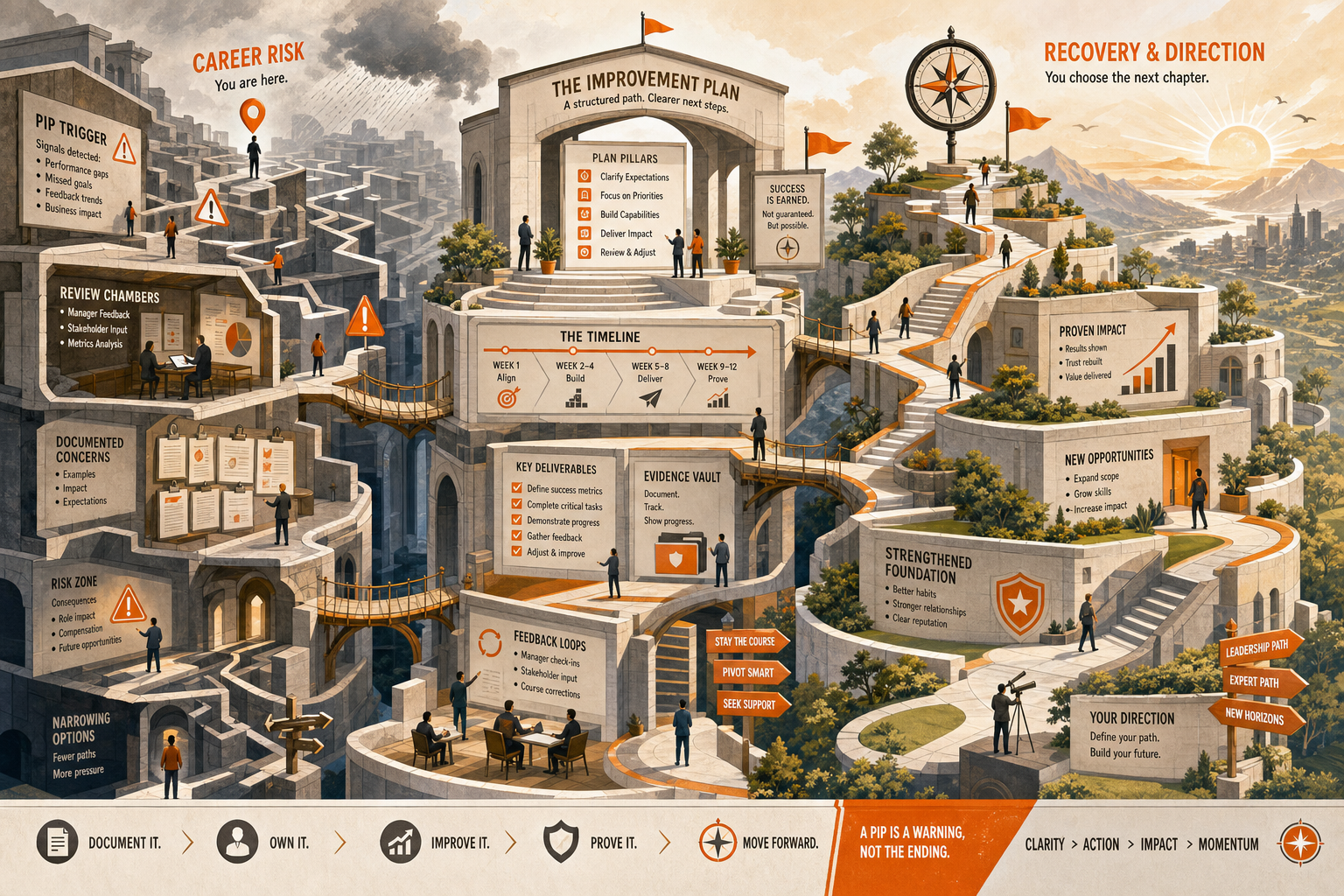
Put on a PIP at Work? Read This Before You Spiral
A PIP can make an ordinary Tuesday feel possessed.
You see the calendar invite. Your mouth goes dry. By dinner, you are mentally re-editing every meeting from the last six weeks like there was a hidden camera and a prosecutor. By Sunday night, you are decoding punctuation in Slack messages from people who are probably just making soup.
That reaction is human. It is also a terrible operating system.
Here is the truth more people need much earlier: a performance improvement plan is not automatically a firing notice with better formatting, but it is never nothing. The company has moved from vibes to paperwork. Once that happens, your job is not to be likable, wounded, or persuasive. Your job is to get specific fast, document what is happening, improve what can be improved, and quietly reduce the amount of power this one job has over your life.
The people who survive a PIP best are usually not the smartest people in the room. They are the people who stop making speeches and start making records.
TL;DR
- A PIP is a career-risk event. Treat it like a process, not a psychic verdict.
- Your first task is to convert mushy criticism into observable behaviors, dates, metrics, and examples.
- Some PIPs are real recovery plans. Others are HR-grade exit documentation with a motivational cover letter.
- You should improve your work and prepare an exit path at the same time.
- During a PIP, less emotion belongs in writing. More facts belong in writing.
First, Stop Treating the PIP Like a Final Judgment
A lot of people hear “performance improvement plan” and immediately react as if the company has already decided the ending and is now just enjoying the theater.
Sometimes that instinct is right. Sometimes it is not. Either way, panic is still a useless strategy.
A PIP is two things at once: a set of stated expectations and a documentation trail. If you only focus on the first part, you miss the game board you are actually standing on. If you only focus on the second part, you become fatalistic and sloppy. Neither helps.
What helps is colder than people want it to be. The company has written concerns down and attached a timeline. Fine. Your job now is to understand exactly what is being alleged, what “better” means in practice, how progress will be judged, and who is responsible for what during the plan. That shift matters because dread loves fog. The moment you force things into bullets, dates, and examples, the fear loses some of its costume jewelry.
If you are still in the first 24 hours, do four unglamorous things before you perform any emotional TED Talk for yourself: get the document, save a copy somewhere you control, pull prior feedback and reviews, and read everything once like a case file instead of a personal betrayal. You can cry in the car, rage-text your friend, or take a revenge walk later. Right now, your move is to understand the terrain.
Translate Corporate Mush Into English a Sane Person Could Use
Most PIPs are written in the dialect of “improve communication,” “demonstrate stronger ownership,” or “exercise better judgment,” which is convenient language if your goal is to sound managerial without saying anything testable.
Those phrases are not always dishonest. They are just too vague to help until somebody nails them to behavior.
If your manager says communication is the issue, what does that actually mean?
Late status updates? Overlong emails? Failing to flag risks? Surprising people in meetings? Giving half-answers when a direct answer was needed? “Improve communication” is not a real instruction any more than “be taller” is a real fitness plan.
This is where people often waste their best chance. They respond with autobiography: I work hard. Nobody told me this. This feels unfair. Other people do the same thing. Maybe all of that is true. It still does not produce a target.
You need six things, in plain language:
- The exact behaviors or deliverables that need to change
- The specific examples being used to justify the concern
- The timeline for improvement
- The standards, metrics, or visible signs of success
- The support or coaching you should expect
- The check-in cadence and who owns it
Ask follow-ups until the answer could survive daylight.
- “Can you give me two recent examples?”
- “What would success look like by the end of this plan?”
- “How will we evaluate progress week to week?”
- “Which parts of this are about output, and which are about process?”
- “What support should I expect from you during this period?”
Notice what those questions do. They pull the conversation out of mood and into mechanics.
Here is the test: could you explain the expectation to a smart friend in one sentence without using words like better, stronger, improved, or more proactive? If not, it is still mush. Rewrite every vague phrase in the PIP in your own words tonight.
Do Not Trust Your Memory After the Meeting
Adrenaline is a terrible stenographer.
After a PIP meeting, people remember the emotional weather and lose the operational details. They remember the tightening in their chest, the weirdly cheerful HR smile, the one sentence that felt like a slap. They do not reliably remember whether the timeline was 30 or 45 days, what examples were named, or whether weekly check-ins were actually promised.
That is how people get trapped later. Not because they are careless, but because fear makes memory dramatic instead of accurate.
So send the recap email.
Not a manifesto. Not a wounded essay with legal energy. Just a short summary of your understanding:
- the areas identified
- the examples discussed
- the goals or deliverables
- the review timeline
- the support your manager said they would provide
- any open questions that still need answers
This is not performative professionalism. It is a dated record. If the process is legitimate, the recap helps everyone stay aligned. If the process starts shape-shifting later, you now have something better than “I’m pretty sure that’s not what you said.”
Pick one sentence you want preserved in writing and send that recap today.
Build a Boring Record Before Your Nervous System Turns Into the Narrator
Once a PIP starts, many people become terrible historians of their own week.
A delayed reply feels sinister. A neutral one-on-one feels like pretermination staging. One decent meeting gives you electric relief for six hours, then a colder-than-usual Slack message sends you right back into doom. Your body starts acting like every workday is a hostage negotiation.
That is exactly why you need a log.
Keep it private. Keep it dull. Dull is your friend here.
Track: - what you completed and when - what feedback you received - what changes were requested - what blockers existed - whether support or coaching actually happened - whether expectations shifted - what you did next
Write facts, not diary entries. “Sent draft Tuesday 2:14 p.m.; manager requested additional client data Thursday morning.” Good. “I can sense a hostile undertone in leadership.” Maybe true. Not useful in this document.
The point of the log is not paranoia. It is stabilization. It gives you material for updates, proof for your own brain, and a way to spot whether the standards are becoming clearer or slipperier. A neutral person should be able to read your notes and understand what happened without needing to decode your feelings. That is the standard.
Figure Out Whether This Is a Recovery Plan or Exit Paperwork
People love grand pronouncements here because certainty is comforting.
“A PIP always means you’re done.” False.
“A PIP is just formal coaching.” Also false.
Some PIPs are sincere efforts to correct a problem. Others are the company making its paperwork neat before walking you out. Most people can feel the difference pretty quickly, then spend two weeks talking themselves out of their own perception because hope is softer than clarity.
A recovery-oriented PIP usually has a few signs: - the expectations are specific - the timeline is demanding but not absurd - examples are concrete - check-ins actually happen - questions get answered - the target does not move every time you get near it
A managed-exit PIP has a different smell. The document is vague. Feedback arrives late. Your manager keeps using language like “overall confidence” or “leadership presence” when you ask what exactly needs to change. Deadlines are too short for the work involved. Meetings get canceled, but lack of progress is still held against you. You ask for clarity and somehow leave with less of it.
This does not always mean cartoon-villain behavior. Sometimes the manager is conflict-avoidant, disorganized, politically motivated, or simply trying to backfill a decision they should have handled earlier. For you, the motive barely matters. An unwinnable process remains unwinnable even if the person delivering it has excellent hair and a calm voice.
Try This: score your PIP from 1 to 5 on clarity, consistency, realism, support, and feedback cadence. If the numbers are ugly, stop demanding reassurance from the situation. Take the information seriously.
Improve the Work and Open the Escape Hatch at the Same Time
There is a certain kind of career advice that sounds noble and gets people hurt: Just keep your head down.
No. Keep your standards up, yes. But do not become so obediently focused on the current role that you ignore the possibility that the role is already ejecting you.
A PIP creates a dual-track job: 1. perform better inside the role 2. reduce your dependence on the role
That means tightening your execution now while also updating your resume, preserving work samples you are allowed to keep, reaching back out to former colleagues, and looking at openings before desperation makes you weird.
Some people resist this because it feels disloyal, or because job searching while on a PIP feels like admitting defeat. I understand that impulse. There is a childish part of most adults that wants perfect devotion to be rewarded by fate. It usually is not. Companies manage risk constantly and without guilt. You are allowed to do the same.
The move this week is simple: message one former coworker and reopen one dormant professional relationship. Do not dump the whole saga on them. Just restart contact while you still sound like yourself.
Professionalism Here Means Fewer Speeches, Better Writing
Under pressure, a lot of people confuse professionalism with emotional suppression plus polished vocabulary.
That is not professionalism. That is just expensive-sounding panic.
Real professionalism on a PIP is boring. It is measured. It is legible. It keeps producing clean evidence when your insides are doing raccoon cartwheels.
In the room, you usually need only four moves: - acknowledge the seriousness - clarify expectations - commit to addressing them professionally - summarize your understanding
That is enough.
You do not need a closing argument.
You do not need to perform wounded dignity.
You do not need to confess to things that are inaccurate just to seem cooperative.
And you definitely do not need to send a midnight email titled “Some thoughts.”
Your written updates should be equally plain: what got done, what is in progress, what is blocked, what decision is needed. Concrete nouns. Short sentences. Dates where useful.
If the process is fair, this helps you progress. If the process is unfair, this helps you build a sane record. Either way, it is better than turning every check-in into a referendum on company culture.
Ask yourself before you hit send: does this message create clarity, or does it merely express my mood? If it is mostly mood, close the laptop and draft it somewhere nobody pays your salary.
If You’re Emotionally Fried, Use Scripts So You Don’t Have to Freestyle
This is the part many workplace articles flatten into “stay calm,” as if calm were a button hidden behind your left rib.
A PIP can mess with your identity in a way that is deeply disproportionate to the document itself. If you are used to being capable, low-drama, praised, reliable, or “the one who always figures it out,” formal performance scrutiny can feel disgusting. Shame in the morning. Rage by lunch. Weird hope after a decent one-on-one. Then Sunday dread again because your manager used a period instead of an exclamation point in Slack and now your brain is making a documentary.
You do not need to be less human. You need less improvisation.
Build scripts for the moments most likely to knock you sideways.
- “Can you give me a specific example so I can address the right issue?”
- “What does success look like by next Friday?”
- “Help me understand the priority order so I execute this correctly.”
- “Can we reschedule the canceled check-in this week? I want to make sure I’m getting timely feedback against the plan.”
- “To confirm my understanding, the immediate priorities are…”
Scripts are not fake. They are safety rails for the version of you who slept badly, feels humiliated, and is one vague comment away from saying something expensive.
Write down the three sentences you most wish you had ready in your next meeting. Then use them.
The Best Outcome Is Clarity, Even When Clarity Stings
There are only a few endings that matter here.
Maybe you improve, the expectations were real, and you come out of this sharper. Good.
Maybe you realize halfway through that the process was mostly administrative choreography before an exit, and you use the remaining time to protect your reputation, gather receipts, and line up what comes next. Also good, in a harsher way.
The worst outcome is not actually being put on the PIP. The worst outcome is spending the whole period in emotional static — half defending yourself, half waiting for rescue, doing neither the internal work nor the external career work that would give you leverage. That is how people lose twice: once in the role, and again in the story they tell themselves about what this moment means.
A PIP is serious, but it is not sacred. It is not proof that you are secretly incompetent. It is not proof that every good thing people have said about your work was fake. It is a high-stakes signal that something in this job has broken down: your performance, your manager’s trust, the company’s willingness to keep investing, or some ugly combination of all three. Your task is not to romanticize that. Your task is to get clearer, steadier, and more deliberate than the moment wants you to be.
That is also where a system matters more than motivation. In a season like this, most people do not need another pep talk about resilience. They need a way to turn spinning into action: a place to track what happened, what changed, what to send, what to improve, and what options to build next. That is exactly the kind of structure Career Compass is built to provide — not motivational confetti, but enough traction to keep you from disappearing into dread.
So if you are on a PIP right now, the mindset shift is this: stop asking, “How do I make this feel less awful?” and start asking, “How do I make this moment more legible?” Legibility is power. Facts are power. Options are power. Get the expectations in writing. Send the recap. Keep the log. Tighten the work. Reopen your network. And remember that whether this role recovers or ends, your job now is to leave this process clearer, more strategic, and harder to corner the next time work turns weird.