Urgent Is Not a Priority at Work
Urgent Is Not a Priority at Work
Work has a sleazy little trick: it takes someone else’s lateness, vagueness, or nerves and tries to install it in your body as a crisis.
If you are early in your career, that trick lands hard. A Slack message pops up with “ASAP.” Your stomach drops. You stop thinking in sentences and start thinking in smoke alarm noises. Suddenly you are rearranging your afternoon, abandoning the thing your manager actually cares about, and calling it “being responsive.”
For about twelve minutes, this feels noble.
By 5:47 p.m., it feels disgusting. Your real work is half-finished. Your brain is buzzy. You were “busy” all day but somehow have nothing clean to point to. That end-of-day shame — the specific, irritating shame of having tried hard without moving anything important forward — is often a priority problem disguised as a work ethic problem.
So let’s separate the two.
“Urgent” is not a priority. It is a time signal. Sometimes it points to a real problem. Sometimes it points to a deadline. Sometimes it points to a dependency. And very often, it points to a person who does not want to sit alone with the consequences of their own planning.
Priority is different. Priority is a decision made in context. It has tradeoffs. It has ownership. It answers the adult question: if we do this now, what are we not doing?
The people who become trusted at work are not the ones who absorb the most panic. They are the ones who can stay useful while pressure is flying around the room.
Why Conscientious People Get Trapped by “ASAP”
This problem is not mainly about productivity. It is about emotion.
A lot of smart people hear “urgent” and translate it into something more personal: prove you’re helpful.
Or worse: prove you are not the bottleneck, not the difficult one, not the junior person who needs too much context before acting.
That is why the reaction feels physical. Tight chest. Faster typing. The immediate urge to respond before you have even understood the request. You are not just evaluating work; you are trying to escape the discomfort of potentially disappointing someone.
That is also why fake urgency is so effective. It piggybacks on good qualities — conscientiousness, generosity, ambition — and turns them against you.
Sit with this for a minute: when you jump the second someone says “urgent,” are you solving a business problem, or are you trying to soothe your own anxiety? The answer is not always flattering. It is still useful.
The move the next time an “ASAP” message lands is painfully simple: do not open fifteen tabs and start thrashing. Ask one clarifying question first.
Not All Urgency Is Fake — But It Is Usually Sloppy
When people say something is urgent, they are usually pointing at one of four very different realities.
1. Real business risk
Something is broken, wrong, exposed, or about to cost the company money, trust, or credibility. A customer workflow is failing. The numbers in a leadership report are incorrect. A launch asset has the wrong pricing on it. In those situations, speed matters because delay creates actual damage.
Do not over-intellectualize those moments. Fix the thing.
2. A real deadline
The meeting starts at 2. The filing goes out tomorrow morning. The board packet closes tonight. The clock is real, and pretending otherwise is not boundary-setting; it is incompetence.
Still, ask what exactly is due by when. “Urgent” often means “I forgot this was today” right up until someone has to name the deadline out loud.
3. A dependency
Another person or team cannot proceed until you finish your part. This one gets underestimated because it does not always feel dramatic. Nobody is yelling. Nothing is on fire. But if five people are waiting on your two paragraphs, your work may deserve to jump the line.
Before you switch, find out who is blocked and what slips if you wait.
4. Anxiety in business casual
This category is wildly common. Someone got pinged by their boss and now wants visible movement. Someone feels behind and wants company in their discomfort. Someone does not actually need completed work; they need the emotional relief of seeing you “on it.”
This is how teams end up treating a formatting tweak like a legal exposure issue. Same tone, same frantic punctuation, completely different stakes.
Your job is to sort the request before you obey it. The next five times you hear “urgent,” label it in your head: risk, deadline, dependency, or nerves. That tiny act will change how much nonsense gets access to your nervous system.
The Cost of Saying Yes Too Fast
Fake urgency rarely wrecks your week in one dramatic blast. It ruins it the way termites ruin a porch: quietly, repeatedly, and just enough each day that you do not notice the structure getting soft until you step through it.
A quick update. A fast deck tweak. A “can you jump on this for ten minutes,” which naturally becomes forty-five because nobody decided what good looked like before asking for revisions. You keep pivoting. You keep being agreeable. By Friday, the project that actually mattered has been sitting untouched like a neglected plant, and now that has become urgent too.
The obvious cost is fatigue. The less obvious one is dread. Not cinematic burnout. Just that low, grim feeling on Sunday evening when you realize your upcoming week is already spoken for by other people’s interruptions.
But the biggest cost is reputational.
People love responsiveness in the short term. It makes their lives easier. Over time, though, many managers do not interpret constant reactivity as heroism. They interpret it as weak prioritization. If your core work keeps slipping because you respond to every blinking request like it’s a hostage situation, you do not look indispensable. You look governable.
That is a brutal thing to discover in a performance review.
Pick one recent week and do a ten-minute interruption audit. Not in some gorgeous color-coded productivity app. On paper is fine. What interrupted you? Who asked? What did you postpone? Which requests actually mattered by the next day? Evidence is more calming than self-blame.
Priority Is a Tradeoff, Not a Mood
This is the sentence a lot of teams spend months avoiding:
If this is now the priority, what should move back?
Ask it calmly and watch how fast the room gets more honest.
Priority is not just a flattering adjective we stick on tasks to make them sound important. It is a resource decision. Time is finite. Attention is finite. Energy is very finite, especially by Thursday afternoon when your brain feels like a damp washcloth and everyone suddenly “just needs a quick turn.”
So every real priority shift should come with a visible cost. Something gets delayed. Something gets simplified. Something gets cut. If nobody can name the tradeoff, then there is a good chance nobody has actually decided this work is important — they have merely decided they would like it done soon by someone else.
That distinction will save you years.
Try saying: “Happy to switch to this. That would move the reporting refresh to tomorrow morning — is that the right tradeoff?”
That sentence is not defensive. It is not territorial. It is the language of a person who understands cause and effect.
If the requester gets vague, irritated, or strangely philosophical, that tells you something too. Many people want urgency without wanting ownership. Do not volunteer to carry both.
Use Language That Makes Cost Visible
A lot of people know, in theory, that they should clarify urgent requests. What they lack is usable language in the moment, when their pulse is up and someone senior has just Slacked them like they’re ordering an ambulance.
You do not need a brilliant script. You need a boring one.
Try a few of these:
- “What deadline is driving this?”
- “I can do this today. That would push the launch prep to tomorrow — should I make that switch?”
- “What does this block if it waits until the morning?”
- “I want to make sure I’m optimizing for the right thing. Is this taking precedence over X?”
- “Since this changes today’s plan, do you want me to confirm with my manager before I reshuffle?”
Notice the magic trick here: none of these lines apologize for your judgment. None of them say, “Sorry, I’m bad and overwhelmed and probably annoying.” They simply ask for context and expose cost.
That is what credible people do under pressure. They do not become dramatic. They become specific.
Try This: save two of those lines somewhere embarrassingly easy to access — your notes app, a sticky note on your monitor, a text file called “Do Not Panic.” Then use one this week. Not when you feel ready. When the next vague “urgent” request arrives.
When to Move Fast, When to Slow the Room Down
Professional maturity is not “always stay calm.” It is knowing when speed is useful and when speed is just expensive confusion.
Move fast when the impact is obvious and delay clearly makes things worse. Customer issue. Executive meeting in an hour. Teammate blocked on a critical input. In those moments, fast is not people-pleasing. Fast is competent.
Slow the room down when the ask is blurry, the deadline is mushy, or the requester seems far more committed to urgency than to clarity. A rushed misunderstanding is still a misunderstanding. You do not get points for efficiently doing the wrong work.
Escalate when the tradeoff exceeds your authority. This is especially important if you are early-career and someone from another team tries to reorder your day through sheer force of confidence. They may be senior. They may sound polished. They may type in that terrifying crisp way some people have, where every message feels like a lawsuit. If they do not own your priorities, they do not get to silently reset them.
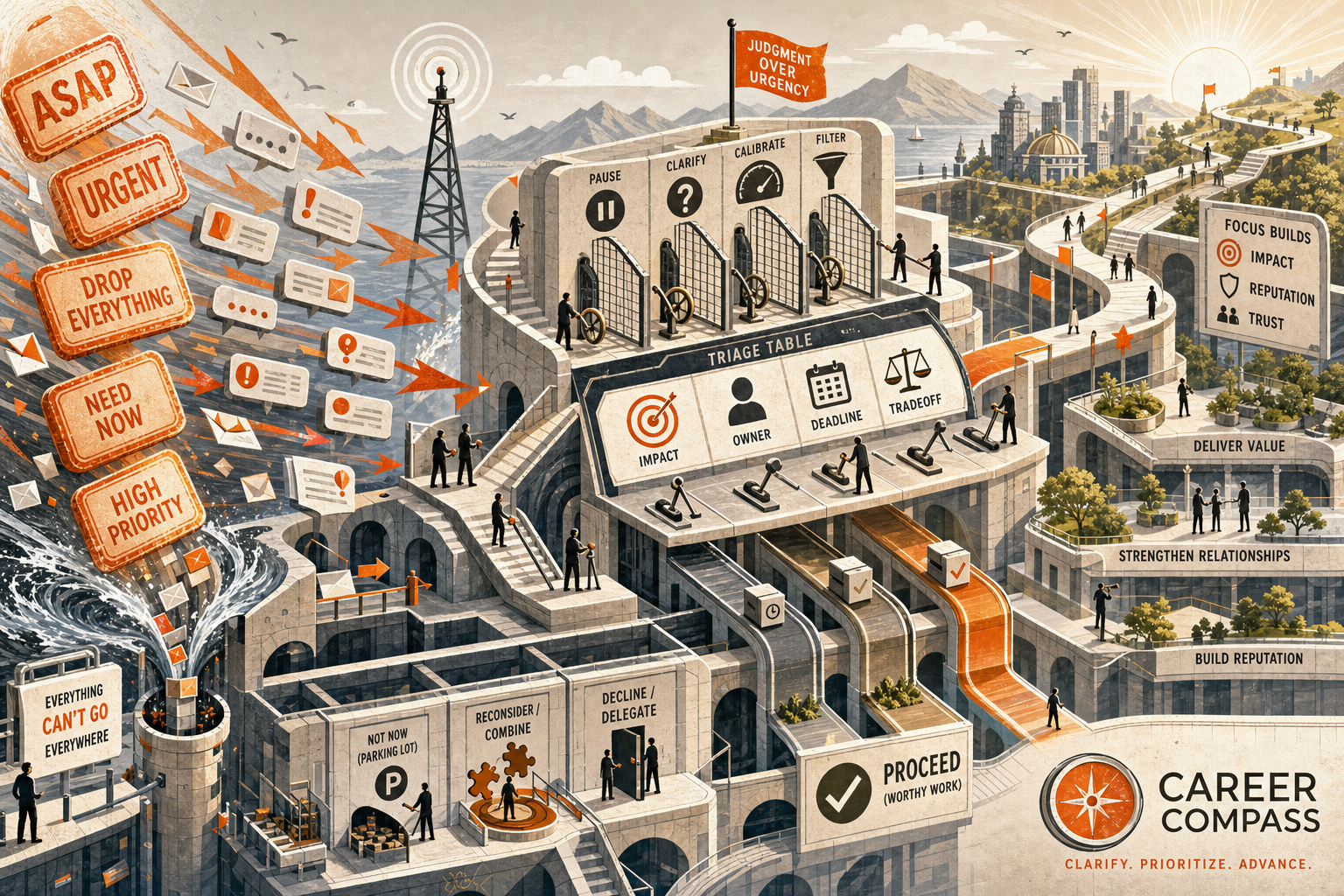
Use this filter:
- Clear impact + real deadline + approved tradeoff = move
- Unclear impact + vague timing + no owner = pause
- Competing priorities + no decision rights = escalate
If you are not sure which bucket a request belongs in, that is your answer. Unclear work should be clarified before it is accelerated.
The Trap Younger Professionals Fall Into
Early in your career, being eager gets rewarded.
You answer quickly. You stay late. You say “happy to help” with the sincerity of a golden retriever wearing a lanyard. People adore this. Of course they do. Flexibility is delightful when it is free and belongs to someone else.
Then the expectations change.
At some point, your value is no longer based on whether you can absorb random work without complaint. It is based on whether you can manage competing priorities, surface risks early, and protect the quality of the work that matters most. The same habit that once made you look promising can suddenly make you look junior.
That shift feels awful when you are inside it. Confusing. Unfair, even. You think, I’m doing exactly what made people praise me before. Yes — and the job changed while your reflexes did not.
At higher levels, “I did everything everyone asked” is not a strong defense. It sounds obedient, not accountable.
Bring one real example into your next 1:1. Not a hypothetical. Say, “Last week Team X asked for Y same-day, and it pushed Z. In that situation, how do you want me to handle the tradeoff?” The relief of getting a direct answer to that question is electric. It replaces guessing with alignment, which is one of the most underrated feelings in working life.
Calm Is Usually a Process, Not a Personality
People talk about being “calm under pressure” as if some workers were born with serene blood and others were not.
Usually, calm is procedural.
It looks like pausing for thirty seconds. Asking one question. Naming the tradeoff. Confirming the decision in writing. Then doing the work without theatrical sighing, martyr energy, or six Slack messages about how slammed you are.
That pause matters because urgency is contagious. One frantic message can hijack your entire body. Shoulders up. Breath shallow. Attention narrowed to a pinhole. The urge to answer immediately just so you can stop feeling activated.
Human, yes. Helpful, not always.
So ask a better question in the moment: what would the credible version of me do here?
Not the nicest version.
Not the fastest version.
Not the version who secretly wants everyone to call them a lifesaver.
The credible version asks for context first, then acts.
Build a Tiny System So This Stops Being a Vibes Problem
If your workplace runs hot, you cannot solve this with resolve alone. Willpower is a flimsy tool at 3:40 p.m. on a Wednesday when three people want something and you have already made two dozen micro-decisions.
You need pattern recognition.
For one month, keep a simple weekly log: - what the urgent request was - who asked - the stated deadline - the actual impact - what got deprioritized - whether the urgency turned out to be real
That is it. No dashboard. No self-optimization cosplay.
What you are looking for is not perfection. It is recurring truth. Maybe one stakeholder creates chaos before every Friday review because they never prepare on Thursday. Maybe your own anxiety spikes anytime a senior person messages you, even when the request is minor. Maybe half the “urgent” asks in your week could have waited a full day without consequence.
Once you can see the pattern, you stop treating every interruption like a unique moral emergency. You start recognizing the species.
That is also the point where tools can help — not as a shiny productivity gimmick, but as a way to make your working life legible. Career Compass is useful here because it gives you a structured place to track weekly wins, stress, work-life balance, job satisfaction, and relationship friction at work. Urgency problems are rarely isolated incidents. They are patterns with emotional consequences. If you can actually see when your stress spikes, who triggers it, and what responses protect your priorities, you are in a much better position to grow out of reflexive reactivity.
If everything feels urgent right now, do not attempt a grand reinvention. Start with one move: the next time someone says “ASAP,” ask a clarifying question before you move a single task.
That tiny pause is not resistance. It is judgment.
And over time, judgment is what changes your reputation. People stop experiencing you as endlessly available and start experiencing you as dependable — someone who can absorb pressure without becoming part of the mess. That shift is quieter than hustle culture makes career growth sound, but it is far more durable.
The deeper mindset change is this: your job is not to prove that you can metabolize everyone else’s chaos on command. Your job is to help the work get done in the right order, for the right reasons, with the costs made visible. Career Compass can support that kind of growth because it helps you notice what your weeks are actually teaching you, not just what your inbox is yelling.
So no: urgent is not a priority. Priority is what remains after clarification, tradeoffs, and ownership enter the room. Learn that early, practice it consistently, and work starts to feel less like a series of small ambushes and more like something you can actually steer.