Your Boss Got Promoted. Your Job Just Changed.

Your Boss Got Promoted. Your Job Just Changed.
This is one of those work events that looks shiny from ten feet away and feels terrible up close.
Your manager gets a bigger title. The team channel fills with confetti reactions. Someone writes, “So well deserved!!!” with the exact number of exclamation points required by corporate civilization. Meanwhile, your actual week starts getting weird. The fast Slack replies vanish. Your one-on-ones become foggy little therapy sessions with no decisions in them. Things that used to get resolved in five minutes now disappear into “circling back next week,” which is office language for I have seventeen bigger fires and your question is currently losing.
If you’re early in your career, this can rattle you more than people admit. Less access to your boss does not register as a tidy org-chart update. It feels personal. It feels like your safety net got quietly removed while everyone else was clapping. Sunday night gets louder. You reread short messages like they contain hidden meaning. You start wondering if you are slipping, if they have lost confidence, or if there was some memo about your future that somehow skipped your inbox and landed in everyone else’s lap.
And then there is the embarrassing part: you feel guilty for feeling bad. Their promotion is objectively good news. You want to be generous. You want to be mature. You also want your old manager back, preferably with the old calendar availability and the old reassuring habit of saying, “Yep, that looks right, go ahead.”
Here is the useful, unromantic truth: this is usually not a relationship problem first. It is a workflow problem, a decision problem, and an expectations problem. Your boss’s job changed. If you keep working together as if it didn’t, friction piles up fast. Then everyone starts describing that friction as a performance issue, which is how ordinary confusion gets promoted into something scarier.
The people who handle this well do not spend a month trying to resurrect the old dynamic. They rebuild the working relationship around the new one. That sounds less comforting, but it is far more effective. And if you do it well, this stretch can help you more than it hurts you. Distance from your manager often reduces comfort while increasing the odds that other people notice how you actually operate.
TL;DR
- When your boss gets promoted, the first thing you lose is not attention. It is clarity.
- The old way of working usually breaks before anyone says out loud that it broke.
- The real danger is drift: fuzzy priorities, stalled decisions, and good work that nobody can summarize upward.
- A newly promoted manager may coach you less often, but they may be able to sponsor you in rooms that matter more.
- Your job is not to get more reassurance. Your job is to become easy to trust from farther away.
Stop turning this into a love story or a betrayal story
Most people interpret this change emotionally before they interpret it structurally.
Of course they do. If a manager who used to answer in ten minutes now answers the next day with “Looks fine,” your nervous system does not calmly say, Ah yes, a standard shift in managerial bandwidth tied to expanded scope. Your nervous system says, Something is wrong. You replay recent meetings. You inventory mistakes. You become weirdly invested in punctuation. A period starts looking hostile. “Thanks” starts feeling like a breakup text.
The problem is not that you are dramatic. The problem is that your first explanation is often wrong.
A promoted manager is suddenly being judged on different things. They are spending more time in budget fights, cross-functional horse-trading, staffing debates, political meetings disguised as planning meetings, and those surreal leadership conversations where everyone says “alignment” for twenty minutes instead of naming the actual disagreement. They have more influence, but they also have more downside. A call that used to affect one project might now affect three teams and a quarterly target. That makes people slower, blurrier, and less available.
So yes, your experience changes. But “my boss cares less about me” is only one possible explanation, and usually not the best one.
| What it feels like | What may actually be happening |
|---|---|
| “They’re pulling away.” | Their attention is being rationed across a much wider field. |
| “They keep dodging decisions.” | More people now have to live with those decisions. |
| “They stopped developing me.” | Their role now rewards team-level judgment more than constant individual coaching. |
| “I’m invisible.” | Your work is no longer visible through casual proximity. |
That last one is the killer. Your work used to be seen because your manager was close enough to watch it happen. Now your work has to survive explanation.
So ask yourself a cleaner question: Has my manager changed their opinion of me, or has the operating system around both of us changed? Write down the answer before your imagination writes one for you.
The real threat is drift, not distance
Less face time is annoying. Drift is what actually damages your job.
Drift happens when nobody resets the rules after a role change. You keep sending long, context-heavy updates because that used to work. You wait for approval on small choices because that used to feel safe. Your manager assumes you can run farther without them. You assume they still know the details. Both of you are using expired expectations, and then one day the mood goes sour for reasons that sound vague and personal.
This is how good employees end up hearing feedback like, “I need you to show more ownership,” or, “I thought you had this.” Not because they got worse overnight. Because the communication system quietly rotted.
In real life, drift usually shows up in four places.
1. Access
You cannot count on live clarification the way you used to. That means confusion sits longer. And confusion, if left alone long enough, hardens into bad judgment.
2. Decisions
You may not know which calls are now yours to make and which still need approval. That uncertainty produces one of two ugly outcomes: hesitation or freelancing. Neither one looks great for long.
3. Visibility
Good work starts falling through cracks because nobody is close enough to see the effort, the tradeoffs, or the judgment behind it.
4. Sponsorship
Your manager may still be willing to back you, but only if they can explain your value quickly and confidently to someone else.
When this goes badly, it rarely starts with fireworks. It starts with office lint. A delayed answer. A muddy handoff. A one-on-one that ends with “anything else?” in that particular dead tone that means nothing useful got discussed. Three weeks later, everybody feels behind and slightly irritated, which is one of the most common workplace atmospheres in existence.
The move now is not to fix everything at once. Pick the one area already costing you the most energy. Is it access? Decision rights? Visibility? Sponsorship? Name the wobble precisely. Vague anxiety loves vagueness. It gets weaker when forced into a category.
Reset the working agreement before confusion turns into feedback
A lot of people wait too long to have the obvious conversation because they are trying to seem chill.
They do not want to be the needy direct report. They do not want to interrupt the celebration. They do not want to look like the one person who heard “promotion” and immediately thought, Okay, but what about me?
That instinct is understandable. It is also how you lose a month.
Silence is not maturity. Often it is just fear in business casual.
What helps is a practical reset conversation. Not a wounded speech about abandonment. Not a delicate fishing expedition for reassurance. A direct conversation about how the two of you should work now.
You are trying to answer questions like these:
- How often should we still meet, and what should those meetings be for?
- What belongs in Slack, what belongs in a doc, and what is worth interrupting you for?
- Which decisions should I make without checking first?
- If you’re unavailable, who can unblock me?
- What does a useful update from me look like now?
If that feels awkward, good. Awkward is often a sign that reality has entered the room.
You do not need a beautifully crafted speech. You need five decent minutes. Try this:
“Now that your scope has changed, I want to make sure I’m not relying on a working style that no longer fits. Can we reset a few basics—how you want updates, what I should decide on my own, and what should still come to you?”
That sentence is doing real work. It shows that you noticed the change. It frames the conversation around effectiveness, not feelings. And it helps your manager solve a problem they are probably aware of but too busy to structure for you.
Pick the next one-on-one on your calendar and use it. Waiting for the perfect moment is how this conversation becomes a postmortem instead of prevention.
Your updates cannot sound like term papers anymore
One of the fastest ways early-career professionals lose altitude in this phase is by communicating upward like excellent students.
They show all the thinking. They include all the context. They build the case carefully, hoping the effort itself will be appreciated. It is a sincere mistake, and on a busy team it fails almost immediately.
A promoted manager does not need the full dramatic retelling. They need signal.
What moved? What is blocked? What decision is needed? What do you recommend? What happens if nobody acts by Friday?
That is not cold. It is merciful.
A useful update usually has four parts:
- What moved: one or two concrete wins
- What is stuck: the blocker in plain English
- What I’m doing next: your next step
- What I need from you: a decision, a contact, or nothing
Here is the difference.
Bad version:
“I’ve been thinking through a few possible approaches to the rollout and after syncing with product and then reconnecting with design, I think there are some open questions around timing and ownership that we should probably align on because there may be dependencies...”
Better version:
“Rollout draft is complete. Blocker: product and design disagree on launch timing. My recommendation is to move the announcement one week and keep the feature release date. I need your call by Thursday.”
One message makes your boss do archaeological work. The other hands them the artifact with a label already attached.
Here is the test: Could your manager forward your update to their boss without rewriting half of it? If not, tighten it until they can.
Send one cleaner update today. Not as a grand identity shift. Just one. Then notice how differently people respond when they do not have to excavate your point.
Build scaffolding that does not depend on your boss’s availability
This is the part people resist because it is boring, and boring solutions rarely get the respect they deserve.
When your manager gets farther from the day-to-day, the answer is not always “I need more manager time.” Sometimes the smarter move is to build support around the work so every little problem does not have to travel upward for oxygen.
That can look like:
- documenting decisions in a shared place instead of relying on memory and vibes
- identifying a peer with adjacent context who can sanity-check something quickly
- asking a senior teammate to be a lightweight sounding board
- writing a short weekly status note so the same questions stop resetting every Tuesday
- clarifying fallback approvers before someone goes dark for three days
- making ownership painfully explicit on cross-functional projects
None of this is glamorous. No one posts on LinkedIn, “Thrilled to announce I reduced recurring confusion by creating a shared decision log.” But this is the stuff that keeps your week from turning into a string of tiny panics.
More important, it changes how work feels in your body. There is a specific kind of dread that comes from knowing one unanswered message can freeze your progress. Replacement structure lowers that dread. It gives you back a little oxygen.
Sit with this question for ten minutes: Where am I currently using my manager as a substitute for process? Your answer will tell you what to build next. Then build one piece of that scaffolding this week, even if it is as small as a decision tracker or a clearer owner list.
You may get less coaching and more sponsorship
This is the trade people miss because coaching feels better in the moment.
Coaching is emotionally satisfying. You walk into a one-on-one tense and leave with that electric little rush of relief: Okay, I’m not crazy. I know what to do now. If your old manager gave you a lot of that, losing it can feel like losing traction.
And you may lose some of it.
But a promoted manager can sometimes offer something more powerful: sponsorship.
Coaching sounds like this:
- “Tighten this recommendation.”
- “Push back sooner next time.”
- “Frame the problem more clearly.”
Sponsorship sounds like this:
- “She can handle that.”
- “Put him on the project.”
- “I trust their judgment.”
- “They’re ready for more scope.”
Early in a career, sponsorship changes trajectory faster than people realize. It affects who gets trusted, who gets stretch work, whose mistakes are interpreted as growth instead of danger, and whose name comes up when opportunities are being assigned in rooms they are not in.
But sponsorship has a hard requirement: your manager must be able to explain your value quickly.
They need to know:
- what you own
- what problems you solve
- how you make decisions
- whether you create calm or create cleanup
That is why “just do good work” is incomplete advice. Plenty of people do good work and still remain oddly invisible. Good work is the baseline. Work that is clear, reliable, and easy to summarize is what travels.
So make your contributions legible. Finish things. Name outcomes. Flag risk early. Show your reasoning without burying the headline. Give your manager sentences they can reuse.
Here is the useful pressure test: if your boss had thirty seconds to describe you to a senior leader right now, what would they say? If the answer is mushy, that is not a branding problem. It is an evidence problem.
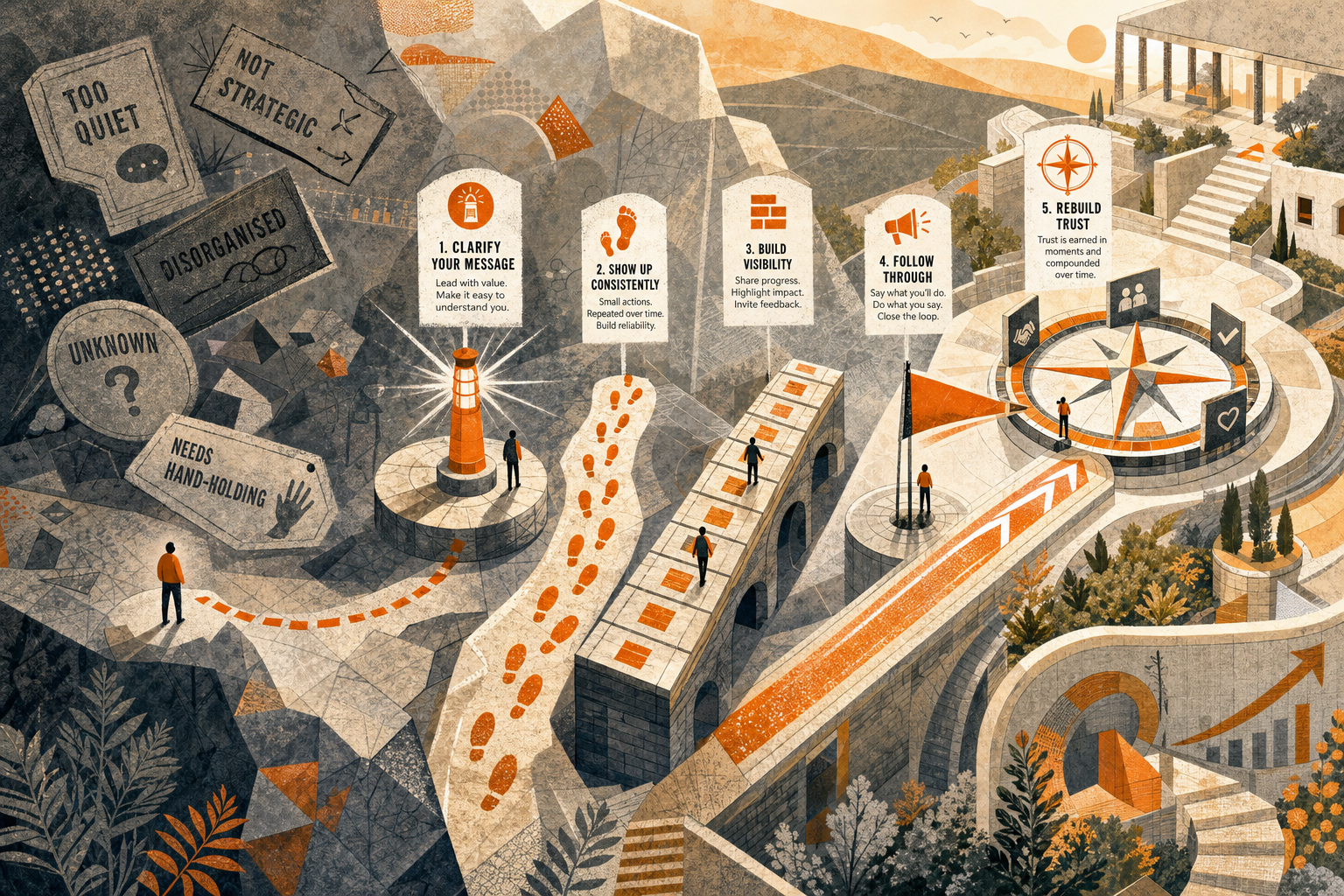
The goal is not more attention. It is trust at greater distance.
That is a harder goal and a better one.
A lot of employees respond to a promoted manager by trying to restore the old closeness. More pings. More check-ins. More “just bubbling this up” messages that are really requests for reassurance in business language. Sometimes you do need a short burst of extra contact. But if that becomes your whole strategy, you end up creating noise while telling on yourself.
What senior people tend to remember is not who asked for the most reassurance. They remember who became easier to work with when complexity went up.
That person:
- surfaces problems before they become expensive
- knows when to decide and when to escalate
- writes updates people can use
- makes cross-functional work cleaner, not messier
- stays steady when access goes down
Steady does not mean robotic. It does not mean never feeling anxious. It means not making your anxiety the operating system for the work.
And yes, this can feel unfair. You did not request this transition. You did not volunteer to become more independent on a random Tuesday because someone else got a bigger title. But careers quietly split in moments exactly like this. One person spends months waiting for management to feel normal again. Another adjusts, sharpens, and starts looking ready for more.
The difference is usually not talent. It is adaptation speed.
So if your week feels off, do not waste all your energy diagnosing whether your boss still “believes in you.” That question is emotionally tempting and strategically weak. A better question is: What would make me easier to trust from farther away? Then go build that version of yourself on purpose.
And if you need help doing that, use something sturdier than mood and guesswork. This is exactly where Career Compass is useful—not as a pep talk machine, but as a system. When your boss’s promotion changes the shape of your job before anyone formally names it, you need a way to spot drift, track what is actually stressing you out, and make focused adjustments instead of panicking in loops. Mapping your growth plan, tracking signals like stress, job satisfaction, and relationship strength, and getting weekly nudges to improve one real behavior at a time is a much better strategy than privately spiraling and calling it reflection.
Your boss getting promoted does not automatically make your job worse. It removes hidden support. It exposes weak process. It asks you to communicate with more precision and operate with more judgment. At first, that can feel like standing on stage without realizing the curtain opened. But handled well, it becomes leverage. You stop being the person who thrives only with close supervision. You become the person people trust when things get less tidy.
So do not spend the next month chasing the old dynamic like it might come back if you are patient enough. Reset the relationship. Tighten your updates. Build scaffolding where dependence used to be. Make your work easy to understand, easy to trust, and easy to sponsor. That is the mindset shift here: your manager’s promotion is not just something happening to you. It is an invitation—annoying, inconvenient, poorly timed—to start operating at the next level yourself.