Bad Skip-Level Meeting? Don’t Diagnose Yourself Fast
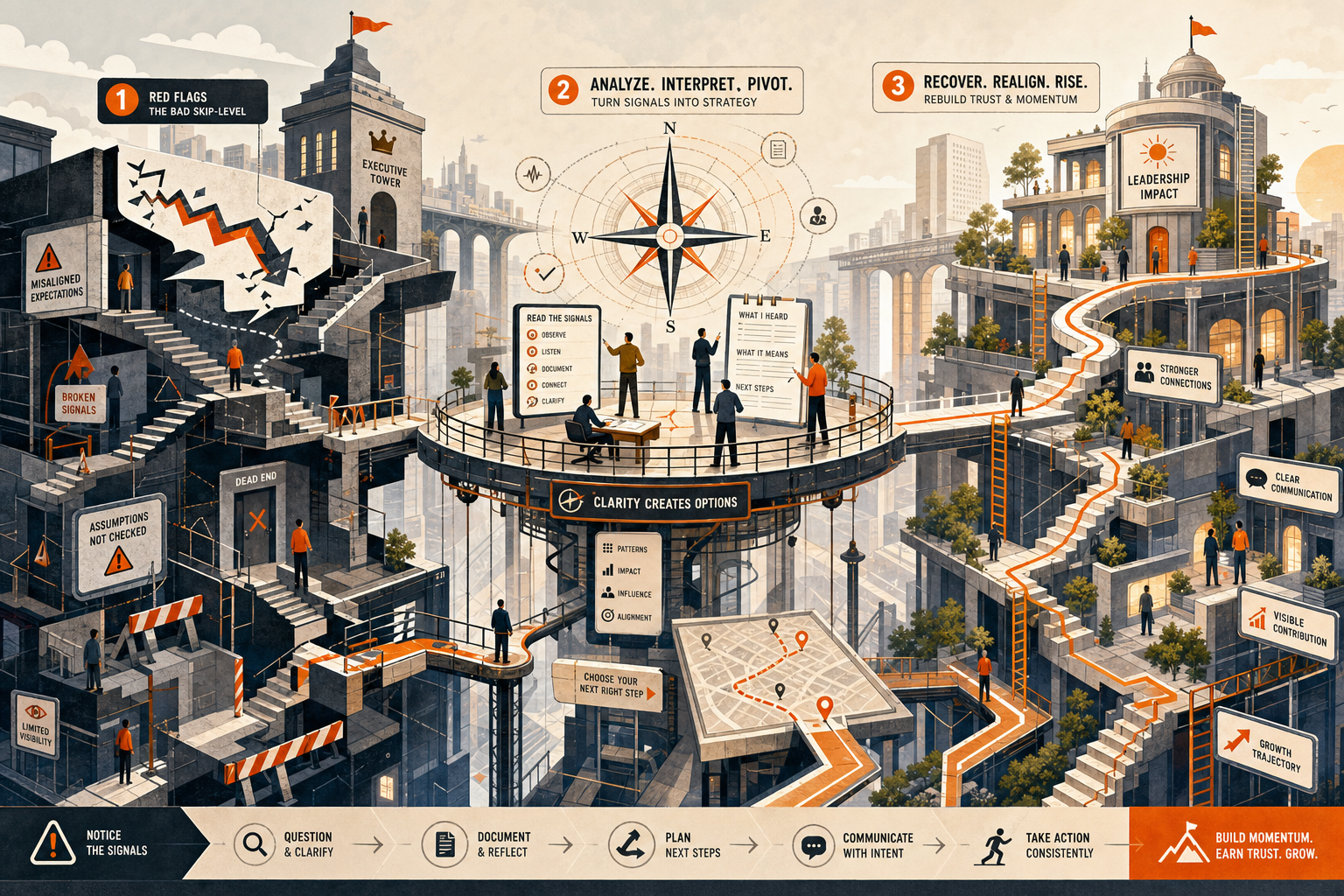
Skip-Level Meeting Went Bad? Don’t Diagnose Yourself Too Fast
A bad skip-level meeting can colonize your brain with shocking efficiency.
Not the obviously bad kind. Not the one where somebody is rude, combative, or careless enough to leave fingerprints. Those meetings are painful, but at least they are legible. You know what happened. You know why you feel awful.
The worse version is cleaner on the surface and nastier in the bloodstream. Everyone was pleasant. The senior leader nodded. You nodded. Nobody said anything you could quote to a friend without sounding unhinged. Then six hours later, while loading the dishwasher or staring at your Sunday-night laptop with that specific pre-work nausea, your brain replays one sentence — the one about priorities, or communication, or your manager — and suddenly you are acting as prosecutor, defense counsel, and jury in the case of Did I Quietly Ruin My Reputation in 27 Minutes?
That feeling has a texture: dread without evidence. Exposure without certainty. You cannot identify the wound, so your mind starts sketching one in with a Sharpie. Maybe I sounded naive. Maybe I sounded political. Maybe they think I’m high-maintenance. Maybe they called my manager right after. Maybe this is why that promotion stalls next quarter.
Here is the useful truth: a bad skip-level meeting usually does not mean you accidentally revealed your fatal flaw. More often, it means the meeting illuminated a mismatch that was already there — in expectations, incentives, trust, or power. The conversation did not create the instability. It turned the lights on long enough for you to notice the crack in the ceiling.
That distinction changes everything. If you interpret the meeting as proof that you are the problem, you will rush into emotional cleanup: apology energy, clarifying emails, extra-smiley professionalism, the whole desperate little tap dance. If you treat it as information, you get calmer, sharper, and much harder to manipulate.
TL;DR
- A skip-level is “bad” when it creates meaningful uncertainty afterward, not when it merely feels awkward in the room.
- Most bad skip-levels are not really communication failures. They are purpose mismatches: you thought this was a growth conversation; they were running a quiet diagnostic on morale, risk, or your manager.
- Do not send the five-paragraph “just to clarify...” follow-up unless there is a real factual error to correct.
- The aftermath is the signal: changes in your manager’s tone, your access, the specificity of feedback, and whether things go strangely quiet.
- One odd meeting is a blip. A pattern plus changed behavior is a situation.
- The move is not to psychoanalyze yourself. The move is to observe, document, and make your next decision from evidence instead of adrenaline.
First, define “bad” correctly
People get skip-levels wrong because they use the wrong measuring stick.
A skip-level is not bad because it felt stiff. Most skip-levels are stiff. You are talking to someone senior enough to influence your future and distant enough to misunderstand your actual job. Of course it feels unnatural. That is not a red flag. That is the format.
A skip-level is bad when it leaves you with more uncertainty that matters. You raised a career question and got a cloud of motivational vapor. You mentioned a friction point and the leader’s face became professionally blank, like a hotel concierge hearing about a murder in the lobby. Your manager was warm before the meeting and oddly procedural after it. A topic that used to be discussable now has the energy of a sealed deposition.
That is different from ordinary nerves, and you need to be ruthless about separating the two. Anxious, competent people tend to moralize discomfort. If they feel embarrassed, they assume they did something wrong. If they feel exposed, they assume they harmed themselves. But discomfort is not a verdict. Sometimes you just told the truth in a room that prefers upholstered lies.
So before you “interpret” anything, strip it back to facts. Write down three things while the memory is still fresh: 1. What you actually said. 2. What they actually said. 3. What changed afterward, if anything.
No adjectives like “weird,” “cold,” or “off” unless you can translate them into behavior. “They stopped making eye contact after I mentioned turnover” is useful. “The vibe got dark” is not. If you cannot tell the story without mood words, you do not have a diagnosis yet. You have leftover cortisol.
What skip-levels are actually for — and why people get burned
Most skip-level meetings go bad because both people walked in solving different problems.
You thought: Finally. An adult conversation. I can talk honestly about my growth, my workload, maybe the friction on this team.
They may have thought: - I should show my face so people don’t think I’m an absentee landlord. - I need a quick temperature check on morale. - I want to know whether this manager is keeping the wheels on. - I’m looking for retention risk before someone rage-quits to a startup with beanbags and lies. - I need signal, not a confessional.
Those are wildly different meetings.
That mismatch is why skip-levels leave people feeling tricked. You showed up for substance and discovered you were in a reconnaissance exercise. You thought you were finally speaking to power; they thought they were doing organizational sonar.
Sometimes the skip-level is basically a visibility lap: the leader wants lightweight connection, a rough sense of the team, and enough accessibility theater to maintain credibility. In that room, unloading a deeply layered complaint about your manager can land like bringing a forensic accountant to brunch.
Sometimes it is a systems check. The leader is comparing notes across teams: morale, clarity, conflict, talent risk, manager quality. If they ask several follow-up questions, that does not always mean you have triggered an intervention. It may simply mean you are one data point in a larger pattern they are trying to confirm.
And yes, sometimes the meeting is one of the few places the truth can surface. If there is a real management problem, a trust breakdown, or a team slowly inhaling its own resentment, the skip-level may matter. But people often overestimate how quickly a senior leader will turn one candid comment into action. Senior leaders are usually slower, more political, and more self-protective than employees hope.
So stop treating every skip-level like a rescue helicopter. Many of them are weather balloons. Useful, maybe. Saving you personally? Not necessarily.
A better question to carry into the next one is: What problem is this leader likely trying to solve by meeting with me? The answer should shape how much you disclose, how bluntly you frame it, and what outcome you can realistically expect.
Read the room without becoming your own conspiracy podcast
You do not need to become a corporate mind-reader. You do need to get less dramatic and more observant.
Here is a better translation guide:
| What happened | What it often means |
|---|---|
| They were warm but vague | This was probably a visibility check or light sensing conversation, not a meeting designed for action |
| They asked unusually specific follow-ups about priorities, conflict, or morale | They may be checking whether your comment reflects a broader pattern |
| They redirected you back to your manager quickly | They want to preserve reporting lines unless the issue clearly exceeds your manager |
| Their language turned formal, careful, or generic | You touched a political or legal risk area and they shifted into self-protection |
| They were encouraging about your future but gave no specifics | They do not yet have context, conviction, or appetite to make commitments |
| They promised to “look into it” and then disappeared | They are either quietly fact-checking or politely putting the conversation in a drawer |
Notice the phrase often means. Not definitely means. The whole point is to trade fantasy for probability.
If you want one practical filter, use this in your notes:
If this meeting mattered, what evidence would show up in the next two weeks?
Then force yourself to answer concretely: - More feedback? - Different feedback? - Less access? - A check-in from your manager? - New scrutiny? - Nothing at all?
That question is boring, which is exactly why it works. Panic thrives on vagueness. Observation kills it. Pick a two-week window and decide now what you will watch for, rather than improvising a fresh theory every night at 11:40.
The mistake people make next: emotional cleanup
After a murky skip-level, your nervous system wants one thing: relief.
That is when people send the cursed follow-up email.
It begins innocently enough — “Thanks again for your time today” — and then slithers into “I just wanted to clarify...” before maturing into a full documentary about your intentions, your professionalism, your loyalty, your nuanced view of cross-functional communication, and your excellent character. By paragraph four, you are not clarifying. You are sweating in writing.
Do not do this unless there is an actual factual error that could cause real damage.
Most cleanup emails are not career strategy. They are self-soothing with timestamps. They tell the reader you are rattled. They create a second artifact for people to interpret. They transform one ambiguous conversation into one ambiguous conversation plus written evidence that you lost your nerve.
What should you send instead? Something so clean it is almost boring:
Thanks for making time today. I appreciated the conversation, especially your point about prioritizing X this quarter. I’m staying focused on A and B and will keep working with [manager] on the rest.
That is enough. Professional. Aligned. Steady pulse.
Try This: Write the frantic version in a private doc if you need to. Get every panicked sentence out. Then wait 24 hours and either cut it to three lines or delete it. Your goal is not to feel instantly better. Your goal is to avoid making anxiety part of the record.
What to watch in the week after
The meeting itself is usually less revealing than the seven to fourteen days that follow.
This is where people either become useful to themselves or completely impossible. Some start hunting for omens in punctuation. Others go into denial and insist everything is fine while the walls quietly move in. Neither response helps.
Watch your manager first, but do it like an adult, not like a frightened Victorian heroine. Did their tone change? Are they more clipped, more formal, more “just looping back” than usual? Are they suddenly asking very specific questions that map suspiciously well to what you raised? Did informal support shrink? Did the easy, human quality of your 1:1s get replaced by canned managerial language?
That stuff matters because career damage rarely arrives with fireworks. More often it shows up as thinning: less context, fewer stretch opportunities, slower replies, vaguer feedback, a strange loss of warmth. Not always malicious. Often just political distancing.
Then watch access. Are you still in the same rooms? Are you still trusted with the same information? Did a development conversation stall out? Did your scope get fuzzier? Did that project you were “definitely being considered for” suddenly become something leadership wants to “revisit later”? You are not looking for one odd moment. You are looking for a pattern of reduced confidence.
And watch for the opposite too, because anxious people are terrible at noticing good news: maybe nothing changes. Your manager stays normal. No retaliation appears. No extra scrutiny materializes. No hidden punishment unfolds. In that case, the meeting may have felt much bigger in your body than it was in the business.
Your move is simple: keep a dated note for two weeks. Separate facts from story I’m telling myself. If you are wrong, the record will calm you down. If you are right, the record will keep you from gaslighting yourself.
Should you talk to your manager about it?
Maybe. Absolutely not by reflex.
If the skip-level was standard territory — priorities, growth, workload, the usual career talk — reinforcing alignment with your manager is often smart. Keep it boring. “I had a useful conversation with [skip-level] about X and Y, and I’m focused on Z this quarter.” Say it like someone who drinks water and pays taxes. No tension. No guilty over-explaining.
If the conversation touched something sensitive — trust, fairness, manager effectiveness, team conflict — do not run back to your manager because your conscience wants a shower. That impulse is often about ending the discomfort, not improving the situation.
Ask yourself a question that saves people from a lot of avoidable mess:
If I bring this up now, am I solving a work problem or trying to sedate my own anxiety?
That is not the same thing.
If you suspect the skip-level surfaced a real issue, wait long enough to gather signal. Then decide whether talking to your manager would create clarity, create exposure, or create a nice clean trail for somebody else to manage around you. Those are different outcomes. Act like they are.
Don’t turn one weird meeting into an identity crisis
This is the part early-career professionals almost never hear firmly enough: one awkward conversation with a senior leader is not a referendum on your ceiling.
It feels like one, though. That is what makes skip-levels so destabilizing. A tactical question — Did that go badly? — mutates into a personal one by dinner. Maybe I’m not politically sharp. Maybe I’m too candid. Maybe I’m too needy. Maybe everyone can tell I don’t belong here. Maybe I’m one of those people who is good at work but bad at power.
That spiral feels sophisticated because it is self-critical. It is not sophisticated. It is just pain wearing glasses.
A skip-level should influence your next move, not your entire self-story. Sometimes the correct response is to stabilize your manager relationship by being unusually crisp, reliable, and low-drama for a few weeks. Sometimes the correct response is to test support directly: make a concrete ask about scope, feedback, or growth and see whether anyone responds with substance or just workplace perfume. And sometimes the meeting confirms what your nervous system already knew on those heavy Sunday evenings when the laptop feels haunted: this environment is too political, too brittle, or too evasive to build a healthy career in. In that case, the mature move is not collapse. It is quiet exit planning.
Write yourself a one-line diagnosis: - “Awkward but harmless.” - “A real mismatch I need to watch.” - “Part of a pattern; I should prepare.”
Then behave according to that line, not according to the most humiliating theory your brain generated in the shower.
The bigger lesson: stop relying on memory when politics are involved
One reason skip-level meetings hit so hard is that most people have no baseline. They are trying to evaluate one ambiguous interaction with nothing but vibes and a recency bias.
That is a terrible system.
If you do not track your wins, your asks, your feedback, the quality of your manager relationship, and your own stress level, every murky meeting starts to feel like divine judgment. You have no trend line. You have only mood. And mood is a dishonest archivist.
The bigger habit worth building is a career record before you are desperate for one.
Track: - what you are delivering, - what support you have asked for, - what feedback you are getting, - what opportunities are expanding or shrinking, - and how your work actually feels in your body over time — energy, dread, motivation, relief.
Because that is the part people miss. Career health is not just output. It is whether you spend every Sunday evening feeling a low electrical panic in your chest, whether a good 1:1 gives you absurd relief because basic clarity has become rare, whether your access is widening, whether your confidence is based on evidence instead of wishful thinking.
This is why tools like Career Compass are useful when used correctly. Not as a shiny “track your goals!” toy, but as a place to keep the receipts: your wins, your patterns, your feedback, your stress, your growth, the real condition of your work life. When a skip-level goes sideways, that record keeps you from overreacting to one strange meeting or underreacting to a genuine pattern. It gives you something better than memory and panic: context.
And that is the mindset shift I want to leave you with. The goal is not to become perfectly unfazed by office politics. That is fantasy. The goal is to become harder to scramble. When you stop treating every uncomfortable meeting as a verdict on your worth and start treating it as one signal inside a larger career pattern, you get your leverage back. You ask better questions. You make cleaner decisions. You stop volunteering for confusion.
So if a skip-level left you rattled, do not rush to redeem yourself. Do not narrate yourself into a tragedy. Get specific. Watch what changes. Keep a record. Then decide whether this was a blip, a warning, or a sign that your ambitions need a better container. Career Compass can help with that record-keeping and pattern-spotting, yes — but the deeper skill is yours to build: trusting evidence over adrenaline.
Careers are long, political, and occasionally ridiculous. One uneasy meeting with your manager’s manager is not destiny. But if you read it well — with less shame, less fantasy, and more disciplined attention — it can save you months of second-guessing and point you toward a much smarter next move.