When a Teammate Misses Deadlines, Protect Your Work

When a Teammate Misses Deadlines, Stop Absorbing the Blast Radius
The fastest way to get blamed for work you didn’t delay is to be endlessly “understanding” while nothing is written down.
A teammate misses a handoff. You tell yourself it’s fine. You don’t want to sound difficult, tense, or weirdly managerial. You don’t want to be the person who turns one late file into a federal case.
So you wait. And wait in that miserable early-career way: pretending you’re chill in public while privately checking Slack like it’s a cardiac monitor.
Then your own deadline starts sliding. In standup, you say something foggy like, “I’m still waiting on a few things,” which is the workplace equivalent of helping wipe down the scene before anyone arrives. Now the delay belongs to the air. And once it belongs to the air, it can very easily end up attached to your name.
That is where people get trapped. Not when a coworker misses. When they quietly volunteer to absorb the consequences.
The adult move is not to build a secret little grievance archive. It’s to make the work legible. Write down the dependency. Name the impact. Force a decision on scope, assumptions, or timing. Do that well, and you protect your reputation without sounding petty, paranoid, or allergic to teamwork.
TL;DR
- The second your deliverable depends on someone else’s missing input, you need a written record.
- Good documentation is boring on purpose: dates, owners, impacts, options.
- Don’t escalate a person before you’ve clarified the work, the handoff, and the tradeoffs.
- If you keep “saving” the project by eating the stress yourself, the organization learns the project was fine.
- The best escalation is calm enough to be credible and specific enough to force a decision.
The problem is not lateness. It’s invisible dependency.
Not every missed deadline is a moral failure.
People get sick. Priorities get scrambled. A senior leader barges in with a “quick ask” that detonates three teams’ plans by noon. Fine. That is normal corporate weather.
But the moment a missed handoff puts your own deliverable at risk, the issue changes. It stops being “Taylor is late” and becomes “there is now delivery risk, and if I don’t name it clearly, I may end up wearing it.”
That sounds obvious on paper. It feels much murkier in your body.
What you feel first is not strategy. It’s static. A low-grade hum of dread. The tiny panic of recalculating timelines while trying to look composed in meetings. The Sunday-night feeling arriving early because some upstream piece still hasn’t landed and you already know who’s going to lose sleep over that.
Meanwhile your manager usually experiences the situation later and more simply. They do not feel your suspense in real time. They see one thing at the end: a project that shipped late, half-baked, or both.
Which means vague explanations are career poison.
“I was waiting on a few things” tells your manager almost nothing.
“I needed approved homepage copy by Tuesday to start QA; it’s now Thursday, so launch either slips one business day or ships with placeholders” tells them you understand how work moves, where risk sits, and what decision is now required.
One sounds passive. The other sounds employable.
Here’s the question to sit with: if your manager messaged you right now and asked, “What exactly is blocked, by whom, since when, and what needs to happen next?” could you answer in two clean sentences?
If not, don’t keep stewing. Write those two sentences now. That is the work.
Nice people get punished by ambiguity
A lot of conscientious people have terrible instincts here.
They think: - “I don’t want to throw anyone under the bus.” - “Maybe I’m making too much of this.” - “I can probably make up the time.” - “Let me just be flexible.”
This feels virtuous for about a day and a half.
Then you are compressing three days of work into one, eating lunch over your keyboard, growing resentful in that very specific way where you’re mad at them, mad at the situation, and most of all mad at yourself for helping create it. You become the team’s human suspension system. Every bump gets routed through your spine.
And because the work still gets done, everybody learns the wrong lesson. The process must be fine. The timeline must be realistic. No ownership fix required. No planning issue here. Apparently you can just keep absorbing impact like a courteous little sponge.
That is how broken systems survive: responsible people keep rescuing them quietly.
It took me too long to understand that being “good at work” is not just doing the work well. It is also making the conditions around the work visible enough that you don’t get flattened by other people’s vagueness.
So stop asking, “Am I being difficult?”
Ask, “Am I leaving a clean record?”
That question is much better because it drags you out of self-consciousness and back into judgment. The move this week is to spot one place where you are carrying silent dependency risk and name it in writing before it mutates into a personality problem.
Document the dependency, not the soap opera
Good documentation is gloriously dull.
You are not documenting sighs, flaky energy, suspicious wording, or your coworker’s bizarre ability to say “circling back shortly” six times in one week. You are documenting operating facts:
- What input was needed
- Who owned it
- When it was due
- Where it stands now
- What work is blocked
- What decision becomes necessary if it stays late
That’s it. No courtroom monologue. No dramatic subtext.
Bad version:
“Still waiting on Jordan, who keeps delaying this.”
Useful version:
“Homepage copy was due Tuesday to complete launch QA. As of Thursday at 2 p.m., copy is still pending. If it doesn’t land today, we either move launch by one business day or reduce scope and publish without the updated FAQ section.”
Same reality. Completely different effect.
The first sounds annoyed. The second sounds like someone I would trust to run a project.
This matters because workplace memory is shockingly flimsy. On Monday someone says, “I’ll send that this afternoon,” and by Wednesday the story has become, “I thought we were roughly targeting end of week.” If you have ever had that disorienting, almost gaslit feeling of wondering whether you hallucinated the original date, congratulations: you have worked with humans.
A short written recap fixes a lot of that.
Try this after any verbal commitment:
Quick recap: I need X by Wednesday 3 p.m. so I can do Y on Thursday. If that timing changes, the likely impact is Z. If helpful, I can also proceed with A or B.
That tiny note does three useful things at once: 1. It confirms the commitment. 2. It makes the dependency visible. 3. It introduces alternatives before everyone is in full nonsense mode.
Try This: after your next live conversation about a deadline, send the recap within ten minutes. Don’t wait until things get tense. Calm documentation always reads smarter than defensive documentation.
Before you escalate the person, corner the work
This is where people tend to become either martyrs or informants. Neither is appealing.
If someone misses once, don’t race to your manager like you’re reporting a security breach. But do not sit there “being patient” while the calendar quietly takes a baseball bat to your week.
Start by forcing clarity around the work itself.
Confirm: - what you need - by when - what slips if it doesn’t arrive - what alternatives exist
The goal is not humiliation. The goal is removing wiggle room.
Say this:
We’re still missing final numbers for Friday’s deck. To stay on track, we need them by noon tomorrow. If they’re not available, I’ll either use last week’s figures, cut that section, or we’ll need to move the review. Which option should I plan for if the numbers aren’t finalized?
That message is powerful for one reason: it kills the fantasy that there is no decision until the last possible second.
A lot of deadline chaos survives because everybody enjoys pretending the missing thing will magically appear in time. Your job is to end the fantasy early enough that somebody has to choose.
Once the tradeoffs are visible, the delay stops being your private stress hobby and becomes a team decision. That is where it belongs.
Pick one current dependency and send the “if we don’t have this, we choose A, B, or C” message today. Not tomorrow, when everyone is already sweating.
Stop rescuing the project in secret
Here is the ugliest pattern, and a lot of high performers are trapped in it.
A teammate is late.
You don’t document it. You don’t clarify alternatives. You tell yourself you’ll just handle it. Then you work late, cut corners invisibly, glue together a compromised version, and present it as if the project proceeded more or less normally.
This feels responsible. It often functions as reputation sabotage.
Because hidden rescue work teaches the organization all the wrong lessons: - the timeline was realistic - the dependency was manageable - your team can always compress execution - no planning, staffing, or ownership changes are necessary
You think you are demonstrating dependability. Sometimes what you are really demonstrating is that you can be overused without making noise.
That is a painful realization, especially if competence is part of your identity. Saving the day can feel good in the moment. You get the tiny hit of righteousness. The “good thing I stepped up” story. Then Sunday night arrives, your chest tightens, and you can already feel the same pattern revving up for another week.
Ask yourself something uncomfortable: where am I still being praised for cleanup instead of respected for clarity?
If you know the answer, interrupt the pattern earlier. Make the risk visible before you compensate for it. One calm note sent on Tuesday can do more for your long-term reputation than another heroic Thursday night that nobody fully understands.
When escalation is necessary, make it boring
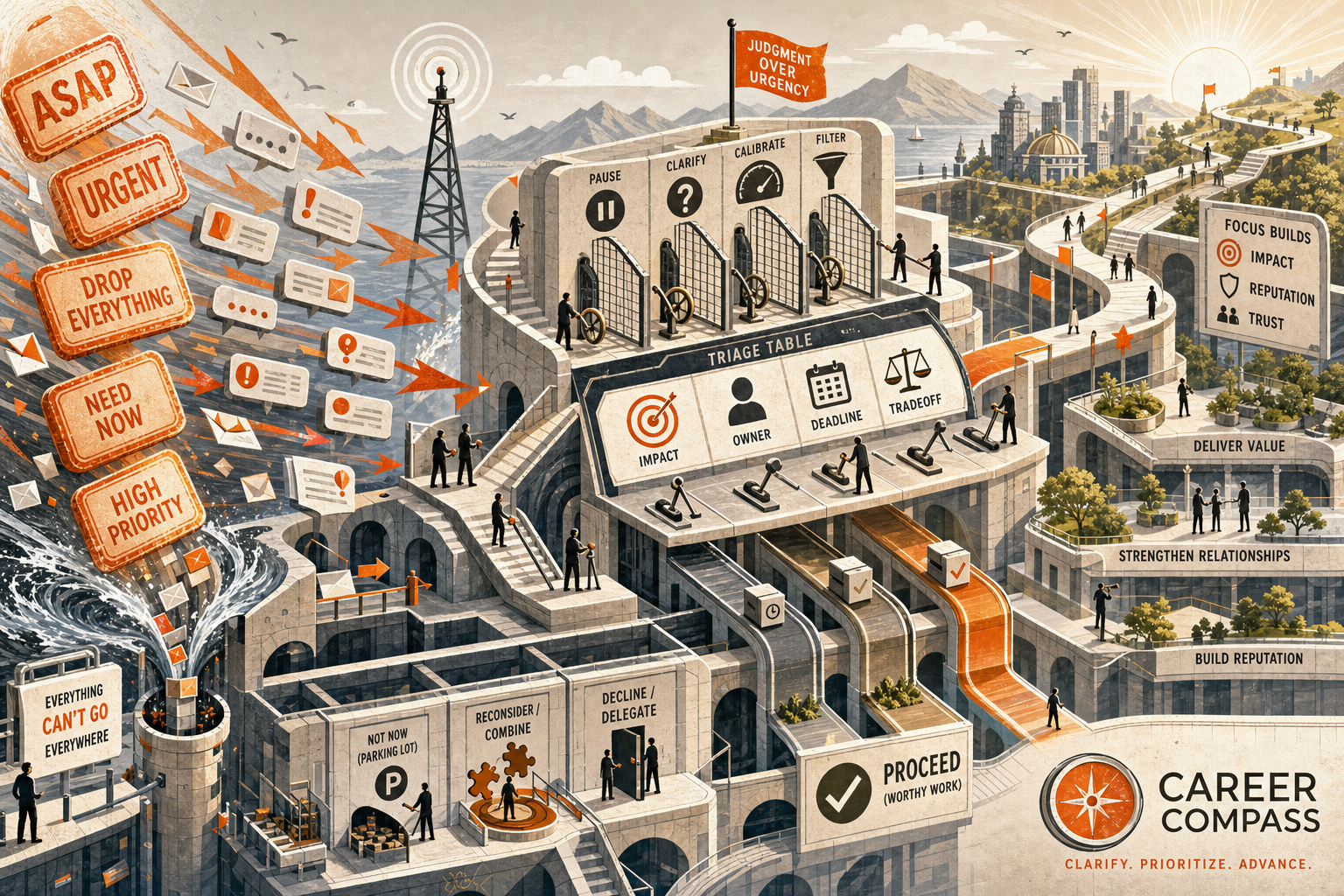
Escalation works best when it sounds like planning hygiene, not revenge.
By the time you escalate, you should already have the bones of the story in writing: dates, asks, slippages, impacts, proposed options. Then the message becomes simple.
Not:
“Jordan never follows through and this is becoming a big issue.”
Better:
“We needed approved copy Tuesday to complete QA. It’s now Thursday, and this is the third slip on this workstream in two weeks. At this point we need a decision on launch timing, reduced scope, or a different owner for approvals.”
That version is hard to argue with because it is anchored in reality, not irritation.
Managers can do something with decisions. They can do very little with injured vibes.
This is also why waiting too long does not make you kinder. It usually just makes the eventual conversation sloppier and more emotional. People tell themselves they are being generous by holding off. Often they are just letting a manageable problem ferment until it smells like resentment.
An early note says, “We have a coordination problem.”
A late rant says, “I have been silently collecting emotional receipts.”
Guess which one lands better in a 1:1.
Your move: draft the escalation you would send if the pattern happened one more time. You may never send it. But writing it will expose whether your record is clean or whether you are still relying on memory, mood, and vibes.
What to actually say when your brain goes blank
If your nervous system short-circuits in these moments, stop improvising. Use language that has already been tested.
To confirm a dependency
Just recapping: I need the revised slides by Wednesday at 4 p.m. to prep Thursday’s client review. If timing changes, I’ll need to either shorten the deck or move the rehearsal.
To surface a delay without accusation
We’re still pending legal review. That means we’re at risk of missing Friday’s publish date unless review wraps today or we reduce launch scope.
To force a decision
If we don’t have the final numbers by noon, I can either use last week’s data, remove that section, or shift the review. Which path do you want me to plan for?
To escalate cleanly
Flagging a delivery risk: the design handoff due Monday is still outstanding as of Wednesday morning, and my team can’t begin build without it. This is the second slip on this milestone. We need a call on timeline, scope, or resourcing.
To stop being the secret backup generator
I can help recover this once, but I want to flag that the current timeline assumes upstream inputs arrive on time. If they slip again, we’ll need to adjust scope or dates rather than compressing execution on our side.
Save these somewhere embarrassingly accessible. Your notes app. A text file called “work, unfortunately.” A sticky note if you must. The point is not eloquence. The point is having words available when stress makes you stupid.
The deeper skill here is protecting your reputation without becoming slimy
Some people hear “protect your work” and immediately imagine office politics in the most embarrassing sense: scorekeeping, finger-pointing, weird little territory wars.
That is not what this is.
This is operational honesty.
You are saying: - Here is the dependency. - Here is the commitment. - Here is the current status. - Here is the consequence. - Here is the decision now required.
That is not manipulative. It is mature.
And it compounds. People start trusting you not just because your output is good, but because you notice risk early, name it calmly, and stop ambiguity from swallowing the project whole. That is a leadership skill. It is also a sanity skill. There is a particular kind of relief that comes from walking into a 1:1 with a clean summary instead of a fog bank of frustration. You stop sounding defensive because you are no longer trying to reconstruct the truth from your own stress.
If this is hard for you, it does not mean you are weak or dramatic. It usually means nobody taught you the invisible half of work: expectation-setting, stakeholder management, escalation timing, and the discipline of not volunteering for other people’s chaos.
That is why this matters so much. The goal is not to become colder. The goal is to become clearer. You can be generous and still insist on reality. You can be collaborative and still refuse to let a missed handoff dissolve into team-wide amnesia. In fact, that clarity is often the most genuinely collaborative thing in the room, because it gives people something solid to react to instead of one more round of hopeful vagueness.
And if you need help building that muscle, that is exactly where Career Compass fits. It’s designed for the career skills that rarely show up in job descriptions but quietly determine whether your work gets seen accurately: communication, escalation judgment, stakeholder management, and the habits that keep small misses from turning into reputation damage. The point is not to become hyper-vigilant or robotic. It is to get better at catching these moments earlier, responding more calmly, and leaving a clean record when the pressure is still low.
So don’t let this article become one more thing you nod at and forget by Tuesday. Open your calendar. Find the project where you are currently carrying fuzzy dependency risk. Send the clarifying note. Force the choice. Make the work visible while there is still time for the team to act like adults. Over a career, that shift changes everything: you stop being the person who silently absorbs blast radius, and you become the person who makes risk legible before it lands on everyone’s desk — especially yours.