How to Handle Conflicting Instructions at Work

Your Boss Gave Conflicting Instructions. Don’t Guess. Force Clarity.
There is a special kind of workplace misery reserved for this moment: you did exactly what you were told, and now your boss is looking at you like you invented the wrong assignment from thin air.
It happens in fragments. Slack says, “Keep it high level.” A meeting becomes, “We need more detail.” Then a drive-by comment in the hallway: “This is still on for Thursday, right?” Now you’re not doing your job anymore. You’re running an archaeological dig through somebody else’s half-finished thoughts.
A lot of early-career people turn this into a private IQ test. If I were better at this, I’d know which instruction counted. That story is poison. Conflicting instructions are not a puzzle designed to reveal your hidden professional worth. They are an alignment failure. And alignment failures do not improve because one nervous employee decides to absorb the ambiguity quietly and hope for applause later.
The useful move is less glamorous: surface the contradiction fast, force a decision, and document what was actually decided while everyone can still remember it.
TL;DR
- “The priority changed” is annoying. “I got two incompatible instructions” is dangerous.
- The expensive mistake is silent interpretation: choosing a path and praying your logic gets retroactive approval.
- Strong managing up is not endless agreeableness. It is making tradeoffs visible.
- A short written recap is not bureaucratic. It is future-you refusing to be framed by revised memories.
- If this happens repeatedly, stop calling it miscommunication. It is a management pattern, and patterns require systems.
Stop treating contradiction like a personality test
Let’s separate two things people lazily lump together.
A real shift sounds like: “We were headed toward X. New information came in. We’re doing Y now.” Not fun, but at least reality has changed in a way everyone can point to.
A contradiction sounds like: “Get me a six-slide summary by Thursday, but include the full market analysis, legal backup, and a detailed implementation plan.” That is not one ask. That is four competing demands wearing one name tag.
When smart people hear that kind of nonsense, many make the same bad choice: they try to be low-friction. They don’t want to seem junior, rigid, confused, or needy. So they do the professional-looking version of panic. They nod, open their laptop, and start privately translating chaos into something executable.
That feels mature for about a day and a half.
Then comes the stomach-drop meeting: “Why would you go in that direction?” And suddenly all your invisible reasoning — the careful compromise, the late-night judgment call, the effort to be helpful — counts for nothing because nobody else agreed to the version you built.
Here’s the standard that will save you time and embarrassment: if two instructions cannot both be true in the final deliverable, your job is no longer “work harder.” Your job is “resolve the contradiction before the work gets expensive.”
Ask yourself this, bluntly: Can these instructions coexist in one output without wrecking timeline, quality, or scope? If the answer is no, stop building. Start clarifying.
The worst mistake is trying to be impressive
Early in your career, chaos can feel like an audition. You want to prove you can “handle ambiguity.” You want to be the person who doesn’t need hand-holding. You want your manager to think, Finally, someone who just gets it.
Reasonable impulse. Terrible strategy.
Because initiative without confirmation is just private gambling. You are betting your time, your credibility, and occasionally your entire evening on an assumption nobody else can see. If the gamble works, you get a bland “Looks good.” If it fails, you inherit the mess alone.
That trade is absurd, but people make it every week.
The trusted person in the room is not the one who plays office psychic. It’s the one who catches contradictions while they’re still cheap, names the tradeoff cleanly, and makes somebody choose. That is a more senior move than heroically burning six hours on a draft built from vibes and fragments.
Go look at one live project right now. Pull up the last five instructions you received on it — Slack, meeting notes, comments, voice memos, whatever weird breadcrumb trail your workplace uses. If they point in different directions, don’t wait for the next meeting to bless you with clarity. Send the note today.
Force the reset early, not elegantly
Most people delay because they want a perfect opening.
They tell themselves they need a little more context first. Or a draft. Or a smarter question. Or a less inconvenient time to “bother” their boss. Meanwhile, the contradiction sits there getting more expensive by the hour, like raw chicken left on the counter.
This does not require a beautifully choreographed conversation. It requires a clean interruption.
Name the mismatch. State the consequence. Ask which version is current.
That’s the whole move.
Here’s a line that works:
“I’m seeing two directions that lead to different outputs. Which one should I treat as current?”
Why does this line work? Because it doesn’t whine, accuse, or perform confusion. It keeps the spotlight on the work. It also quietly refuses to do the most dangerous thing in these situations: pretend there isn’t a decision to make.
If you want to be even more useful, bring options with tradeoffs attached:
- “If Thursday is fixed, I can do the shorter exec version.”
- “If you want the deeper analysis, I’ll need until early next week.”
- “If the audience is leadership, I’ll tighten the storyline and cut the appendix.”
- “If legal needs full documentation, this becomes longer and less polished.”
That is what managing up actually looks like. Not smiling through impossible combinations. Not saying “totally” to everything. Not taking the assignment home and letting your nervous system solve a scope conflict at 10:40 p.m.
Try This: the next time competing instructions show up, say the contradiction out loud within 24 hours. Not after the rough draft. Not after your resentment has matured into a personality disorder. Within 24 hours.
Yes, it feels socially dangerous
This is where people freeze, so let’s be honest about it.
There is a very specific bodily feeling that comes with telling someone more powerful than you, “Those directions don’t line up.” Your pulse jumps. Your face gets hot. You hear a primitive little voice saying, Do not create tension. Do not look difficult. Do not accidentally imply the boss is wrong.
That fear is real.
What is not real is the fantasy that staying quiet keeps you safe.
Silence just converts short-term awkwardness into long-term exposure. You can endure a tense 20-second clarification now, or you can endure the much worse meeting later — the one where the wrong deliverable is on screen, the air feels thin, and your boss says, “I thought we were aligned,” as if alignment were a weather pattern no one controls.
One version is mildly uncomfortable. The other one follows you home, ruins your evening, and reappears in the shower the next morning with better dialogue.
So reframe the act. You are not confessing confusion. You are reducing execution risk. You are not being precious. You are protecting time, quality, and everyone’s sanity. Those are not junior instincts. Those are the behaviors of people who get trusted with larger, messier problems.
The move this week is simple: practice one neutral sentence until it comes out of your mouth without emotional static. Borrow one from this article if you want. The point is to stop improvising while stressed.
Match your response to the setting
The principle stays the same. The delivery should not.
If your boss is speed-walking to another meeting, do not trap them in a TED Talk about alignment norms. Use one sentence: “Quick check — Slack said short exec version, but in the meeting we added detailed analysis for Thursday. Which should I optimize for?” Fast, dry, answerable.
If other people are in the room, resist the urge to build a legal case. Publicly cornering your boss may feel righteous in your imagination, but in real life it usually becomes a status contest. Your goal is clarification, not a victory lap. Keep the tone almost boring.
If the contradiction is scattered across channels — Slack, comments, meeting chatter, a post-lunch hallway remark — assume memory is already compromised. Modern work is full of half-decisions sprayed across software. That means “I’m pretty sure you said…” is weak. “To confirm the current direction…” is stronger, cleaner, and much harder to wriggle away from.
And when you get the classic “just use your best judgment,” pause before taking that as a compliment. Sometimes it is real trust. Sometimes it is managerial fog in a nice suit — a way of transferring political risk to you while preserving deniability.
Ask yourself: When they say “use your judgment,” are they giving me authority, or dodging a decision? Your answer should determine whether you proceed or push once more for an actual call.
Pick one situation from the past month and replay it. Where did the contradiction appear? What shorter, cleaner question would have forced clarity sooner?
The written recap is not petty. It is armor.
The verbal clarification solves the immediate problem. The written recap protects you from the sequel.
Because without a recap, Friday arrives and suddenly everyone’s memory has been rewritten by stress, ego, and the passage of 72 hours. The human brain is a spectacularly unreliable storage device, especially in organizations.
This note does not need to sound stiff or prosecutorial. If it reads like evidence assembled for a future tribunal, people will resent it. Keep it short and useful.
Capture five things: 1. What the current direction is 2. What changed 3. What is explicitly not happening yet 4. Who owns the next step 5. When you’ll check in again
That can fit in three sentences.
For example:
“Recapping so we’re aligned: we’re prioritizing the six-slide exec deck for Thursday and holding the detailed appendix until next week. I’ll send a draft Wednesday afternoon, and we can decide then whether legal needs a separate backup doc.”
That note does two excellent things. It creates a shared reference point. And it gives people one final chance to object while objections are still cheap.
I learned this the annoying way. In several roles, the technical work was not the thing wrecking projects. Drift wrecked them. Half-decisions wrecked them. Vague conversations that felt productive in the room and became useless by tomorrow wrecked them. Once I got disciplined about recaps, the volume of “Wait, I thought…” dropped fast.
Send one after your next messy conversation. Not because you’re defensive. Because your future calendar deserves a little mercy.
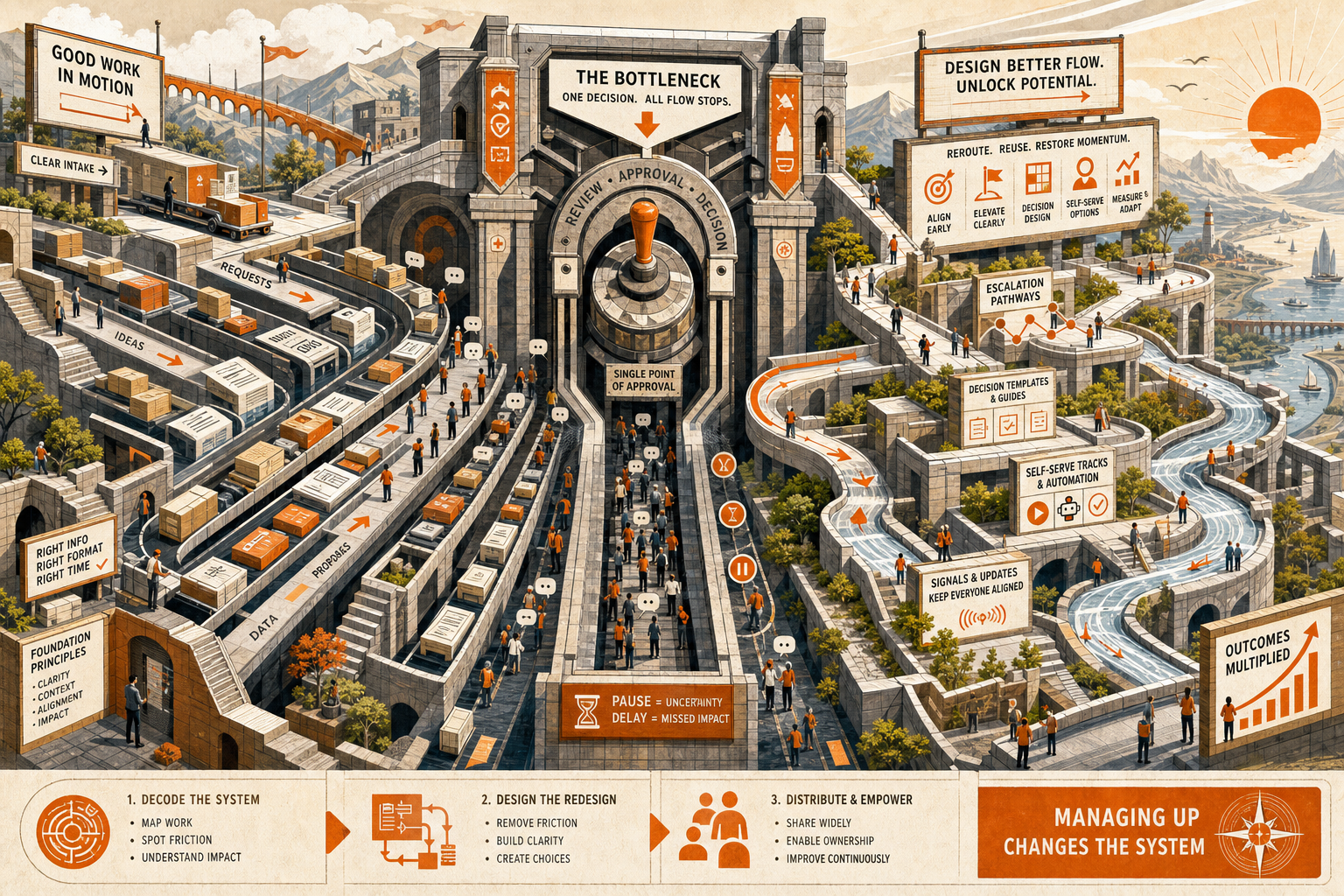
If it keeps happening, you do not have a misunderstanding. You have a system problem.
One scattered week? Normal.
A boss who occasionally contradicts themselves because they are overloaded, distracted, or operating on four hours of sleep and two iced coffees? Also normal.
But when this becomes a pattern — same person, same confusion, same rework — stop treating it like random static. It is not random. It is an operating pattern, and you are probably the one paying for it.
This is where conscientious people get trapped. They become human shock absorbers. They translate the chaos. They smooth over reversals. They absorb the last-minute changes. They do damage control so well that the team appears functional from the outside.
Everyone praises them for being “flexible.”
Meanwhile, they are fried. Their evenings are gone. Their confidence erodes because they keep confusing survival with competence. And their actual development stalls, because instead of getting sharper at strategy, craft, or judgment, they’re spending all their energy cleaning up somebody else’s decision clutter.
That is not resilience. That is unpaid emotional and operational labor dressed up as professionalism.
So build structure.
Use your 1:1 to review live priorities in plain language. Start a lightweight decision log for projects with multiple stakeholders. Track reversals that create rework. Then name the impact without dramatics: “We’ve changed direction three times on this deliverable, and it’s affecting timing and quality.”
That is not complaining. That is operational reporting.
Your Move: open a note called “Current Decisions” for one messy project. Date every update. Keep each entry to three bullets: what we decided, what that means, what’s off the table for now. You will thank yourself within a week.
Know when clarification becomes escalation
Not every conflicting instruction deserves a grand escalation. Some really do just need a clean reset and a recap.
But once the pattern starts hitting deadlines, client trust, team credibility, or repeated wasted work, the issue is no longer your personal frustration. The issue is delivery risk.
That’s the threshold.
Escalation is not tattling. It is naming the process failure to the person accountable for outcomes. The language matters. Stay out of personality critique. Nobody needs your amateur diagnosis of who is disorganized, avoidant, or addicted to chaos.
Keep it work-shaped:
- “We’re losing time to late direction changes, and it’s affecting what we can ship.”
- “I want to flag a recurring alignment issue that’s causing rework on this project.”
- “We need a clearer approval path because the current setup is producing conflicting direction.”
Notice the discipline there. No melodrama. No score-settling. Just consequences and process.
If you’re unsure whether you’re there yet, sit with this question: Is this merely annoying, or is it materially degrading output? Annoyance is part of having a job. Output is the line.
The reputation you want is not “easy.” It is “trustworthy.”
A lot of people spend the first part of their careers trying to be pleasant enough that nobody can fault them.
That sounds nice. It also creates a lot of quiet misery.
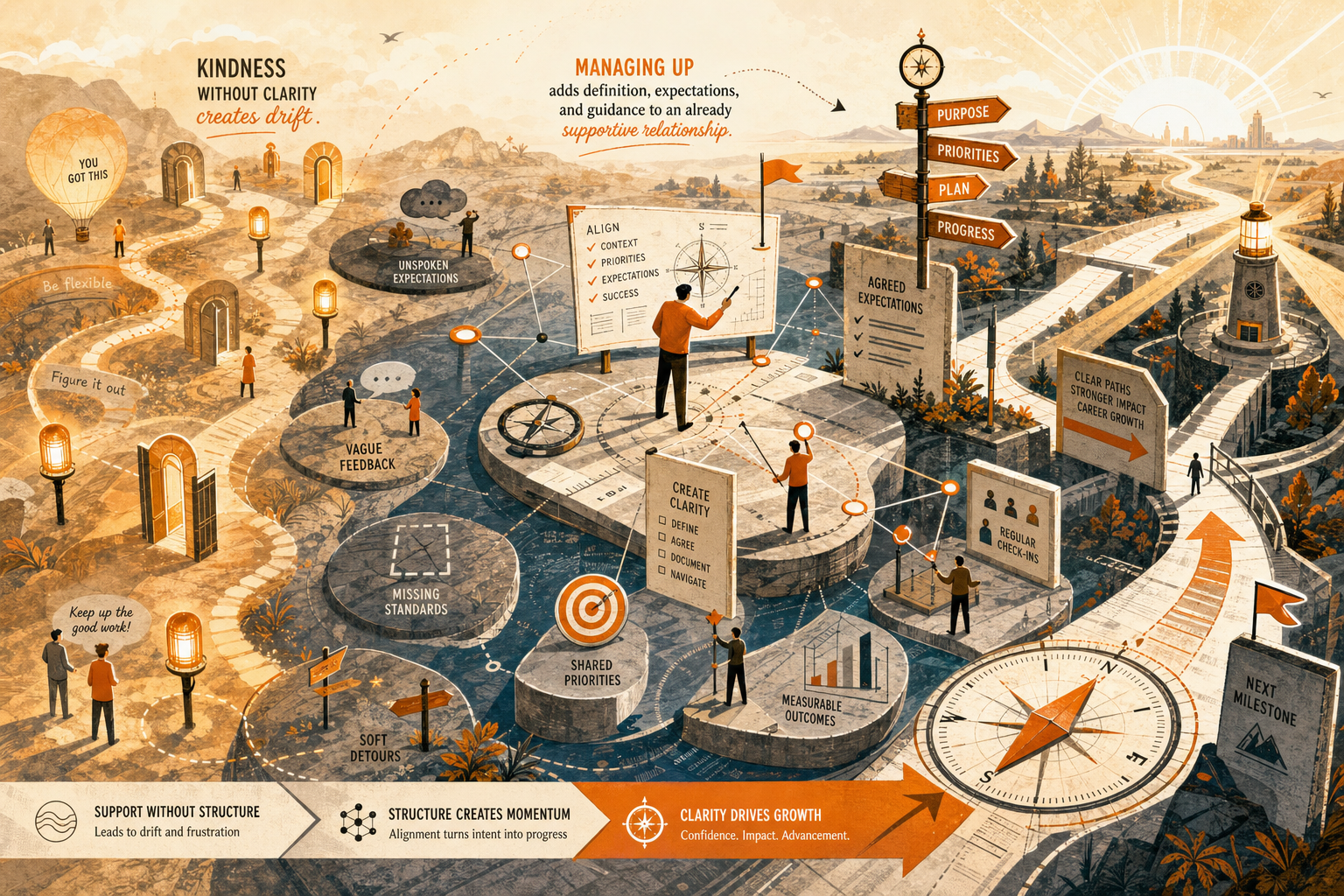
Because “easy to work with” too often becomes code for “willing to absorb confusion without making it anyone else’s problem.” And while that may buy you temporary approval, it does not buy you trust. Trust comes from making fuzzy work clearer. From surfacing tradeoffs before they explode. From being the person who can leave a meeting with an actual decision instead of a fog bank and a follow-up panic.
That kind of clarity changes your emotional life at work too. There is a huge difference between ending the day with the dull dread of I hope I guessed right and ending with the solid relief of we made the call, I wrote it down, and if it changes, everyone will know it changed. One of those feelings follows you into Sunday night. The other lets you shut your laptop and rejoin your life.
So the next time your boss gives you two incompatible directions, do not treat it like an invitation to prove how intuitive, loyal, or endlessly accommodating you are. Treat it like what it is: a decision that has not been made yet. Your job is to bring that fact into the open.
And if this is a recurring pattern in your work life, that is exactly where Career Compass can help. Not by feeding you generic confidence slogans, but by helping you track the patterns underneath the stress — where confusion keeps showing up, which relationships create unnecessary friction, which projects drain you, and where your judgment is actually getting stronger. When you can see the pattern, you stop making every bad week mean something existential about your ability.
The deeper mindset shift is this: professionalism is not guessing correctly under pressure. It is refusing to build expensive work on unspoken contradictions. Force clarity early. Name the tradeoff. Document the decision. The point is not to become harder. It is to become steadier — someone who does not let other people’s fuzziness turn into private chaos.
That shift matters more than one deck, one deadline, or one annoying manager. It is the difference between building a career around anxious interpretation and building one around visible judgment. And visible judgment is what people actually trust.