Imposter Syndrome at Work: Diagnose the Real Gap
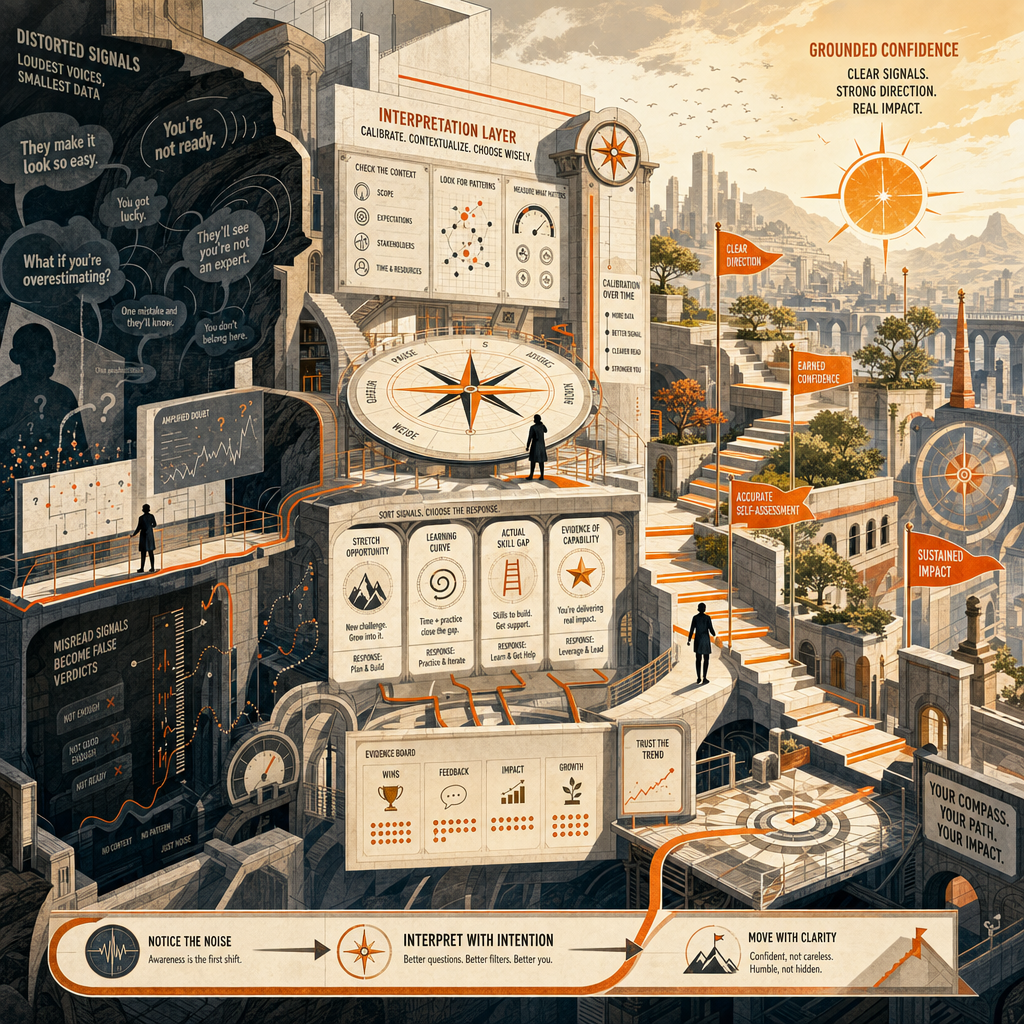
Imposter Syndrome at Work Is Information. Stop Treating It Like a Sentence.
Somewhere between the Sunday-night stomach drop and the Tuesday afternoon Slack message you reread six times before replying, a very convincing lie shows up:
If I feel inadequate, I probably am.
It sounds responsible. Mature, even. You missed a detail in a meeting. Your manager gave feedback that was technically words but not meaning. A coworker explained something you thought you were supposed to know already, and now your face is hot, your chest is tight, and suddenly your whole career feels like an administrative error.
The feeling is real.
The conclusion usually is not.
What many people call imposter syndrome at work is often a sloppier pile of things: unclear expectations, thin onboarding, comparison brain, a real skill gap in one area, and a nervous system that has decided uncertainty is basically a bear attack. Your brain takes every unknown, stamps it evidence against me, and calls that discernment.
It is not discernment. It is panic with a spreadsheet.
If you keep translating every wobble into “I’m not good enough,” you start behaving like someone who needs permission to occupy their own job. You hedge. You overexplain. You apologize for drafts that are perfectly fine. You stay quiet in meetings and then deliver a dazzling monologue to your shampoo bottle twelve hours later.
So let’s stop being poetic about it and get useful.
TL;DR
- Imposter syndrome at work is usually not a verdict on your worth. It is a signal that something in the picture is unclear, underdeveloped, or unsupported.
- The better question is not “Am I failing?” It is “What kind of gap am I dealing with: confidence, skill, context, or support?”
- If you misdiagnose the gap, you choose the wrong fix. You cannot affirm your way out of bad onboarding.
- Work confidence is less a mood than a record: clear standards, visible contributions, tighter feedback loops, and actual proof that you are helping.
- You do not need to perform certainty. You need to be specific, prepared, and useful.
Most imposter syndrome starts in the fog, not in the truth
People talk about imposter syndrome like it is a secret finally breaking through the floorboards. Deep down, I know I tricked them. The real me has been discovered. It’s over.
Usually, no.
Usually you are just in the fog.
New role. New scope. New boss. New industry language that makes every meeting sound like people are communicating through airport codes. You got promoted and, for three thrilling hours, it felt validating. Then the work changed shape, the easy competence disappeared, and your brain started making horror films out of normal ambiguity.
This is why capable people often feel most fraudulent right after they level up. The old signals of competence are gone. You are slower than you used to be. You need more clarification. Tasks that once took 20 minutes now take 90, and not because you got worse, but because the terrain changed.
That waiting period has a particular emotional texture. It is not dramatic despair. It is a constant low-grade agitation. A sense that everyone else got the invisible memo. The embarrassment of needing to ask what the deliverable is again. The exhausting little performance of trying to look composed while internally thinking, I truly do not know what counts as good here.
That last sentence matters.
Because discomfort in a new environment is not evidence against your ability. It is often evidence that you are missing information. Sometimes you are learning. Sometimes the role is badly scoped. Sometimes your manager thinks “figure it out” is leadership. Those are not the same problem, and your self-esteem should not have to absorb all of them.
When the spiral starts, open a note and divide the page into three columns: - what I know - what I’m assuming - what no one has actually made clear
Do that before your brain gets to write its usual melodramatic script. You need data before interpretation.
Stop asking “Am I bad at this?” Ask “What gap is this?”
“I’m not good enough” has a huge advantage as a thought: it explains everything instantly.
It is also intellectually lazy.
Most work anxiety gets flattened into one big emotional blob when it is actually one of four very different problems. And if you do not separate them, you will prescribe nonsense to yourself. You will give a pep talk to a context problem. You will buy a course when what you need is one competent conversation. You will meditate at a support failure and call that growth.
Name the gap properly.
1. The confidence gap
This is when your actual performance is decent or better, but your internal narration behaves like a hostile witness. You keep treating effort as proof of inadequacy. You assume everyone else is more certain than they are. You confuse visibility with danger.
This gap shows up most aggressively when other people can see your thinking: presenting, writing recommendations, speaking before the senior person has spoken, sending work that might be critiqued in writing. The fear is not just “what if I’m wrong?” It is “what if being wrong exposes something humiliating about me?”
If that’s the pattern, stop trying to pump yourself up with inspirational garbage. Pull proof instead.
Make a short file called “evidence.” Put three things in it by the end of the day: - a problem you caught early - a piece of work you improved - a moment someone relied on your judgment
Not compliments. Not “great job!” from Slack. Actual events.
Confidence that rests on receipts survives a bad Tuesday much better than confidence built from slogans.
2. The skill gap
Sometimes the answer is less emotional and more annoying: you do, in fact, need reps.
Your writing may be vague. Your spreadsheet skills may be weak. You may be facilitating meetings before you know how to run one. You may be expected to synthesize instead of summarize, and those are not the same thing no matter how many people use the words interchangeably.
This is not a moral indictment. It is a training issue.
A lot of people prefer the story of imposter syndrome because it sounds psychologically sophisticated. “I’m struggling because I secretly doubt myself” is, frankly, more flattering than “I need to get better at Excel.” But one of those stories helps you improve, and the other helps you stay interesting at brunch.
Pick one skill that keeps creating friction. Just one. Then force it into a practice loop that touches real work. One output a week. One person who can tell you what good looks like. One specific thing to improve next time. Not a grand reinvention. A loop.
Choose the skill that would make next month less miserable, not the one that would make your LinkedIn headline more glamorous.
3. The context gap
This one wrecks people because it feels like personal incompetence when it is really missing criteria.
You do not know how polished the deck needs to be. You do not know whether the audience wants options or a recommendation. You do not know if speed matters more than detail. You do not know whether your manager loves initiative or just says they do before punishing it.
So every assignment feels like taking a test where they forgot to print the questions.
Of course you feel shaky.
If this keeps happening, stop trying to “be more confident” and start asking setup questions that make ambiguity smaller. Before you begin, ask: - Who is this for? - What decision is this supposed to support? - What would make this strong? - Where can this be rough? - What matters most here: speed, accuracy, depth, or buy-in?
These questions do not make you look needy. They make you look like someone who understands that work has a purpose beyond generating files.
Send them before your next project kickoff. Better to feel briefly exposed asking than quietly deranged for six hours afterward.
4. The support gap
This one gets internalized most brutally, especially by people who were rewarded their whole lives for being “so independent.”
You are waiting days for answers. You are left out of decisions that affect your work. Feedback arrives too late to use. Priorities keep changing. Nobody onboarded you in any serious way, yet everyone seems surprised that you are operating on guesswork and caffeine.
Then you tell yourself that stronger employees would need less help.
Absolutely not.
A healthier system would provide more support, sooner, with fewer mystery rituals attached.
Support gaps trigger shame because they force need into the open. And if your whole identity is wrapped around being competent, easy, low-maintenance, and “quick to pick things up,” asking for structure can feel weirdly humiliating. Do it anyway.
Name the missing support in operational terms. Do you need: - faster response times - examples of strong work - more frequent calibration - access to the right decision-maker - clarity on priorities
Then ask one person for one upgrade. “Could we use our Monday 1:1 to align on top priorities so I’m not making avoidable guesses?” works much better than “I’m feeling a little lost.”
Vagueness creates sympathy. Specificity creates change.
Mislabel the problem, and you start shrinking in public
This is the expensive part.
Imposter syndrome is not just uncomfortable. It changes how you show up. And usually not in charming ways.
You become tentative. You explain the explanation. You send things late because you keep buffing them until they lose all oxygen. You ask for permission when a recommendation was required. You pre-apologize so often that people start wondering what catastrophe is coming.
From the outside, that can read as weak judgment or low ownership. In other words, the fear begins producing the exact signals you were trying to avoid.
That is why precision matters. If it is a skill gap, practice. If it is a context gap, get criteria. If it is a support gap, ask for structure. If it is a confidence gap, gather proof and keep moving before your feelings form a union.
Sit with this question for a minute:
What am I currently blaming on my personality that would make more sense as a problem of information, training, or environment?
Write down the answer without trying to sound noble. Irritation is allowed. In fact, irritation is often progress. It means you are finally locating the real friction instead of turning yourself into the villain.
Confidence at work is not a vibe. It is a paper trail.
Your brain is a terrible archivist.
It stores your awkward comment from April 14 in museum-quality preservation and tosses your competent work into a damp cardboard box labeled “miscellaneous.” Then, during a rough week, it strolls through the exhibit and says, “As you can see, the evidence is overwhelming.”
So build a better archive on purpose.
Keep a weekly record with four headings: - finished - solved - praised - improved
That’s it. Five minutes on Friday. Boring enough to work.
You are not doing this because journaling is magical. You are doing it because when review season arrives, or when one weird meeting makes you feel professionally doomed, you will need something sturdier than memory.
Your feedback questions also need to get sharper. “How am I doing?” is an invitation to receive vague reassurance from a busy person. Ask narrower questions: - “Was the recommendation clear enough for this audience?” - “What would have made this more useful?” - “Should I go deeper next time, or was this the right level?” - “What would have made this a stronger first draft?”
Specific questions produce usable answers. Usable answers calm the nervous system because they replace abstract dread with something you can adjust on Wednesday.
Try This
Before your next assignment, send:
Before I get too far, can I confirm the bar here? Who is the audience, what decision should this support, and what would make this strong rather than just acceptable?
That single message can save you hours of anxious, unnecessary overwork.
Visibility helps, but only when it is attached to something real
A lot of insecure people respond by disappearing.
They tell themselves they will surface when the work is airtight, the thinking is polished, the wording is impeccable, and nobody could possibly criticize a thing. This is a fantasy, but an understandable one. Hiding feels protective. Secrecy gives you the illusion that your competence can remain untested and therefore intact.
Unfortunately, careers are not built on secret excellence.
People need to see your work taking shape. They need updates before they need to chase you. They need recommendations, not just piles of disconnected observations. Visibility is useful when it reduces uncertainty for other people.
That is the standard.
Not “be louder.” Not “personal brand harder.” Not “speak up in every meeting so everyone knows you exist.”
Be useful in public.
Send the recap after the meeting. Share the draft early enough for course correction. Tell your manager where a project stands before they have to ask. Offer your current read instead of forwarding a swamp of thoughts and calling it collaboration.
If your instinct under pressure is to go silent until everything is perfect, reverse the instinct in one small way today. Send one concise progress update. Three sentences is enough.
Please stop trying to sound confident
This is where so much workplace advice turns into bad theater.
You are told to “be more confident,” which is almost impressively unhelpful. Or you are encouraged to fake certainty until it becomes natural, as if the professional ideal is simply speaking in a firmer tone while privately dissociating.
That approach creates a very recognizable type of employee: polished wording, shaky thinking, lots of executive-sounding filler, very little substance.
You do not need swagger.
You do not need to cosplay certainty like a management consultant in a cologne ad.
You need to say what you know, what you think, what you are unsure about, and what happens next.
That sounds like this: - “My recommendation is Option B because it solves the timing issue. I’d want finance to pressure-test the cost assumption.” - “I’m confident in the analysis. I’d like calibration on whether this is the right level for the audience.” - “I see two reasonable paths. My current lean is X for speed unless stakeholder buy-in is the bigger concern.”
That is grounded confidence. Not loud. Not slick. Just clear enough that other people can work with you.
Pay attention to your padding phrases this week. Cut one hedge per day. Replace “This might be a stupid question” with the question. Replace “Just my thoughts” with the thought. Replace “I’m not sure, but…” with “My read is…”
Say the thing before your anxiety decorates it.
What professionalism actually looks like when you’re still learning
A lot of people secretly imagine professionalism as emotional stainless steel. Never rattled. Never confused. Perfectly calibrated facial expressions. No follow-up questions. Crisp outfit, dead eyes, immaculate notes.
Bleak.
Real professionalism is much more alive than that. It is the ability to stay functional while still learning in public.
It is asking one sharp question instead of five panicked ones. It is coming to a 1:1 with a point of view, not just a weather report on your stress. It is updating your thinking when new information appears without turning correction into a personal tragedy. It is being coachable without becoming spineless.
Especially early in your career, professionalism often looks almost boring. Prepared. Specific. Reliable. You can explain your reasoning. You can make a recommendation. You can hear “this needs work” without internally entering a Victorian fainting scene.
That last ability matters more than most people realize.
For many people, imposter syndrome is not actually fear of work. It is fear of identity injury. Feedback does not land as information. It lands as exposure. Like someone has reached into your chest, grabbed your self-concept, and started taking notes in red pen.
So simplify the next feedback conversation. Write down only: - what was said - what changes - what you’ll do next
No extra narration. No side plot about whether this means you are a fraud. Facts first. Your feelings can have a meeting later.
Relief tends to arrive through specificity, not self-esteem speeches.
When the problem is the system, not your psyche
Not all insecurity is irrational. Some workplaces genuinely make people worse.
Some managers are chronically unclear and then weirdly disappointed when confusion follows. Some teams reward mind-reading and punish clarification. Some cultures treat urgency as a personality trait and chaos as proof that important things are happening.
If your confidence reliably collapses in one environment, that is worth noticing. A bad system can make a solid employee feel incompetent on a daily basis.
That does not mean you are helpless. It means your strategy needs more than mindset. You need scaffolding.
Build repeatable supports: - a kickoff checklist for every assignment - a weekly wins log - a standing calibration meeting - two trusted people who can give fast reality checks - a personal rubric for what a good week looks like, so one messy afternoon does not get to define the whole thing
And if you need more than your memory and good intentions to hold that structure together, use a system that helps you see what is actually happening. Career Compass is useful here not because it hands out decorative affirmations, but because it gives shape to the blurry stuff: your wins, your stress patterns, your satisfaction, your energy, your progress, the actual signals of whether work is stretching you or just grinding you down. Sometimes what breaks the spiral is not a better mantra. It is seeing your career with enough clarity that your feelings stop acting like the sole source of truth.
The next spiral does not deserve the final word
The next time you leave a meeting feeling stupid, or get a vague message from your manager, or watch a coworker answer in 12 seconds what would have taken you two minutes and a recovery walk, try not to hand the microphone to your worst interpretation.
Pause.
Ask: what gap is this? What information is missing? What proof already exists that I am conveniently forgetting? Who can clarify the standard? What is one move I can make before the end of today?
Then make the move. Send the question. Ask for the example. Book the 15 minutes. Log the win. Practice the skill. Name the support you need out loud instead of hoping someone magically notices and supplies it.
That is the mindset shift: your insecurity is not automatically insight. It is a signal that needs sorting. Sometimes it points to growth. Sometimes it points to bad management. Sometimes it points to a skill you can absolutely build. But it is not a court ruling, and it does not get to sentence you.
The goal is not to become the kind of person who never doubts themselves. That person either does not exist or is unbearable in meetings. The goal is to become someone who can feel the wobble, diagnose it accurately, and respond with something more intelligent than self-condemnation. That is what steadiness at work actually looks like.
And if you want help building that steadiness, Career Compass can be part of the structure, not just the pep talk. A better career is rarely built by winning one dramatic battle against self-doubt. It is built by noticing what is true, tracking what is changing, and refusing to let one bad moment become your whole professional identity.