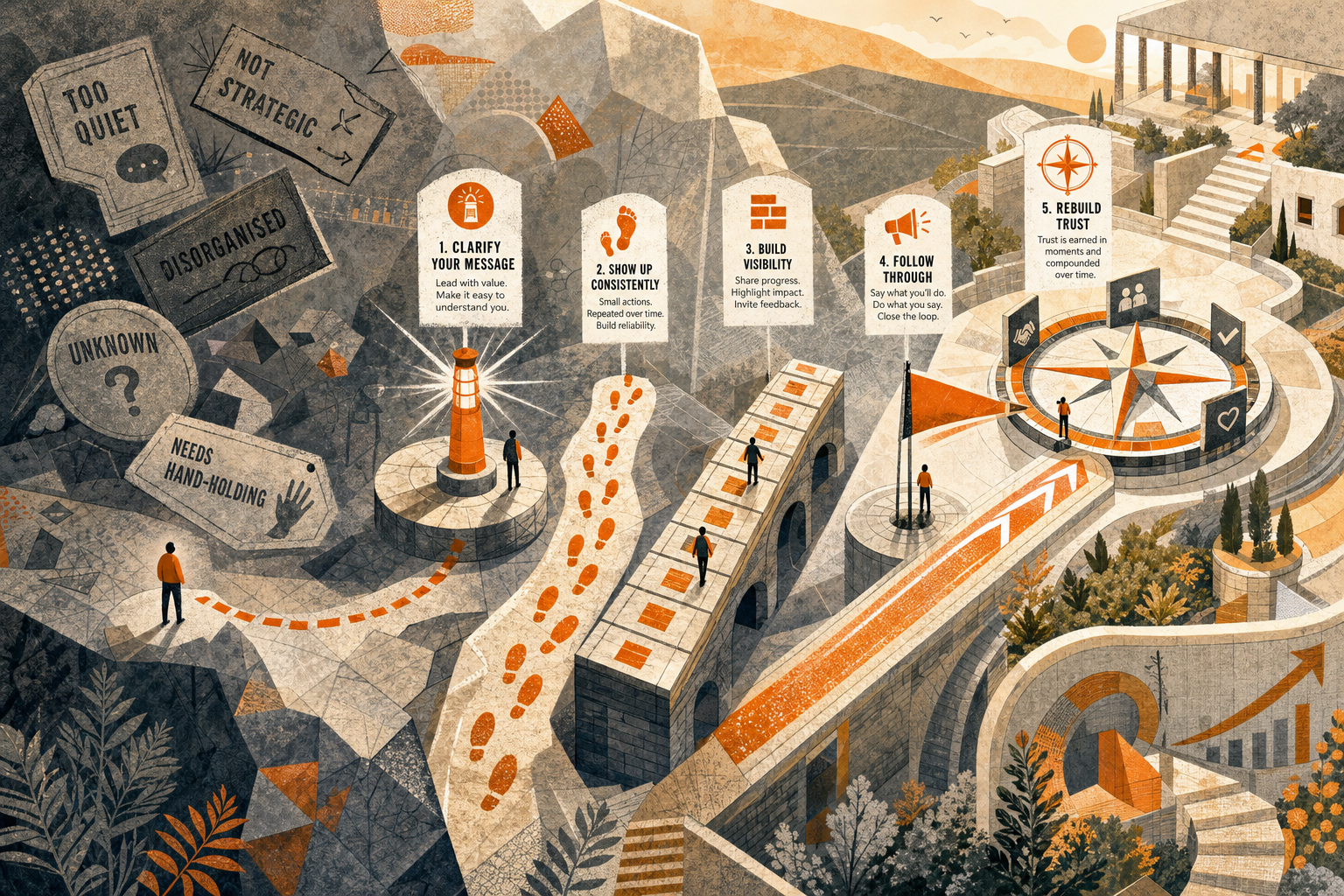
Promoted Over Peers? Build Trust With Clarity

You Got Promoted Over Peers. Don’t Pretend Nothing Changed
The fastest way to lose credibility after getting promoted over former teammates is to perform a weird little theater piece where you insist nothing is different.
It is different.
You still have the same face, the same laugh, the same annoying habit of overusing thumbs-up in Slack. But now you also control priorities, visibility, feedback, and sometimes access to information people badly want. That changes the emotional physics of the room whether anyone says it out loud or not.
New managers hate this. So they reach for the worst possible coping strategy: they overcompensate with friendliness. They soften every decision until it sounds optional. They keep old side friendships humming in the background. They talk like a peer when it’s convenient and like a manager when the stakes show up. Then they wonder why the team feels jumpy, suspicious, or oddly cold.
Being liked and being trusted are not the same currency. After a peer promotion, trust matters more.
If you’re in that transition now, you probably feel some combination of pride, guilt, loneliness, defensiveness, and a very specific Sunday-night dread. You’re replaying harmless messages in your head like evidence in a trial. You’re trying to sound clear without sounding power-drunk. You miss the old ease, even if you wanted the promotion.
All of that is normal. What will hurt you is pretending the cure is to “stay chill.”
It isn’t. The cure is clarity.
In Short
- A promotion over peers is a relationship change, not just a title change.
- Your first job is not to soothe everyone. It’s to make the new rules visible.
- Fairness will be judged more closely than charisma.
- Former peers often “test” a new manager because expectations are fuzzy, not because they’re villains.
- If the team feels tense, don’t add more warmth. Add more legibility.
Name the Awkwardness Instead of Making Everyone Perform Around It
A peer promotion creates a strange social fog. Everybody can feel it, but half the team tries to act like they can’t. That fog is expensive. It makes people overread tone, invent motives, and waste mental energy on questions they shouldn’t have to ask.
Yesterday, you were another person in the meeting tossing out ideas. Today, your opinion lands differently because it can become a decision. You may know things you can’t share yet. You may decide who gets staffed on what. You may give feedback to people who used to complain alongside you in the hallway after bad meetings. Of course it feels weird.
So stop making people carry the burden of pretending it isn’t.
Say the obvious thing. In plain English. Something like: “I know this shift can feel awkward. The relationships haven’t disappeared, but the role has changed, and I want to be clear about how I’m going to handle decisions, communication, and fairness.”
That sentence does not solve everything. It does something better: it removes the fake air freshener. People can stop smiling through the discomfort and start orienting themselves to reality.
A useful question before your next team meeting: where are people currently forced to guess what changed? Write down three answers. That list is your first management agenda.
Stop Trying to Look Like a Leader. Build Rules People Can Actually Use
A lot of first-time managers crave a moment. A speech. A tough call. A dramatic display of authority that proves they belong in the seat.
Usually that urge is insecurity in a blazer.
Your team does not need a “leadership moment.” They need an operating manual. Not a giant one. Just enough structure that people can stop using rumor, access, and tone analysis to understand how work happens now.
That means getting painfully specific about questions like:
- What can people decide without you?
- What needs your sign-off?
- What belongs in a one-on-one versus a team meeting?
- How will priorities shift when something urgent lands?
- What does “keep me posted” actually mean?
If you don’t answer those questions, people will answer them for themselves. That is how politics sneaks in wearing business-casual clothes.
Try language with some bones in it:
- “If it affects only your project timeline, you own the call. If it changes cross-team commitments, bring me options first.”
- “Use our one-on-one for priorities, blockers, feedback, and growth—not surprise status theater.”
- “If I redirect work, I’ll explain the tradeoff, not just hand down the instruction.”
- “I won’t always be able to share everything immediately, but I won’t leave silence where context belongs.”
Yes, this can feel a little formal if your old team ran on shorthand, jokes, and psychic guessing. Too bad. Vibes are wonderful for after-work tacos. They are a terrible management system.
Pick one mushy area this week—approvals, deadlines, escalation, ownership—and write the rule down. Then say it out loud where everyone can hear it.
Fairness Is the Real Interview
Most new managers think the team is asking, “Can they do the job?”
That’s not the sharpest question in the room.
The real question is, “Will this now become a place where access matters more than fairness?”
That’s what people are scanning for. Not because they’re petty. Because unfairness makes work feel unsafe. Once people suspect there’s an inner circle, they stop giving clean attention to the work and start running background surveillance on the social order. Morale gets brittle. Every small decision starts dragging around extra emotional weight.
And favoritism is rarely a dramatic scandal. It’s usually subtle, deniable, and corrosive.
It looks like one former friend getting the unfiltered version in DMs while everyone else gets the sanitized announcement. It looks like more patience for one person’s mistakes because “that’s just how they are.” It looks like a plum assignment appearing from a conversation nobody else knew happened. It looks like “you know how I think” said to one person and never to the rest.
The fix is not to become icy. The fix is to make your judgment visible.
Explain criteria. Summarize decisions in writing. Use the same quality bar across people, especially when it would be more socially comfortable not to. If someone gets a stretch project, say why. If a priority changes, say what changed. If you had an important verbal conversation, follow it with notes so no one is left reconstructing reality from scraps of memory and tone.
Your Move: audit your access habits like a prosecutor, not a poet. Who hears things first? Who gets the longer answer? Who gets your grace when they miss? If the pattern embarrasses you a little, good. You found the leak before it became culture.
Friendship Is No Longer a Management Strategy
This is the part people resist because it feels mean.
It’s not mean. It’s grown-up.
You cannot use friendship to carry responsibilities that structure should be carrying. If your main instinct is to preserve emotional comfort at all costs, you’ll create the exact environment you’re trying to avoid: one where people leave interactions feeling vaguely uneasy because they cannot tell whether they were just supported, managed, warned, or gently manipulated.
That ambiguity is exhausting.
You don’t need to become a robot with a calendar fetish. You can still be warm. You can still be funny. You can still ask about someone’s sick kid or terrible landlord or weekend plans. But your friendliness can no longer be the thing people rely on to understand where they stand.
Here’s a useful gut-check: if one of your former teammates described your management style to someone else, would they say, “clear and fair,” or “really nice, but kind of hard to read”? That second one sounds flattering. It is not. “Hard to read” is where resentment grows mold.
In your next one-on-one, reset the purpose in one sentence: “I want these meetings to be useful, so we’re going to use them for priorities, blockers, feedback, and development.” Then hold the line when the conversation tries to slide into gossip, reassurance fishing, or endless mood maintenance.
The move this week is to notice where you’re using charm to avoid clarity. Replace one soft, blurry sentence with a clean one.
When a Former Peer Starts Pushing Back
This is where the promotion can feel personal in a way few career transitions do.
A former teammate gets sharper with you in meetings. They challenge decisions with a little more heat than the topic requires. They smile, nod, and then reopen the issue in side conversations afterward like a raccoon getting back into the trash. You feel the sting instantly because this isn’t just disagreement. It’s old familiarity colliding with new authority.
Sometimes they are angry they didn’t get the role. Sometimes they’re disappointed, embarrassed, or testing where the boundary now lives. Sometimes they are responding to your own inconsistency. If you’ve been fuzzy about when you’re speaking as a manager versus when you’re just thinking out loud, you helped build the confusion.
So before you diagnose attitude, inspect the system.
Is ownership explicit? Are deadlines concrete? Do people know what disagreement should look like on your team? Have you said, clearly, which decisions are up for debate and when the debate ends? If not, then people are self-governing inside a rulebook that exists only in your head, which is a terrible place to run a team from.
When you address the behavior, keep it observable and work-focused. Not: “I feel undermined.” Even if you do. Try this: “I’ve noticed we’re reopening decisions after meetings, and it’s slowing execution. I want disagreement before the call is made. After we decide, I need alignment in how we move.”
That gives the other person a real chance to adjust without making the conversation about your wounded pride.
Then watch the response. If the behavior changes, you were dealing with transition friction. If it doesn’t, congratulations: you now have an actual performance issue instead of a foggy emotional weather pattern.
Pick one tense relationship and write down the observable behaviors—not your interpretation, not your annoyance, just the behaviors. That prep will make your next conversation ten times calmer.
Boundaries Are Not Betrayal
New managers are often secretly scared that boundaries will make them seem fake, arrogant, or disloyal to the people they used to sit beside.
What actually destroys trust is sloppy boundary-setting.
If confidentiality changed, say so. If you can’t gossip the way you used to, stop flirting with the old pattern. If you now have input into evaluations, compensation, staffing, or visibility, your “casual” side chats are no longer casual in the same way. Power changes the meaning of informality whether you intended it to or not.
That can bring grief with it, by the way. Real grief. You may miss the ease of old banter. You may feel guilty stepping back from conversations that used to feel normal. You may worry people think you’ve become stiff or self-important.
Let them have their feelings. Your job is not to be socially identical to the past version of yourself. Your job is to be readable.
People often feel safer with a manager who is slightly less available socially but dramatically more predictable. Predictability calms the nervous system. It’s the reason a clear one-on-one can feel like oxygen after a week of murk.
So say the boundary instead of hinting at it. “I’m not going to discuss staffing decisions in side chats.” “If you disagree, bring it to me directly, not around the room.” “I’m happy to talk, but I can’t be the off-record version of myself on team matters anymore.”
What boundary have you been mumbling around because you hope people will infer it? Don’t hope. State it this week.
Your First 30 Days: Make the Team Exhale
If you’ve just stepped into the role, you do not need a polished management philosophy and a favorite Brené Brown quote by Friday. You need a few visible habits that lower the collective heart rate.
Start here.
First, meet individually with each former peer and reset the working relationship explicitly. Ask what is unclear, what support helps them do strong work, and what they need more or less of from you. Then tell them how you’ll handle decisions, communication, and follow-through. Not in corporate wallpaper language—in normal human language.
Second, put your decision rules on one page. A page, not a manifesto. What can be decided where. What gets escalated. How priorities shift. What people should expect from your one-on-ones. What they can count on you to explain.
Third, reduce hidden channels. If something important gets discussed in a hallway, on a call, or in DMs, summarize the relevant parts in the right shared place. You are not building a paper trail because you’re paranoid. You’re removing the conditions that make people invent stories.
Fourth, be careful after hours. This is where new managers accidentally plant landmines. No, you do not need to vanish into a cave and become “Leadership Person.” But if a private pattern would look questionable in daylight, it is questionable enough already.
And fifth: keep your tone steadier than your feelings. You will feel clumsy, overexposed, and occasionally ridiculous. Fine. The team does not need you to feel smooth. They need you to act consistent.
The Goal Is Not to Recover the Old Vibe
This is the part worth really accepting: the goal is not to get everyone to feel exactly the way they felt about you before.
That chapter is over.
Trying to restore it usually creates the worst of both worlds—you still have the authority, but now everyone also has to tiptoe around your discomfort with it. That’s when a team starts feeling emotionally expensive. Every conversation carries static. Every decision arrives wrapped in apology. Every one-on-one becomes half work, half reassurance ritual.
A better goal is less sentimental and more useful: build a team that feels fair, predictable, and easy to work inside under the new reality. That is what people are starving for when a peer becomes the boss. Not charm. Not perfect phrasing. Not endless accessibility. Relief. The relief of knowing how decisions happen. The relief of not having to decode favoritism. The electric relief of a one-on-one where the rules are finally plain and the work can become the work again.
If you’re serious about making that shift, Career Compass can help in a way most generic management advice can’t. This transition gets messy because it’s partly operational and partly psychological: you need better systems, but you also need a more honest read on your own habits. Career Compass gives you a practical place to build that. You can map a growth plan for the first months in role, track patterns in stress, job satisfaction, work-life balance, and relationship health, and get nudges that force you to look at what’s actually improving instead of what you’re merely hoping will settle down on its own.
That matters because early management is a prime season for self-deception. You tell yourself the team is “still adjusting” when they’re actually living in ambiguity. You tell yourself you’re being kind when you’re really dodging a clear conversation. You tell yourself more time will fix what only boundaries and structure can fix. Time is not a manager. You are.
So ask a better question than, “How do I get everyone to feel the same about me?” You won’t, and you shouldn’t try.
Ask: “What would make this team feel safer, clearer, and more respected now?” Then go do that, even if it costs you some short-term comfort. That is the real promotion—not the title, but the willingness to stop performing familiarity and start building trust on purpose.
Before you publish your next move at work, make one choice on purpose: ask earlier, with sharper context, while options are still open. That is what separates reactive stress from professional judgment.
If you want help building that habit, Career Compass is designed for exactly this moment: a personalized growth plan, weekly coaching nudges, and visible progress tracking so your career growth is deliberate instead of accidental.