Stop Accepting Verbal Assignments Like They Count
Stop Accepting Verbal Assignments Like They Count
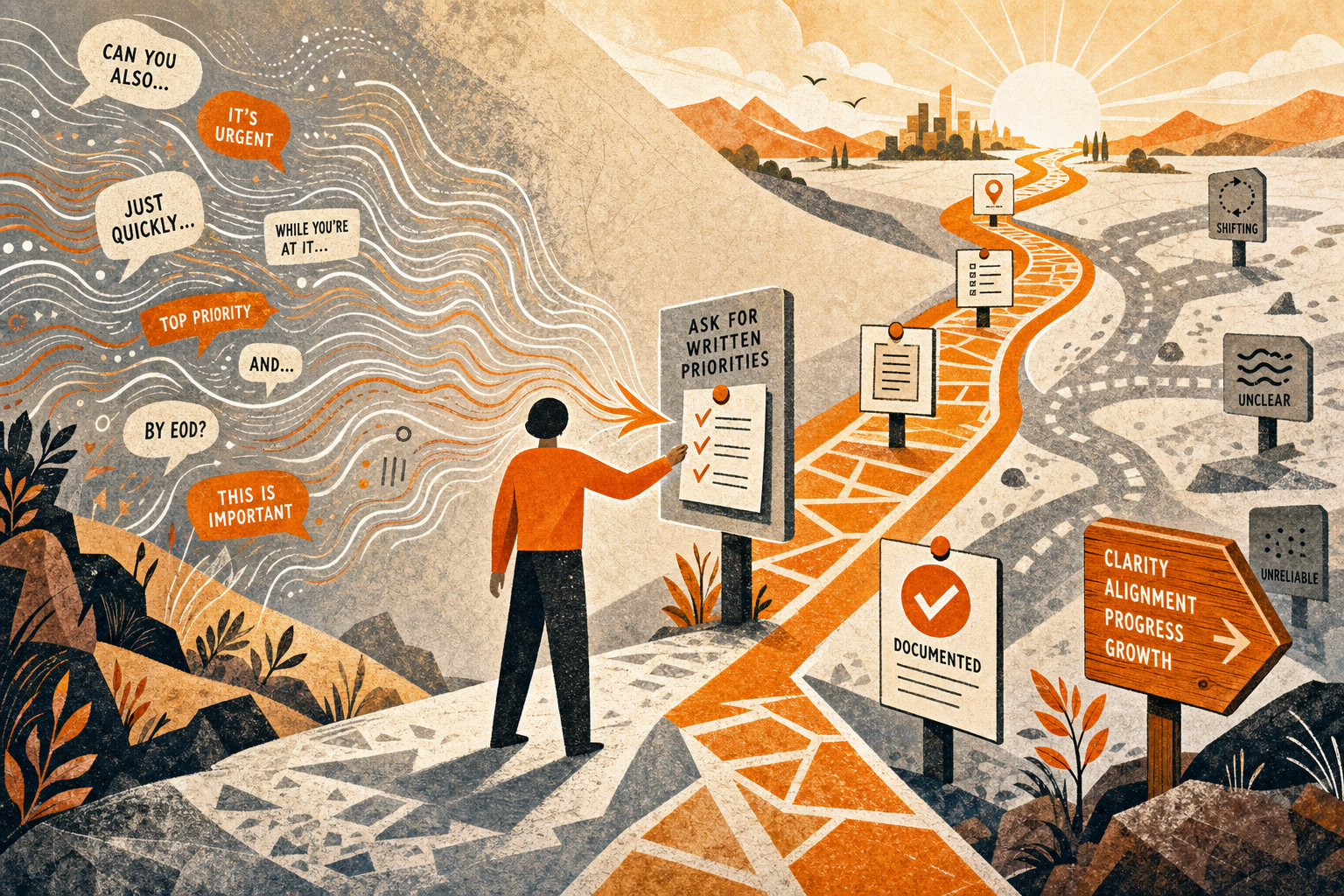
A verbal assignment is not a plan. It is a mood with a deadline attached.
If that sounds dramatic, good. So is the experience of getting voluntold into a “quick ask” on Tuesday and then being quietly blamed on Friday for not reading someone’s mind.
You know the scene. Your manager catches you as everyone is leaving a meeting.
“Can you get this done by Friday?”
“Actually, this is the priority now.”
“Let’s just keep this moving.”
You say yes because you’re competent, and because most ambitious people have been trained to treat immediate compliance as professionalism. Then the ask starts shape-shifting. Friday becomes Thursday morning. “Quick pass” becomes “polished draft.” The work you paused to make room for it still somehow matters. And because the whole thing lived in air, you’re left holding a problem you can feel in your chest but can’t prove on paper.
That awful feeling is not you being disorganized. It is you being exposed.
When work exists only in conversation, the person with more status gets the final edit on reality. That’s the game. So if a task changes your priorities, scope, timeline, or ownership, get it into something searchable. Slack. Email. The project board your team pretends to use. A shared doc. I don’t care. The point is to stop storing work in your bloodstream.
TL;DR
- Verbal assignments are cheap to give and expensive to carry.
- The danger is not forgetting the task. The danger is losing the tradeoff: what got bumped, what “done” means, and who agreed to the change.
- Written follow-up is not uptight. It is how adults prevent work from turning into folklore.
- If someone changes your priority out loud, capture it immediately.
- The people who earn trust fastest are usually the ones who create clarity early, not the ones who perform heroics inside preventable messes.
The real problem is not the ask. It’s the disappearing context.
Most workplace chaos does not start with betrayal. It starts with a sentence that sounds harmless and lands like a hand grenade three days later.
“Can you take this next?”
“We need to move quickly on this.”
“This is the focus now.”
Fine. Compared to what? For how long? At what level of polish? Who else knows this changed? What gets delayed to make room?
That is the missing context. And that is where people get trapped.
Early-career professionals are especially vulnerable here because they often mistake ambiguity for a maturity test. They think the grown-up move is to nod, absorb the confusion, and somehow transform fuzzy instructions into excellent work without bothering anyone with follow-up questions.
That is not maturity. That is volunteering to become your team’s emotional storage unit.
You carry the assumptions. You absorb the contradiction. You try to reconcile the impossible timeline in your own head. Then when things collide, everyone looks at you like the problem appeared spontaneously in your lap. The emotional texture of this is familiar if you’ve lived it: a low electrical buzz of anxiety, resentment you feel guilty for having, and that Sunday-night dread where your brain starts replaying hallway conversations like surveillance footage.
So here is the rule worth stealing: if a conversation changes what you are doing, when it is due, what success looks like, or who owns it, write it down while the conversation is still warm.
Pick one recurring source of vague work this week — your manager, the cross-functional “just circling back” person, the coworker who says “tiny favor” with the confidence of a liar — and stop letting their asks vanish into mist.
Stop acting like written follow-up is rude
People avoid documenting verbal assignments for social reasons, not practical ones.
They worry about how it looks. They imagine the other person thinking: Wow, okay, what is this, court? So they keep things casual, which sounds nice until casualness turns into revisionist history.
In real life, most reasonable people are relieved when someone writes the work down. You are not creating tension. You are removing the burden of mutual guesswork.
The difference is tone.
“I need this in writing” sounds like a threat from someone who has already printed the email chain.
“Here’s my understanding so I can move quickly” sounds like a competent person with a calendar.
Same goal. Totally different vibe.
Use language that makes clarity feel useful, not defensive. For example:
Weak:
“Just confirming what we discussed.”
That phrase is the beige paint of office communication. It says nothing.
Better:
“To keep this moving, I’m treating the client deck as today’s top priority and pushing the reporting cleanup to Monday. I’ll send a draft by 3 p.m. if that timing still works.”
That message does three useful things at once: 1. It names the new priority. 2. It shows the tradeoff. 3. It gives the other person a chance to correct you now instead of rewriting the story later.
That correction window matters. Good documentation is not a trap. It is a short, civilized opportunity for reality to be negotiated while everyone still remembers what they meant.
If this feels awkward, welcome to professional growth. Useful habits often feel awkward before they feel obvious. So does setting boundaries. So does asking what “urgent” means. So does telling a senior person that if they want this by tomorrow, something else has to move. Awkward is not proof you are overreacting. It is often proof you are finally behaving like someone with judgment.
Try This: After your next verbal assignment, send a two-sentence recap within ten minutes. Not at 7 p.m. when your adrenaline has turned into resentment. Ten minutes.
Document the part people magically forget later
Most follow-ups fail in one of two ways: they are either so vague they are useless, or so detailed they read like a hostage statement.
You do not need a transcript. You need the decision skeleton.
Capture these four things:
- Priority — Where does this sit compared to your other work?
- Owner — Who is driving it, and who is supporting?
- Deadline — When is it needed, and how real is that date?
- Definition of done — What counts as finished?
That last one matters more than people admit. “Can you take a look?” could mean skim it, rewrite it, build the deck, pull the data, or perform a minor miracle in Google Slides. If you do not define the outcome, everyone gets to be disappointed in their own custom way.
And then there is the part people skip because it feels slightly confrontational: the tradeoff.
If this is now top priority, what moved? If the answer is “nothing,” someone is quietly pretending time expands in response to managerial enthusiasm. It does not.
Here is a bad recap:
“Following up on our conversation, I’ll work on the deck and send something over soon.”
This is workplace oatmeal. Soft, bland, and impossible to build on.
Here is a useful version:
“Following up from this morning: I’m shifting to the client deck as top priority and will send a draft by Thursday at noon. I’m pausing the Q2 reporting cleanup until Friday unless you want that handled sooner.”
Now the assignment is real. So is the cost.
Ask yourself one question the next time someone verbally redirects your day: If I had to defend my understanding of this next week, would my current notes help me or humiliate me? If the answer is bad, write the recap before you touch the work.
Use the lightest tool that can survive disagreement
Not every conversation needs an email with bullet points and timestamps. If you document every passing remark, people will begin avoiding eye contact with you in hallways.
The goal is not bureaucracy. The goal is preserving reality at the right level.
Use the smallest tool that still keeps the assignment from evaporating:
- Quick, low-stakes ask? Slack.
- Priority shift or delivery date change? Slack plus a project board update.
- Cross-functional dependency or anything politically delicate? Email or shared doc.
- Something that affects multiple people’s workload? Put it somewhere visible to everyone involved.
A simple rule: the greater the chance of future disagreement, the more durable the record should be.
People get weirdly philosophical about tools because they want the perfect system. You do not need a perfect system. You need a repeatable reflex. If your team lives in Slack, use Slack. If your manager ignores Asana but reads email instantly, use email. Purity is for hobbyists. At work, the best tool is the one the relevant human being will actually see.
The move this week is to audit your own habits. Where do misunderstandings usually happen on your team? In DMs? In meetings with no notes? In “quick syncs” that produce five different interpretations? Put the next recap in the place most likely to outlive the conversation.
Why this matters more when you’re junior
When you are early in your career, people are not just judging whether you get things done. They are judging whether it feels safe to hand you messy, high-context work.
Unfair? A little. Real? Completely.
Managers notice who can make work legible. They notice who surfaces tradeoffs without sounding panicked. They notice who can say, calmly, “If this moved to the top, here’s what slips.” That reads as judgment. It reads as steadiness. It reads as someone who can eventually own more than one moving part without melting into apology.
Meanwhile, plenty of smart juniors look flakier than they really are because they keep crucial context in their heads. They know exactly what happened. Unfortunately, no one else can see it. Their week becomes a pile of invisible decisions, and when one of those decisions gets questioned, they have nothing but sincerity to defend themselves with.
Sincerity is nice. Searchable evidence is better.
There is also a mental-health angle here that gets waved away too quickly. Written clarity reduces a specific kind of stress: that hunted feeling that your workload can be renegotiated anytime by whoever catches you between meetings. Once the assignment is written down, your brain stops acting like a frightened intern inside a courtroom drama. You can think. You can plan. You can work.
Send one recap this week for a task you would normally keep in your head. Then notice what happens in your body. For a lot of people, the feeling is immediate: less spinning, less second-guessing, more oxygen.
Scripts worth stealing
You do not need to invent graceful language from scratch while annoyed. Save a few scripts and use them.
After a hallway conversation:
“Got it — I’m treating this as the priority for tomorrow and pushing the vendor review to Thursday. I’ll send a draft by 2 p.m. if that works.”
After your manager changes scope:
“To make sure I’m aligned: the revised version now includes slides 8–12 and the recommendation summary. That shifts delivery to Friday morning unless we cut something else.”
When someone drops a “quick” request:
“Happy to take this on. Given my current deadlines, I can get it to you Wednesday afternoon. If you need it sooner, tell me what you’d like me to deprioritize.”
When ownership is fuzzy:
“Just so we don’t duplicate work: am I driving this, or am I supporting while Jordan owns final delivery?”
After a meeting where everyone nodded and nobody actually decided anything:
“My takeaway is: Priya owns the data pull, I’ll draft the deck, and we’re aiming for review Thursday at 11. If I missed anything, I’ll update.”
Notice what these scripts do not do. They do not grovel. They do not over-explain. They do not hide the cost of the request behind fake breeziness. They simply force the work to become visible.
Your move: save two of these in your notes app right now. Future-you should not have to improvise clarity while running on cortisol.
If this feels “too formal,” you’re probably reacting to a bad culture, not a bad habit
The people most resistant to documentation are often the ones already paying for the absence of it.
They tell themselves: - “It’s not that serious.” - “I’ll remember.” - “We move fast.” - “I don’t want to be difficult.”
And then Friday arrives with a ridiculous argument about who knew what, when, and why nothing is where anyone thought it would be.
Here is my opinionated take: a shocking number of teams brag about being “fast-paced” when what they really mean is “nobody writes anything down and we call the panic energy momentum.”
Speed is useful. Institutional amnesia is not.
If verbal assignments routinely become little crises on your team, the answer is not for you to become more chill. The answer is to stop participating in preventable ambiguity as if it were a personality trait. You do not have to fix the entire culture to protect yourself. You just have to stop letting your own work disappear.
Make your yeses visible. Make your tradeoffs visible. Make it impossible for someone to add work to your plate without also seeing the shape of the plate.
What would happen if every priority shift had to survive one written sentence? Start there.
Build the habit before you need to defend yourself
The worst moment to start documenting is after trust has already cracked.
Once people are stressed, everyone turns into a highly selective historian. Tone gets reinterpreted. Memory becomes a self-serving art form. A minor mismatch suddenly feels moral. If you begin writing everything down only after things go wrong, people may read it as escalation rather than normal process.
That is why this works best as a default.
When recaps are simply how you operate, nobody treats them like a weapon. They read them as your style: organized, clear, low-drama. Over time, that reputation compounds. People bring you cleaner asks. They are more careful when changing priorities. They know you will surface tradeoffs early, not silently absorb them until something breaks.
That is the deeper point here. Documentation is not about catching people. It is about refusing to collaborate with confusion. It is a way of saying: if this work matters enough to interrupt my day, it matters enough to exist somewhere outside your mouth and my memory.
And that is a career advantage, not just a coping mechanism. The people who grow into bigger roles are rarely the ones with the highest tolerance for chaos. They are the ones who can turn chaos into something legible before it becomes expensive.
If you want help building that reflex, this is exactly the kind of pattern Career Compass is useful for. Not because it swoops in with magic career answers, but because it helps you notice the habits shaping your work life week by week: where your stress spikes, where your boundaries collapse, which relationships create confusion, and which small systems make work feel steadier. The platform is most valuable when it helps you turn vague good intentions — “I should probably get clearer about priorities” — into repeatable behavior.
So the mindset shift is simple, but not small: stop treating clarity as a favor you ask for after things go wrong. Treat clarity as part of the assignment itself. If the work is real, the record should be real. If the priority changed, the tradeoff should be visible. If someone wants your labor, they can tolerate one sentence describing what they just asked you to do.
Next time someone gives you an assignment out loud, do not just nod like a polite hostage. Capture it. Name the tradeoff. Put it where reality can find it later. That one habit will not make your workplace perfect, but it will make you harder to confuse, harder to blame, and much easier to trust.