Use a Decision Log to Prevent Scope Creep
The Decision Log That Saves You When Everyone “Remembers It Differently”
A lot of career damage does not start with bad work.
It starts with a blurry conversation on Tuesday, a rushed Slack message on Wednesday, and a very confident senior person on Friday saying, “No, that’s not what we agreed.”
If you are early in your career, that moment hits differently. Your stomach drops. You start replaying the meeting in your head while opening old tabs, old messages, half-finished notes, looking for proof that you are not losing your mind. You wonder whether you misunderstood, whether you should have pushed harder, whether speaking up now will make you sound defensive. Meanwhile, the person with the bigger title sounds calm, and calm often gets mistaken for correct.
This is why undocumented decisions are so dangerous. Not because everyone around you is scheming, but because work is noisy, memory is sloppy, and people protect their version of events once deadlines get tight and reputations are on the line.
Here’s the blunt truth: if a decision matters, and it lives only in the air, it is not stable. It is a rumor with calendar invites.
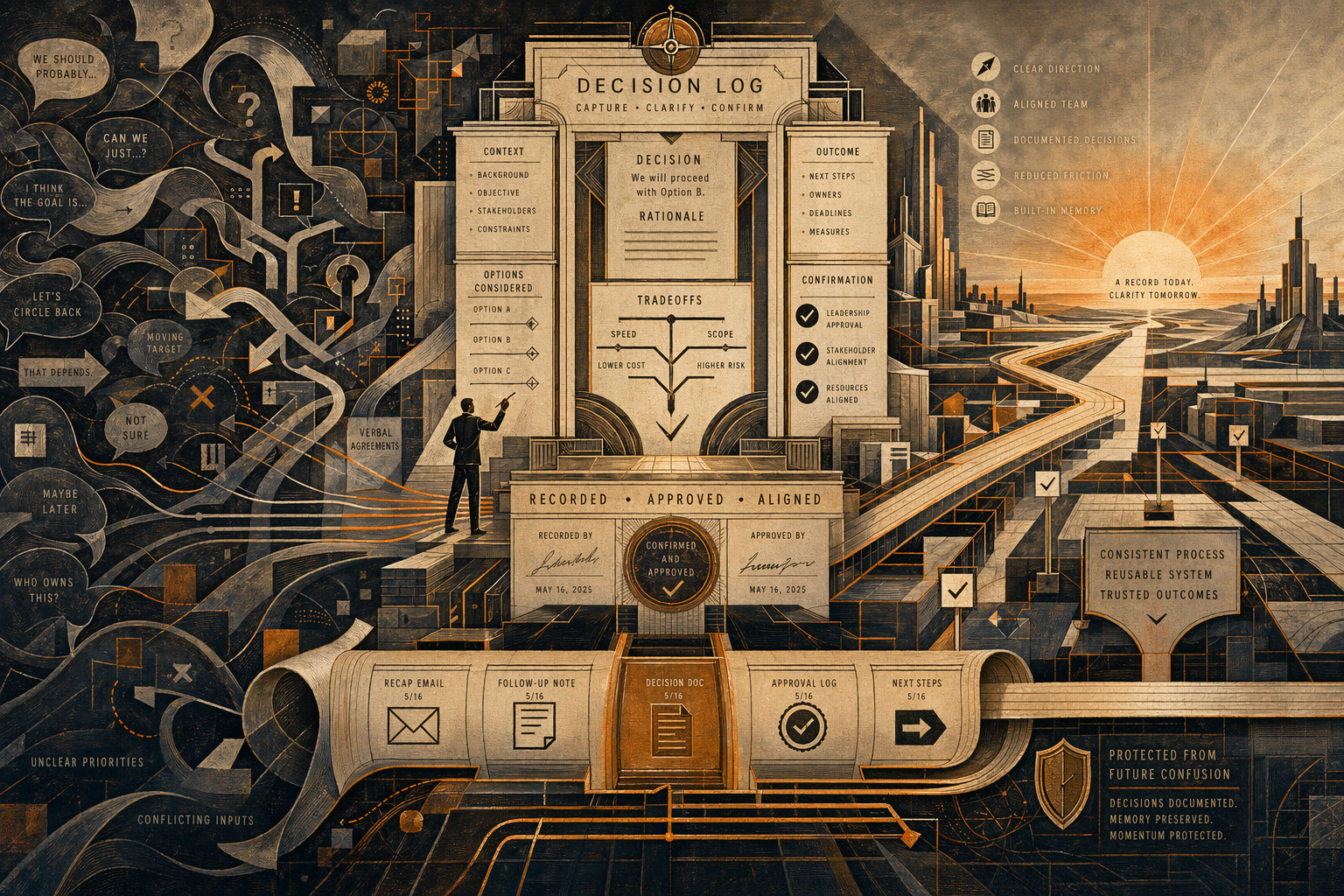
That is where a decision log comes in. Not a giant spreadsheet nobody updates. Not a dramatic dossier for future courtroom scenes in Conference Room B. I mean a lightweight written record of the decisions that actually shape the work: what changed, why it changed, who agreed, what still looks shaky, and what happens next.
Done well, this habit makes you look like the adult in the room. Done badly, it looks stiff and weird. So let’s talk about the version that actually works.
TL;DR
- Most workplace conflict that sounds personal is really a fight between competing memories.
- Meeting notes are fine, but they are not enough; they often capture discussion while completely missing the decision.
- A decision log is simple: what was decided, why, who owns it, when it changes the work, and what risk is still hanging there like a loose ceiling tile.
- If you are junior, written follow-through is one of the few tools fully in your hands when deadlines slide, scope shrinks, or priorities start shape-shifting.
- If someone gets oddly twitchy about putting a decision in writing, pay attention. That discomfort often tells you more than the meeting did.
Why good, responsible people get burned by unwritten decisions
The people who get burned by this are usually not the careless ones.
They are the helpful ones. The fast responders. The “sure, I can take that on” people. The ones trying to be low-drama and pleasant, because they correctly understand that nobody loves working with the person who turns every passing comment into a constitutional amendment. So they hear a verbal change, accept it in good faith, and keep moving.
Then two weeks later, they discover that everyone left the same meeting with different movies playing in their heads.
The product manager thinks engineering agreed to cut feature B. Engineering thinks product merely floated the idea. Marketing thinks the launch date stayed fixed. The designer thinks the launch date moved but nobody wanted to say it out loud yet. Your manager vaguely remembers “a conversation about tradeoffs” and asks why you did not “raise the risk sooner,” which is an especially irritating question when you did raise it, but only with your mouth, in a room, where it vanished into the drywall.
That kind of confusion feels personal when you are on the receiving end of it. It feels embarrassing. It feels unfair. It can also make you start doubting your own judgment, which is one of the fastest ways to become timid at work. You speak less directly. You hesitate before acting. You over-explain because you are trying to pre-defend yourself against future misunderstandings. None of that helps your reputation.
What helps is written clarity.
A decision log is not the same thing as meeting notes, and mixing them up is where a lot of smart people go wrong. Meeting notes often read like a polite transcript: discussed timeline, reviewed mockups, flagged legal concern, next meeting Tuesday. Fine. Useful sometimes. But notes often preserve the fog instead of clearing it. They tell you what people talked about, not what the team is now committed to.
A decision log is narrower and much more valuable. It answers five plain questions:
- What was decided?
- Why was that choice made?
- Who approved it or owns it?
- What changes now because of that decision?
- What is still unresolved?
That is the stuff that saves projects.
Early in my own career, I learned this in the least glamorous way possible: by being right and still losing. I had done the analysis. I had said the risk out loud. People nodded. Then later, when the timeline slipped and everyone became allergic to blame, the verbal agreement disappeared like a magician’s coin. Nothing malicious. Just convenient amnesia under pressure. I remember the specific mix of feelings even now: annoyance, self-doubt, and that hot little flare of resentment you get when you realize competence alone is not enough. You also have to make reality visible.
So if you are someone who prides yourself on being easy to work with, here is a useful correction: being easy to work with does not mean being vague. It means reducing confusion before confusion gets expensive.
Pick one live project and ask yourself a blunt question: if a disagreement broke out on this tomorrow, where would I point to show what was actually decided?
If the answer is “well, we talked about it,” you do not have alignment. You have vibes.
A decision log is not bureaucracy. It is how calm professionals keep chaos from becoming their problem.
A lot of early-career people resist this habit for emotional reasons before they resist it for practical ones.
They do not want to look stiff. They do not want to sound political. They definitely do not want to be the person who sends a follow-up message that makes the room go cold. This fear is understandable, because most of us have seen bad documentation behavior. Somebody weaponizes a recap email. Somebody writes “as previously stated” like they are auditioning to become the world’s least-loved vice president. Somebody drops a ten-paragraph memo after a five-minute conversation and turns a small coordination task into a tax audit.
That is not what I am recommending.
Good decision logging is not about catching people. It is about sparing everyone from the exhausting theater of re-litigating old conversations. It cuts down on three things that make work miserable: repeated debates, moving goalposts, and sneaky resentment.
Imagine a marketing coordinator named Priya working on a webinar launch. In a Tuesday planning call, the sales lead says they only need one customer quote for the landing page, not three, because the team is behind and legal review is taking forever. Priya hears this, updates the draft, and keeps moving. On Friday, the director reviews the page and says, “Why is there only one quote? We said three.” Priya now has two bad options. She can quietly eat the blame and scramble. Or she can say, “Actually, Tom changed that on Tuesday,” which instantly sounds like she is tossing someone under the bus, even if it is true.
A two-sentence recap sent Tuesday afternoon would have prevented the whole stupid scene:
Quick recap so I work from the latest direction: we’re using one approved customer quote on the landing page for this webinar in order to keep legal review on track for Friday. Tom confirmed the tradeoff; if legal clears faster than expected, we can still add the other two later.
That message does several things at once. It locks the decision. It records the reason. It names the tradeoff. It leaves room for change without pretending no choice was made. Most importantly, it means Friday is about the actual work, not a memory contest.
This is why documentation is a trust tool. It tells people, “I listened carefully enough to write down the real point.” That builds confidence, especially when projects are messy. A manager may not consciously think, wow, excellent recap discipline, but they will notice the downstream effect: fewer surprises, cleaner handoffs, less confusion in check-ins, less panicked backtracking before deadline day.
There is also a reputation piece here that matters more than many people realize. At work, your reputation is not only built on output. It is built on how you operate under ambiguity. Can you hear a vague conversation and turn it into clear next steps? Can you preserve nuance without becoming bureaucratic? Can you lower the emotional temperature when everyone else is getting sloppy? That is real professional maturity.
And yes, this matters during performance reviews. Not because managers sit around grading your note-taking style, but because people remember patterns. The person who consistently creates clarity gets described as reliable, organized, thoughtful, and strong with cross-functional partners. The person who lets everything live verbally often gets described in squishier ways: hardworking, positive, still developing executive presence. Translation: nice, but not yet trusted with messier problems.
Here is the move this week: stop treating recap messages as extra credit. On any project with a shifting deadline, fuzzy scope, or more than two stakeholders, send one short written summary after the next verbal decision. You are not slowing the work down. You are putting guardrails on it before it slides into the ditch.
The easiest version: one recap message that nails the decision without sounding weird
You do not need a special app.
You do not need a color-coded dashboard.
You do not need a “decision management framework,” which sounds like something invented by a consultant who has never had to chase approvals at 4:47 p.m. on a Thursday.
In most workplaces, the simplest version works best: one recap message in the same channel where the work already lives. That might be Slack. It might be email. It might be a project doc with a date-stamped update. The format matters less than the fact that the decision now exists somewhere other humans can see it.
The tone is what makes or breaks this.
If your follow-up sounds prosecutorial, people will stiffen. If it sounds collaborative and practical, most people will thank you, or at least quietly appreciate that you saved them from future confusion. Small phrasing choices matter here. “To make sure I’m acting on the latest direction…” sounds like teamwork. “Per our conversation, you stated…” sounds like you are preparing exhibits.
A useful template is:
- Decision: What changed?
- Reason: Why did we choose this?
- Owner: Who is doing what now?
- Timing: What date or milestone does this affect?
- Open risk: What is still unresolved?
Here is what that looks like in real life.
Example 1: Deadline stays, scope shrinks
Say you are a junior analyst. In a project meeting, your manager agrees to remove one slide section from Friday’s deck so the team can hit the board deadline. Good. That is a legitimate tradeoff. But by Friday morning, senior leaders often remember the deadline and forget the compromise that made the deadline possible.
Send this:
Quick recap so I’m building the right version of Friday’s board deck: we’re dropping the regional breakdown section for this round in order to keep the delivery date unchanged. I’ll finalize the core performance analysis and recommendations by Friday noon; the regional cut can be added in the next update if needed.
Now the record is clear. Nobody can fairly act shocked that the deck does not include the section you explicitly agreed to cut.
Example 2: Ownership shifts mid-project
You are a coordinator at a nonprofit, and in a meeting someone says comms will “take first pass” on donor email edits. A week later, development assumes you owned it all along and asks why the draft is late. This kind of mushy ownership language creates endless low-grade chaos.
Instead, write:
To lock in ownership from today’s meeting: comms will draft the first pass of the donor email by Wednesday, and I’ll review for fundraising accuracy by Thursday afternoon before it goes to leadership. Current risk is waiting on final event attendance numbers.
That one note can save five awkward check-ins and one very annoying “just circling back” thread.
Example 3: Approval was conditional, not final
This one matters a lot. A senior person says, “Yeah, this looks fine to me,” and then later claims they had only meant the concept, not the final execution. If you do not clarify the condition, you are setting yourself up for a reputational bruise.
Try:
Thanks for the review today. My understanding is that the current draft is approved directionally, pending legal’s sign-off on the claims language and final brand review of the header copy. I’ll hold the send until those two checks are complete.
Now “approved” has shape. It is not a vague blessing that can mutate later.
You can also keep a tiny running decision log for larger projects. I mean tiny. A shared doc with five columns is enough:
| Date | Decision | Why | Owner | Open Risk |
|---|---|---|---|---|
| Mar 3 | Launch moved from Apr 10 to Apr 17 | Vendor assets delayed | PM | Sales enablement timeline tight |
| Mar 5 | Feature B cut from v1 | Protect launch date | Product lead | Customer support FAQ needs update |
| Mar 8 | Legal review required before press release | Claims sensitivity | Marketing | Could delay media outreach |
That is it. Nobody needs a cathedral. You need a paper trail slim enough to maintain and solid enough to trust.
Try This: Before your next meeting, open a blank note and type these five headers: decision, reason, owner, deadline, risk. During the meeting, listen specifically for those points. Afterward, send a recap in under ten minutes. Fast is good here; if you wait two days, everyone’s memory has already started editing the film.
When people push back on documentation, do not panic — get curious
Sometimes a decision really is too small to document. Nobody needs a formal recap because Sam moved the Tuesday sync to 3:30.
But when scope changes, ownership moves, deadlines tighten, or risk gets accepted, resistance to writing it down is worth noticing. Not dramatizing. Not escalating into a speech about transparency and accountability. Just noticing.
Because pushback usually points to one of three things.
First, the decision is not actually made. People are talking as if they are aligned because that feels socially smoother than admitting they are still conflicted. Writing it down forces the fuzziness into daylight, which can be uncomfortable. Good. Better uncomfortable now than furious later.
Second, nobody wants to own the tradeoff. This happens constantly. A leader wants the deadline to stay fixed, but does not want to be seen as the one who cut quality checks. A cross-functional partner wants to reduce scope, but wants wiggle room to deny they ever asked. The moment you document the choice, the tradeoff stops being invisible. Again: useful.
Third, someone wants reversible memory. That is the most irritating version. It is when a person likes the flexibility of being able to say different things later depending on how outcomes look. If the result is good, they supported it. If the result is messy, they merely “raised concerns.” A calm written recap quietly ruins that game.
The wrong response to pushback is to get defensive and start explaining yourself too much. That makes you sound nervous, which invites people to treat clarity as a personal quirk rather than a professional standard.
The better move is boring confidence.
“Just sending this so I can execute against the latest direction.”
“Capturing the decision and owner so I don’t miss anything.”
“Writing down the tradeoff so we can move faster next week.”
These lines work because they keep the focus on the work, not your feelings about the work.
Let’s make this concrete. Suppose you are an associate product manager and a senior engineer says, “We don’t need to put every little thing in writing.” Fair point in theory. But if the “little thing” is that the bug fix will ship before the feature request, and customer success has been promising the feature to a major client, that is not little. That is exactly the sort of choice that becomes a finger-pointing festival later.
So you might reply:
Totally — not trying to document every discussion. Just capturing that we’re prioritizing the bug fix ahead of the feature request for this sprint, so I can update CS and avoid sending the wrong timeline externally.
Short. Calm. Hard to argue with unless the person objects to reality itself.
There is another reason this matters: your own stress.
When everything lives in spoken conversation, your brain becomes the storage unit. You carry a dozen half-decisions around all week. By Sunday night, that turns into the familiar dread: the buzzing feeling that you are forgetting something important, that Monday will bring a surprise, that some loose conversation from three days ago is about to come back wearing a fake mustache and ruin your morning. Written decisions reduce that cognitive tax. They let your nervous system stand down a notch.
Ask yourself this: where in your current work are you relying on memory when you should be relying on a record?
That is probably the place costing you the most hidden energy.
The real career value is not self-protection. It is visible judgment.
Yes, a decision log can protect you. Let’s not be precious about that. It absolutely can stop someone from casually rewriting history at your expense.
But if you stop there, you miss the bigger value.
The deeper benefit is that written decision-making makes your judgment visible. It shows how you think. It shows that you can hear tradeoffs, spot dependencies, and translate a messy discussion into concrete action. Those are career-building signals.
A lot of early-career professionals assume promotions come from doing more. More output. More responsiveness. More availability. More heroic last-minute fixing. Some of that helps, but the people who become trusted fastest are often the ones who create order. They do not just complete tasks; they reduce ambiguity for everyone around them.
That quality becomes especially noticeable in messy seasons. Reorgs. Launches. Leadership changes. Tight budgets. The moments when everyone is a little fried and nobody has a full map. In those periods, the person who can say, “Here’s what changed, here’s who owns what, here’s the risk we accepted, here’s the next decision we need,” becomes incredibly valuable.
It also helps during review season in a very practical way. If you have even a basic record of key decisions you clarified, risks you flagged, and cross-functional confusion you cleaned up, writing your self-review gets much easier. You are no longer trying to remember six months of invisible coordination work through a fog of old calendar invites. You have receipts, yes, but more importantly, you have examples of professional judgment in action.
For instance:
- “Clarified scope reduction with design and engineering to keep launch on schedule.”
- “Documented legal dependency early, which helped the team reset timeline before external comms.”
- “Resolved ownership ambiguity between sales and marketing by summarizing approved workflow.”
That is strong evidence of impact. Not glamorous. Very real.
And there is a quiet emotional payoff too. When you get into the habit of documenting decisions, work feels less slippery. You stop bracing for surprise revisions of the past. You stop carrying so much unspoken uncertainty in your body. A good 1:1 feels better because you can walk in grounded. A tense project meeting feels less menacing because you know you can turn noise into clarity afterward. Even bad news lands differently when it is written plainly. There is relief in specificity.
Your move is simple: start small and stay consistent. Do not announce a new system. Do not ask for permission to be organized. Over the next two weeks, send recaps for any decision that changes scope, timing, ownership, or risk. Save those messages in one folder or doc. At the end of the month, look at what you have. You will have more than documentation. You will have a record of how often you were the person keeping the work honest.
And that is the kind of reputation people remember for the right reasons.
One message you can send today
If you want a starting point, use this and adapt it to your voice:
Quick recap so I’m working from the latest direction: we decided to [change/keep/cut] [scope/timeline/owner] because [reason]. I’m taking [next step] by [date], and [person/team] owns [related piece]. The only open risk is [dependency/approval/blocker], which could affect [impact].
Then stop fussing with it and hit send.
Not every thought deserves documentation. Important decisions do.
So the next time a meeting ends with everyone nodding and saying some version of “sounds good,” do not trust the pleasant fog. Write the sentence that future-you will be grateful to find.