When Your Manager Keeps Changing Direction

When Your Manager Keeps Changing Direction
One change of plan is work.
Ten is whiplash.
A lot of early-career professionals get fed the same thin little line here: be flexible, stay positive, roll with it. It sounds polished. Mature, even. It also trains you to become the shock absorber for somebody else’s sloppy thinking.
That’s the part nobody says out loud.
The issue is not that priorities changed. Priorities change. Customers complain. Budgets get cut. A senior leader lobs a “quick idea” into a meeting and blows a crater in the roadmap. Fine. That is work.
What is not fine is a manager who keeps reversing decisions, redirecting projects midstream, and restarting work without saying what gets dropped, what deadline moves, who informs stakeholders, or how success is now being measured.
That creates a very specific kind of misery. Not dramatic burnout. Not a neat HR complaint. Just the low, grinding anxiety of never knowing whether the thing you are working on today will still count by Friday. It’s the Sunday-night dread of opening your laptop and seeing four half-alive versions of the same deck, all of which were urgent at some point, and none of which feel safe.
So here’s the contrary view: your job is not to prevent every change in direction.
Your job is to make the cost of those changes visible enough that people have to look at it.
TL;DR
- Healthy reprioritization comes with tradeoffs, owners, and a revised plan.
- Direction thrash is repeated course-changing with no memory and no accountability.
- The most dangerous mistake is silent rework: doing extra labor privately and letting it disappear.
- When the plan changes, translate it into consequences: what stops, what slips, what restarts, and what now needs explicit confirmation.
- One sudden change may be reasonable. A pattern is what threatens your reputation.
- Documentation is not pettiness. It is how you stop your work from being rewritten into folklore.
Call the problem what it is
Let’s stop dressing this up.
Direction thrash is when a manager repeatedly changes course without clearly acknowledging what work just got wasted, what priorities just moved, what stakeholders need updating, or what “done” now means. It is not agility. It is churn wearing business casual.
That distinction matters because if you’re conscientious — and most people reading this are — your first instinct is usually self-blame. Maybe I’m too slow. Maybe I’m not strategic enough. Maybe high-performing teams are just this chaotic. That story is seductive because it gives you control. If it’s your fault, maybe you can fix it with more effort.
Usually, you can’t.
What often happens instead is quieter and worse: you start compensating in secret. You redo the analysis. Rewrite the brief. Clean up the timeline. Make the stakeholder calls. Patch over the confusion so no one has to feel it but you. Outwardly, you look competent and unbothered. Inwardly, you feel jittery, foggy, and vaguely stupid, even though the real issue is that the target won’t stop moving.
Meanwhile, an awful lesson gets reinforced: changing direction is free, because you keep paying for it off the books.
That hidden labor is exactly what disappears at review time. People remember the final deliverable, not the abandoned versions, the reversed recommendation, or the emergency stakeholder syncs you had to run because the story changed again. If this sounds familiar, sit with one question for a minute: when your manager changes direction, do they also name the cost — or do you quietly absorb it for them?
Learn the difference between a real pivot and managerial pinball
Not every change is a problem. Some changes are just leadership doing its job.
A healthy reprioritization sounds like this: “We got new information. We’re changing approach. That means Project B pauses, Friday moves to Tuesday, and I’ll update the client.”
Annoying? Sure. But coherent.
Unmanaged churn sounds like this: “Actually, let’s do something else,” followed by total amnesia about the thing you were told to do three days ago.
The difference is not how often plans change. The difference is whether the tradeoffs get named. Adults can handle changed priorities. What breaks people is changed priorities with no memory, no ownership, and no acknowledgment that someone just lit eight hours of work on fire.
If you want one rule burned into your brain, use this one: flexibility is part of the job; unpaid invisibility is not.
So pull up one active project and look at the last two changes in direction. Were the tradeoffs made explicit, or were they smuggled into your workload like contraband?
Your job in the moment is not resistance. It’s translation.
When a manager drops a fresh reversal on your desk, the strongest move is usually not arguing.
It’s translation.
Most direction-thrashing managers are operating at the level of impulse, pressure, preference, or fear. They are not consistently thinking at the level of operational consequences. That is where your leverage lives. You do not need to win a philosophical debate about whether the change is wise. You need to turn a vague instruction into a visible decision.
Use this sequence:
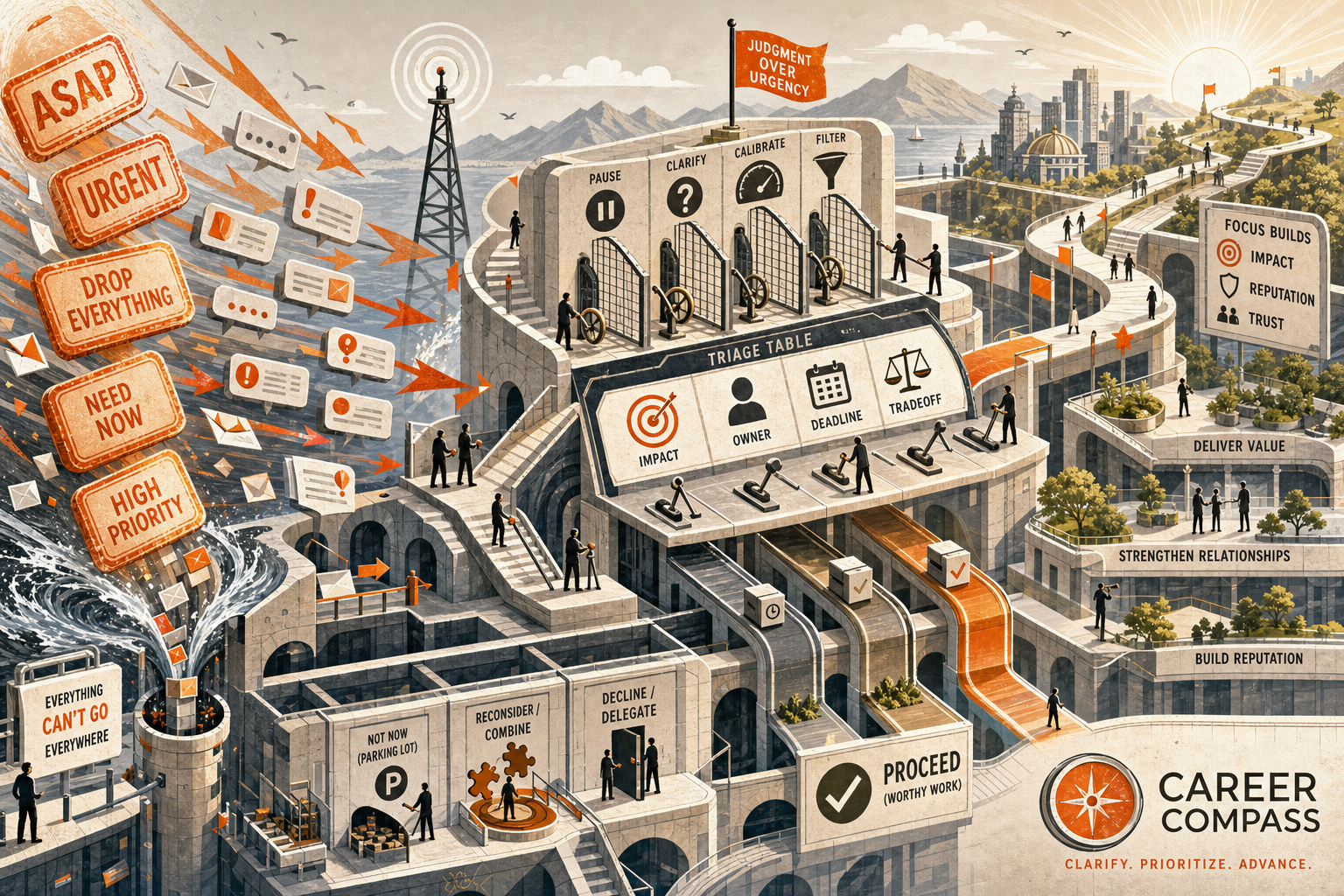
Change → Impact → Tradeoff → Confirmation
The change is the new ask.
The impact is what current work gets altered.
The tradeoff is what now slips, stops, or restarts.
The confirmation is getting explicit agreement before you vanish back into execution.
This matters because it drags the conversation out of vibes and into reality. If you respond with irritation, maybe you’re justified — but now the story becomes your attitude. If you respond with cheerful compliance, the story becomes that everything is easy and free. The stronger move is calmer than both: “Understood. Here’s what this changes.”
A few examples:
- “Got it — I can switch to Option B. That shelves the current draft and likely moves tomorrow’s deadline. Are you comfortable resetting to Thursday?”
- “Understood. Since this reverses last week’s call, can we confirm which version is now the source of truth?”
- “I can adapt to this direction. I also want to flag that we’ve changed course a few times on this project, and each shift has created rework. I’d like to confirm the current priority before I restart.”
Short. Clean. Hard to pretend you didn’t hear.
And yes, wording matters. “This is chaotic” starts an argument. “This change pauses X, delays Y, and requires sign-off from Z” creates clarity. Write one sentence like that now, while you’re calm, so you’re not improvising under adrenaline later.
The responses that look “easygoing” are often the ones that bury you
The most dangerous replies in these situations are the ones that sound cooperative.
“Sure, no problem.”
“Happy to update.”
“Will do.”
Those phrases are harmless when the request is small and rare. But when direction keeps changing, they become little acts of self-erasure. They flatten major rework into something trivial. They tell everyone around you — your manager, your team, your future performance review — that the transition was seamless when in reality you were in the back room reassembling the plane.
Here’s the difference:
| Situation | Response that buries you | Response that protects the work |
|---|---|---|
| Manager changes direction in Slack | “Sure, I’ll update it.” | “Got it. I’ll switch to this approach. That shelves the previous draft and likely pushes tomorrow’s deadline — okay to move it to Thursday?” |
| Manager reverses last week’s decision | “No problem.” | “Understood. Since we’re reversing last week’s plan, can we confirm which version is current and what drops for now?” |
| Stakeholders are hearing mixed messages | Silence | “I want to make sure everyone is aligned on the latest direction. I’ll send a quick recap so we have one current plan.” |
| This keeps happening | Private resentment | “I can keep adapting, but the repeated changes are creating rework and timeline risk. I want to make the tradeoffs visible so we can execute cleanly.” |
Notice what the stronger responses are not. They are not dramatic. Not sarcastic. Not martyr theater. They simply put a price tag on the decision.
That’s the whole move: stop saying “no problem” when there plainly is one. Replace it with a sentence that names the consequence, and send it today in whatever channel your manager actually reads.
Don’t analyze each incident. Diagnose the pattern.
This is where a lot of smart younger professionals get trapped: they keep trying each new mess as a separate case.
Don’t.
One abrupt change might be reasonable. A repeated pattern tells you what game you’re actually playing.
Sometimes the story is benign. A client changed the brief. Another team missed a dependency. Market conditions shifted. Your manager got new information and is upfront about the cost. Irritating, yes. Sinister, no.
Sometimes the story is chronic indecision. That usually looks like bold instructions delivered with total confidence and abandoned 72 hours later, priorities that change with whoever last spoke, and a manager who treats every passing thought like a five-alarm fire. The emotional effect is nasty. You stop trusting the plan. You hesitate to go deep because part of you assumes the work will be scrapped. You feel shallow, jumpy, and weirdly guilty, even though you are working hard.
That isn’t laziness. That is your nervous system reacting to unstable expectations.
And sometimes the story is political. Your manager may not be inventing the chaos so much as piping it downhill. Leaders above them are fighting. Priorities are changing weekly. Nobody wants to tell the loudest person in the room “no.” In that environment, your manager may be less mastermind than conduit.
It helps to know which problem you have, because the response changes:
- If it’s normal reprioritization, tighten communication.
- If it’s chronic indecision, document aggressively and force decisions into the open.
- If it’s organizational instability, widen visibility so tradeoffs are shared beyond your direct manager.
Here’s the question worth answering honestly: over the last six weeks, how many times has direction changed on your main project — and how many of those changes were documented in writing with a clear tradeoff? The ratio will tell you a lot.
This becomes dangerous when confusion gets retold as your execution problem
Not every messy project is a career threat.
But some absolutely are.
The danger arrives when the direction keeps changing and the evidence keeps evaporating. That is when delays, confusion, and rework get rewritten as though they came from you. Suddenly “constant reversals” becomes “struggled to execute.” Suddenly “moving target” becomes “missed the brief.” You can probably feel the injustice of that in your chest because it is maddening.
Watch for these signs:
- Changes happen verbally and never get written down.
- Half-finished work disappears without acknowledgment.
- Stakeholders are unclear on which version is current.
- You keep explaining contradictory instructions from one week to the next.
- Deadlines slip, but the story told later is just “execution issues.”
- You leave 1:1s with that electric, awful feeling of I thought we were aligned, and now I’m less sure than before.
That last one matters. Good management usually creates relief. You leave clearer, lighter, less split in six directions. Bad management creates static. You leave with five vague directives, one implied criticism, and a creeping sense that if you were just better at telepathy, this would all somehow work.
When it starts feeling review-risky, don’t make a grand dramatic move. Build stages. First, clarify in the moment. Then send the recap: “Here’s my understanding of the updated direction, timeline shifts, and what’s paused.” If needed, widen visibility: “To keep everyone aligned, I’m sending a quick summary of the revised plan.” That sentence sounds boring. It has saved careers.
Try This: start a running log for one active project: date, original direction, new direction, tradeoff, who confirmed it. Notes app is fine. Bureaucracy is not the goal. Memory is.
Documentation is not politics. It is self-respect with timestamps.
A lot of early-career professionals are scared of seeming rigid, difficult, or too “process-heavy.” Especially if your manager is unpredictable, the temptation is to stay pleasant, move fast, and hope your effort speaks for itself.
It often doesn’t.
Workplaces are full of selective memory. Once pressure rises, people tend to remember events in the version that protects them best. Not because everyone is evil. Because self-preservation is a very old human hobby. If you have no written record, your work becomes vulnerable to whatever story is most convenient later.
So keep the receipts — not theatrical receipts, not gotcha receipts, just boring, professional receipts.
Save the recap emails. Keep notes on when priorities changed. Track when projects were paused, rescoped, or restarted. If you spent three days on a deliverable that got redirected, write that down somewhere you can find later. That record is not just defensive. It lets you tell the truth about your contribution.
In a review, “I worked on Project X” is weak.
“I kept Project X moving through three direction changes by clarifying scope, resetting timelines, and aligning stakeholders each time” is a different caliber of story entirely.
That is real work. Name it like it counts. And if reliable execution is starting to break down, say so plainly: “We’ve had several changes in direction on this project, and I want to make sure the timeline and tradeoffs are visible so we can deliver cleanly.” That is not being political. That is being competent. Send one recap this week after a live conversation that would normally vanish into the ceiling tiles.
Stop building your identity around being endlessly absorbent
There is a deeper trap here, and it’s emotional.
A lot of ambitious people quietly become proud of being the one who can handle it. The one who can take the messy brief, the impossible timeline, the confused stakeholder, the half-baked strategy, the 4:47 p.m. reversal, and somehow make it all work. Early in your career, this gets rewarded. People call you reliable. Mature. Calm under pressure.
Then one day you realize you have become everybody’s favorite place to dump ambiguity.
That is not praise. That is exposure.
If this situation is wearing on you, pay attention to the feelings, not just the logistics. Are you dreading Monday because you expect another restart? Are you procrastinating on important work because some part of you no longer trusts the direction? Are tiny requests making you disproportionately angry because they feel like the opening notes of another rework cycle?
That is data.
Career problems often show up in the body before they show up neatly in the org chart: tight shoulders, bad sleep, the heavy irritation that arrives before you’ve even opened Slack, the strange mental fatigue of having to rebuild certainty over and over again. Your system is often telling the truth before your calendar does.
So the move is not to become combative. It is to become less absorbent. More explicit. Harder to use as a human sponge for unpriced chaos.
Build a system before the mess starts rewriting your self-perception
One of the sneakiest effects of a chaotic manager is distortion. After enough reversals, you can start feeling disorganized, forgetful, overly sensitive, or bad at prioritizing — even when what’s actually happening is that you’re trying to function inside a hall of mirrors.
That is why systems matter.
You need something outside the swirl of the week that helps you track what’s real: what changed, what it cost, what you handled well, where your stress is rising, whether the pattern is improving, and whether this is a frustrating season or a genuinely unhealthy setup. Without that, it all blurs together. You just feel bad and busy, which is a useless diagnosis.
This is exactly where a tool like Career Compass fits naturally. Not as a shiny productivity gimmick, and not as a substitute for hard conversations, but as a way to keep your footing when work gets noisy. If your manager keeps changing direction, Career Compass can help you log patterns, capture wins that would otherwise disappear, notice when stress is becoming a warning sign instead of a rough week, and turn a chaotic quarter into usable evidence and a smarter next move.
And that matters because the real goal here is not to become cynical or armored to the point of numbness. It is to become accurate. Accurate about what is happening. Accurate about what it is costing you. Accurate about the level at which you are already operating when you create clarity, preserve momentum, and protect the truth of your work in an environment that keeps trying to smear it.
So the next time the plan flips, don’t rush to argue, and don’t rush to absorb. Pause. Name what changed. Name what it affects. Name the tradeoff. Get the confirmation in writing. That single habit can change how your work is seen — and how you see yourself.
A messy manager can make you feel like you’re the unstable one. You’re not. If you can hold onto reality, make the hidden costs visible, and keep your contribution from disappearing into other people’s fog, you are not being difficult. You are practicing one of the most valuable career skills there is: refusing to let confusion become your identity.